
Introduction
Choosing an engineering branch is one of the most important decisions students make after completing Class 12. Engineering remains one of the most respected and sought-after career paths because it offers diverse opportunities across industries, technologies, and global markets. Many students focus primarily on college selection while overlooking the importance of selecting the right specialization. The reality is that your engineering branch can significantly influence your academic experience, skill development, career opportunities, and long-term professional growth. The article What is Technical Branch provides much information regarding technical branches.
Many students struggle with the question of how to choose the right engineering branch after 12th because numerous options are available today. Traditional disciplines such as Civil Engineering, Mechanical Engineering, and Electrical Engineering continue to provide strong career prospects. Emerging fields including Artificial Intelligence, Data Science, Robotics, and Cybersecurity are attracting increasing attention from students interested in modern technology.
The right decision depends on personal interests, academic strengths, future career aspirations, industry demand, and learning preferences. A branch that works well for one student may not be suitable for another. Understanding your strengths and researching available options can help you make an informed choice.
This comprehensive guide explains how to choose the right engineering branch after 12th while helping students understand the factors that matter most when selecting an engineering specialization.
Why Choosing the Right Engineering Branch Matters
Many students believe that obtaining an engineering degree alone guarantees career success. While engineering education opens many doors, the branch you choose often determines the types of opportunities available throughout your career.
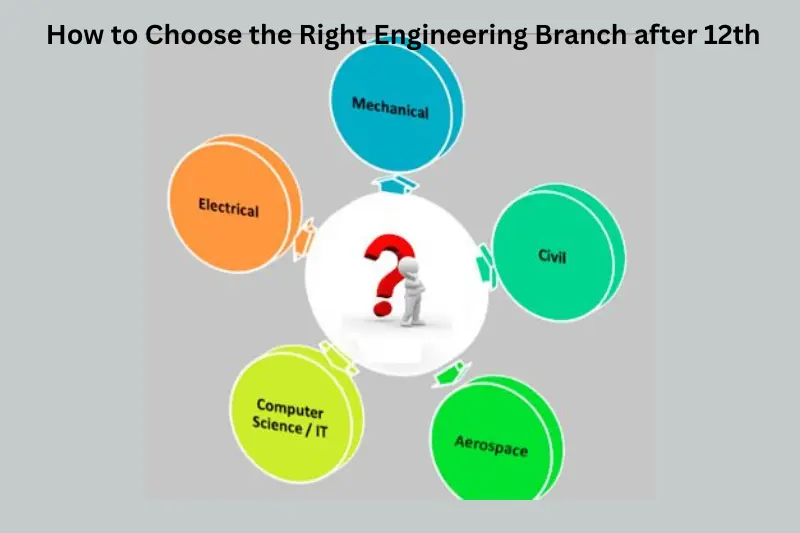
Each engineering discipline focuses on different concepts, technologies, industries, and practical applications. Civil engineers design infrastructure projects. Mechanical engineers work with machines and manufacturing systems. Computer science professionals develop software and digital solutions. Electrical engineers focus on power systems and electronics.
Your chosen specialization influences:
- Subjects you study during college
- Technical skills you develop
- Internship opportunities
- Entry-level job roles
- Career growth potential
- Industry exposure
- Higher education options
Selecting a branch based solely on popularity, peer pressure, or market trends can lead to dissatisfaction later. Students who align their branch with personal interests often perform better academically and professionally.
Understand Your Interests Before Choosing an Engineering Branch
One of the most important steps in understanding how to choose the right engineering branch after 12th is identifying your genuine interests.
Engineering disciplines differ significantly in terms of daily work, learning requirements, and professional responsibilities. Students should honestly evaluate which subjects and activities they enjoy most.
Students who enjoy mathematics, programming, and logical problem-solving often gravitate toward Computer Science Engineering, Artificial Intelligence, Data Science, and Information Technology.
Those fascinated by buildings, roads, bridges, and urban development may find Civil Engineering more appealing.
Students interested in machines, manufacturing processes, automobiles, and industrial systems often prefer Mechanical Engineering.
Electrical Engineering may suit students who enjoy studying circuits, power systems, electronics, and energy technologies.
Interest-based decisions usually produce stronger academic performance because students remain motivated throughout their studies.
Evaluate Your Academic Strengths
Academic strengths provide valuable clues when deciding how to choose the right engineering branch after 12th.
Engineering disciplines require different combinations of skills and competencies. Understanding your strengths can help narrow your options.
Students with strong analytical and mathematical abilities often excel in Computer Science, Artificial Intelligence, Electronics, and Data Science.
Those with excellent visualization skills may perform well in Civil Engineering, Architecture-related fields, and Mechanical Engineering.
Students interested in experimentation and scientific analysis may find Chemical Engineering, Biotechnology, or Environmental Engineering rewarding.
Communication, teamwork, and leadership skills are valuable across all engineering disciplines but can be especially important in project-based fields.
Self-assessment helps students identify branches where they are most likely to succeed academically and professionally.
Explore Popular Engineering Branches and Their Scope
Understanding available engineering specializations is essential before making a final decision.
Computer Science Engineering remains one of the most popular choices due to growing demand for software developers, programmers, cloud engineers, cybersecurity specialists, and artificial intelligence professionals.
Mechanical Engineering continues to play a critical role in manufacturing, automotive industries, robotics, aerospace, and industrial design.
Civil Engineering focuses on infrastructure development, construction management, transportation systems, and urban planning.
Electrical Engineering supports industries related to power generation, renewable energy, electronics, automation, and communication systems.
Electronics and Communication Engineering combines electronics, telecommunications, networking, and embedded systems.
Information Technology focuses on software systems, databases, networking, and digital infrastructure management.
Chemical Engineering involves industrial processes, manufacturing, petrochemicals, pharmaceuticals, and material science.
Emerging engineering disciplines include:
- Artificial Intelligence Engineering
- Machine Learning Engineering
- Robotics Engineering
- Cybersecurity Engineering
- Data Science Engineering
- Mechatronics Engineering
- Renewable Energy Engineering
Researching each branch thoroughly helps students identify the best match for their interests and career goals.
Consider Career Opportunities and Industry Demand
Career prospects play a significant role when evaluating how to choose the right engineering branch after 12th.
Students should examine current and future industry trends rather than focusing solely on short-term popularity.
Technology-driven sectors continue to create opportunities in software development, artificial intelligence, machine learning, cloud computing, cybersecurity, and data analytics.
Infrastructure development supports demand for civil engineers involved in construction, transportation, urban planning, and smart city projects.
Manufacturing industries continue to require mechanical engineers for product design, automation, production systems, and industrial innovation.
The transition toward sustainable energy is generating opportunities for electrical engineers and renewable energy specialists.
Healthcare technology, biotechnology, and environmental engineering are also emerging as promising career fields.
Students should balance market demand with personal interests instead of selecting a branch solely because it appears profitable at the moment.
Analyze Future Growth Potential
The engineering industry evolves continuously due to technological advancements and changing economic conditions.
When learning how to choose the right engineering branch after 12th, students should consider long-term growth opportunities rather than immediate job availability alone.
Artificial Intelligence and Machine Learning are transforming industries worldwide. Companies increasingly rely on intelligent systems for automation, decision-making, and predictive analysis.
Cybersecurity has become essential as organizations protect digital assets from growing security threats.
Renewable energy technologies are expanding rapidly due to environmental concerns and sustainability initiatives.
Data Science continues to influence business strategy, healthcare, finance, manufacturing, and research sectors.
Traditional engineering disciplines also remain highly relevant because infrastructure, manufacturing, transportation, and energy systems require ongoing development and maintenance.
A branch with strong future relevance can provide greater career stability and advancement opportunities.
Understand the Difference Between Core and Emerging Engineering Branches
Students often face confusion when comparing traditional engineering branches with newer specializations.
Core branches include:
- Civil Engineering
- Mechanical Engineering
- Electrical Engineering
- Chemical Engineering
These disciplines form the foundation of engineering education and support critical industries worldwide.
Emerging branches include:
- Artificial Intelligence
- Data Science
- Robotics
- Cybersecurity
- Internet of Things
- Mechatronics
Emerging fields focus heavily on technological innovation and digital transformation.
Core branches generally provide broader foundational knowledge and flexibility. Emerging branches often offer specialized expertise aligned with rapidly growing industries.
Students should evaluate whether they prefer broad engineering foundations or highly specialized technical education.
Research College Curriculum Before Choosing a Branch
Many students select branches based on reputation without reviewing the actual curriculum.
Studying the curriculum helps students understand what they will learn during the next four years.
For example, Computer Science Engineering involves programming, algorithms, databases, operating systems, software development, and computer networks.
Mechanical Engineering includes thermodynamics, manufacturing technology, machine design, fluid mechanics, and industrial systems.
Civil Engineering focuses on structural design, surveying, construction management, transportation engineering, and environmental systems.
Electrical Engineering covers circuits, electronics, power systems, electrical machines, and control systems.
Reviewing course structures provides realistic expectations and prevents future disappointment.
Related Posts:


Consider Your Preferred Work Environment
Different engineering branches lead to different professional environments.
Software engineers often work in offices, technology companies, startups, and remote settings.
Civil engineers frequently spend time on construction sites, infrastructure projects, and field locations.
Mechanical engineers may work in factories, manufacturing facilities, design centers, and industrial plants.
Electrical engineers often operate in laboratories, power plants, industrial facilities, and research environments.
Students should think about where they would enjoy working on a daily basis.
Career satisfaction often depends not only on the subject matter but also on the professional environment associated with the chosen branch.
Salary Expectations Across Engineering Branches
Salary should not be the only factor when deciding how to choose the right engineering branch after 12th. However, understanding earning potential remains important.
Compensation varies based on:
- Industry
- Location
- Skills
- Experience
- Employer
- Specialization
Technology-related branches often attract attention because of competitive salary packages. Software engineering, artificial intelligence, cybersecurity, and data science roles frequently offer attractive compensation for skilled professionals.
Traditional engineering fields also provide strong earning potential, especially for individuals who develop specialized expertise and leadership capabilities.
Students should focus on building valuable skills rather than chasing salary figures alone.
Common Mistakes Students Make When Choosing an Engineering Branch
Many students make avoidable mistakes while deciding how to choose the right engineering branch after 12th. These mistakes can affect academic performance, career satisfaction, and long-term professional growth.
One of the most common mistakes is following friends. Students often choose the same engineering branch as their classmates without considering their own interests and abilities. Career decisions should always be based on personal goals rather than social influence.
Another mistake involves selecting a branch solely because of current salary trends. High-paying industries can change over time. Students who choose a specialization without genuine interest may struggle to remain motivated throughout their studies.
Some students rely entirely on parental preferences. Parents provide valuable guidance, but the student will ultimately spend years studying and working within that field.
Ignoring future industry developments is another concern. Engineering evolves continuously. Students should research future technologies, automation trends, and emerging industries before making a final choice.
Many students also fail to understand the actual curriculum. They may be attracted by a branch name without knowing what subjects they will study during college.
Avoiding these mistakes significantly improves the chances of selecting the right engineering specialization.
How Aptitude Tests Can Help Students
Career aptitude assessments can be valuable tools for students who feel uncertain about their future direction.
These assessments evaluate various factors including analytical ability, logical reasoning, problem-solving skills, personality traits, learning preferences, and technical interests.
Aptitude tests do not make decisions for students. They provide insights that help students better understand their strengths and weaknesses.
For example, a student with strong numerical reasoning and logical thinking skills may find technology-focused engineering branches more suitable. Another student with excellent visualization and design abilities may perform better in Civil Engineering or Mechanical Engineering.
Many educational institutions and career counseling organizations offer professional aptitude testing services. Combining these results with personal interests and market research often leads to better career decisions.
Students should view aptitude tests as one component of the decision-making process rather than the sole determining factor.
Engineering Branches with the Best Future Scope
Students frequently ask which engineering branch offers the best future opportunities. While no single branch is ideal for everyone, several disciplines are expected to experience strong demand in the coming years.
Computer Science Engineering remains among the most promising fields because organizations increasingly depend on software, cloud computing, and digital infrastructure.
Artificial Intelligence Engineering is growing rapidly as businesses adopt intelligent systems for automation, decision-making, and predictive analytics.
Data Science Engineering continues to expand due to the increasing importance of data-driven business strategies.
Cybersecurity Engineering has become critical as organizations face sophisticated digital threats and data protection challenges.
Electrical Engineering is benefiting from the global transition toward renewable energy, electric vehicles, and smart power systems.
Mechanical Engineering remains relevant because manufacturing, robotics, aerospace, and industrial automation continue to evolve.
Civil Engineering is expected to remain essential due to ongoing infrastructure development, urbanization, and smart city projects.
Students should remember that future success depends more on skill development and continuous learning than on selecting a trendy branch.
Importance of Researching Job Roles Before Choosing a Branch
Understanding future job roles can simplify the process of deciding how to choose the right engineering branch after 12th.
Many students focus only on the degree title rather than the actual work they may perform after graduation.
A software engineer may spend significant time coding, testing applications, solving technical problems, and collaborating with development teams.
A civil engineer often participates in planning, designing, and supervising infrastructure projects.
Mechanical engineers may work on product design, manufacturing systems, robotics, automotive technology, or industrial processes.
Electrical engineers frequently deal with power systems, electrical equipment, automation technologies, and renewable energy solutions.
Researching real-world job responsibilities helps students develop realistic expectations and identify careers that align with their interests.
Professional networking platforms, company websites, internship experiences, and industry webinars can provide valuable insights into engineering careers.
Role of Higher Education in Engineering Careers
Many engineering graduates pursue advanced education to expand their expertise and career opportunities.
Master’s degrees allow students to specialize in specific technical areas. Examples include Artificial Intelligence, Structural Engineering, Robotics, Data Science, Power Systems, and Cybersecurity.
Research-oriented students may choose doctoral programs and contribute to technological innovation through academic or industrial research.
Business-focused engineers often pursue management qualifications such as MBA programs to transition into leadership positions.
International education opportunities can also enhance global career prospects and exposure to advanced technologies.
When evaluating how to choose the right engineering branch after 12th, students should consider whether the branch offers pathways that align with their long-term educational goals.
Branches with strong higher education opportunities often provide greater flexibility throughout a professional career.
How Parents Can Support the Decision-Making Process
Parents play an important role in helping students choose an engineering specialization.
Supportive guidance often produces better outcomes than pressure or rigid expectations. Parents should encourage students to explore their interests, strengths, and career aspirations openly.
Constructive discussions about future opportunities, educational investments, and industry trends can help students make informed decisions.
Parents can assist by arranging career counseling sessions, researching colleges, attending educational seminars, and discussing potential career paths.
Students benefit most when parents listen carefully and respect individual preferences.
Engineering is a long-term commitment. Students who feel ownership over their decisions are generally more motivated and engaged throughout their education.
A collaborative approach often leads to better academic performance and career satisfaction.
How to Create a Personal Engineering Branch Selection Plan
A structured decision-making process can reduce confusion and improve confidence.
Students can begin by listing their favorite subjects from high school. Identifying strengths in mathematics, physics, computer science, chemistry, or design-related areas provides useful direction.
The next step involves researching various engineering branches and understanding their curriculum, career opportunities, and future demand.
Students should compare different specializations based on:
- Personal interest
- Academic strengths
- Career prospects
- Industry demand
- Higher education opportunities
- Preferred work environment
Speaking with engineering students, professors, alumni, and industry professionals can provide valuable real-world insights.
Creating a shortlist of three to five engineering branches often makes the final decision more manageable.
This systematic approach reduces uncertainty and supports better career planning.
Engineering vs Other Popular Degree Branches
| Factor | Engineering | Medical | Business & Management | Law | Arts & Humanities |
|---|---|---|---|---|---|
| Primary Focus | Technology and Problem Solving | Healthcare and Medicine | Business Operations | Legal Systems | Social and Human Studies |
| Study Duration | 4 Years | 5–6+ Years | 3–4 Years | 3–5 Years | 3–4 Years |
| Mathematics Requirement | High | Moderate | Moderate | Low | Low |
| Science Requirement | High | Very High | Low | Low | Low |
| Technical Skills | Very High | High | Moderate | Low | Low |
| Creativity Requirement | Moderate to High | Moderate | High | Moderate | High |
| Job Diversity | Very High | High | Very High | High | Moderate |
| Global Opportunities | Excellent | Excellent | Excellent | Moderate | Moderate |
| Starting Salary Potential | High | Moderate to High | Moderate to High | Moderate | Moderate |
| Future Growth Potential | Very High | High | High | High | Moderate |
| Best For | Students Interested in Technology | Students Interested in Healthcare | Students Interested in Business | Students Interested in Law and Justice | Students Interested in Writing, History, Psychology, and Social Sciences |
Related Posts:
Skills Every Engineering Student Should Develop
Regardless of specialization, certain skills contribute significantly to engineering success.
Problem-solving remains one of the most valuable engineering competencies. Engineers are expected to analyze challenges and develop effective solutions.
Critical thinking helps students evaluate information objectively and make informed decisions.
Technical communication skills enable engineers to explain ideas clearly to colleagues, clients, and stakeholders.
Teamwork is essential because most engineering projects involve collaboration across multiple disciplines.
Adaptability has become increasingly important as technologies and industry requirements evolve rapidly.
Digital literacy, data analysis, project management, and continuous learning also contribute to long-term career growth.
Students who focus on developing these transferable skills often perform well regardless of their chosen engineering branch.
Comparison of Engineering Branches
| Engineering Branch | Main Focus Area | Best For Students Who Like | Career Opportunities | Future Scope |
|---|---|---|---|---|
| Computer Science Engineering | Software, Programming, AI | Coding and Technology | Software Developer, AI Engineer, Data Scientist | Very High |
| Mechanical Engineering | Machines and Manufacturing | Design, Machines, Robotics | Mechanical Engineer, Production Engineer | High |
| Civil Engineering | Infrastructure and Construction | Buildings, Roads, Structures | Civil Engineer, Construction Manager | High |
| Electrical Engineering | Power Systems and Electronics | Circuits, Energy Systems | Electrical Engineer, Power Engineer | High |
| Electronics & Communication Engineering | Communication Systems and Electronics | Networking and Electronics | ECE Engineer, Telecom Engineer | High |
| Information Technology | Software and Networking | Programming and Databases | IT Specialist, Network Engineer | Very High |
| Chemical Engineering | Industrial and Chemical Processes | Chemistry and Manufacturing | Process Engineer, Chemical Engineer | High |
| Artificial Intelligence Engineering | AI and Machine Learning | Intelligent Systems and Automation | AI Engineer, ML Engineer | Very High |
| Data Science Engineering | Data Analytics and Insights | Statistics and Data Analysis | Data Scientist, Data Analyst | Very High |
| Cybersecurity Engineering | Digital Security | Ethical Hacking and Security | Cybersecurity Analyst, Security Engineer | Very High |
| Robotics Engineering | Automation and Robotics | Machines and Automation | Robotics Engineer, Automation Engineer | Very High |
| Mechatronics Engineering | Mechanical + Electronics + Software | Multidisciplinary Technology | Mechatronics Engineer | High |

Frequently Asked Questions About Choosing an Engineering Branch
Many students wonder whether Computer Science Engineering is better than Mechanical Engineering. The answer depends entirely on personal interests, skills, and career goals. Both disciplines offer excellent opportunities.
Students also ask whether core engineering branches still have value. Core disciplines such as Civil, Mechanical, Electrical, and Chemical Engineering continue to support critical industries worldwide.
Another common question involves future-proof engineering careers. Fields related to artificial intelligence, cybersecurity, renewable energy, automation, robotics, and data science currently show strong growth potential.
Some students worry about making the wrong choice. Research, self-assessment, career counseling, and discussions with professionals can significantly reduce this risk.
Many students ask whether branch selection matters more than college selection. Both factors are important, but choosing a branch aligned with personal interests often has a greater impact on long-term satisfaction and success.
Final Thoughts on How to Choose the Right Engineering Branch after 12th
Understanding how to choose the right engineering branch after 12th requires careful evaluation of interests, strengths, career aspirations, industry trends, and educational opportunities. Engineering offers numerous paths, each with unique challenges and rewards.
There is no universally perfect engineering branch. The best choice is the one that aligns with your abilities, interests, and long-term goals. Students who make informed decisions based on research rather than external pressure are more likely to enjoy their studies and build successful careers.
Technology will continue transforming industries and creating new opportunities for engineers. Continuous learning, adaptability, and skill development will remain essential regardless of specialization.
Take time to explore your options, understand future possibilities, and seek guidance from trusted mentors. A thoughtful decision today can establish the foundation for a rewarding and fulfilling engineering career tomorrow.