Introduction
Mechanical engineering is one of the broadest and most versatile branches of engineering. It deals with the design, development, analysis, manufacturing, testing, and improvement of machines, mechanical systems, devices, and physical products. Mechanical engineers use mathematics, physics, materials science, computer-based design, and engineering principles to turn ideas into practical solutions.
A simple answer to what is mechanical engineering is that it is the branch of engineering concerned with how physical objects and systems work, especially those involving motion, force, energy, heat, and mechanical components. The field covers everything from small components and precision devices to automobiles, aircraft, robots, manufacturing systems, power equipment, medical devices, and spacecraft.
Mechanical engineering is not limited to designing engines or large machines. It is involved in many technologies used in everyday life. Refrigerators, elevators, vehicles, washing machines, pumps, turbines, heating and cooling systems, industrial machines, robots, and many medical devices can involve mechanical engineering.
Columbia University describes mechanical engineering as the study of objects and systems in motion and emphasizes the role of mechanical engineers in taking products from an initial idea toward manufacturing and the marketplace. Michigan Technological University similarly explains the discipline through the principles of motion, energy, and force and its application from design through manufacturing.
To learn more about the A–Z abbreviations, acronyms, and initialisms used in engineering, read our detailed guide on Mechanical Engineering Initialisms – Alphabet A. It explains common engineering terms and their meanings in an easy-to-understand format. This resource can help students and professionals quickly understand the abbreviations frequently used in mechanical engineering.
What Does Mechanical Engineering Mean?
Mechanical engineering means applying scientific and mathematical principles to understand, design, manufacture, operate, and improve physical systems. Engineers study how forces, motion, energy, heat, materials, and fluids interact and then use that knowledge to develop useful products and technologies.
The discipline covers the entire life cycle of many products. A mechanical engineer may begin by identifying a problem or customer requirement. The engineer can then develop concepts, create a computer-aided design, select materials, perform calculations and simulations, build a prototype, test the product, identify weaknesses, make improvements, and support the manufacturing process.
This combination of theory and practical application makes mechanical engineering a particularly broad field. A mechanical engineer may need to understand how a component behaves under load, how heat moves through a system, how a fluid flows through a pipe, how a product can be manufactured efficiently, and how different components work together as a complete system.
The University of Washington describes mechanical engineering as a field concerned with understanding how things work, ranging from very small systems to spacecraft and the human body. Its applications include transportation, manufacturing, energy, medicine, robotics, and other areas.
What Do Mechanical Engineers Do?
Mechanical engineers solve engineering problems involving physical products, machines, components, systems, and processes. Their responsibilities vary according to their industry, specialization, employer, and position.
A mechanical engineer working in product development may design a new machine or component. Another may use engineering software to analyze stresses and deformation in an existing design. A manufacturing engineer may improve production processes, while an engineer working in energy may develop or improve turbines, heat exchangers, engines, or energy systems.
Mechanical engineers can also develop prototypes and conduct laboratory tests to determine whether a design performs according to its requirements. When a product or machine fails, they may investigate the cause and recommend changes to the design, material, manufacturing process, or operating conditions.
According to the U.S. Bureau of Labor Statistics, mechanical engineers design, develop, build, and test mechanical and thermal devices and may analyze problems, develop and test prototypes, investigate equipment failures, and oversee manufacturing processes.
Their work can therefore include:
- Designing mechanical components and systems
- Developing new products
- Creating prototypes
- Performing engineering calculations
- Using CAD and simulation software
- Testing products and components
- Selecting engineering materials
- Improving manufacturing processes
- Studying heat and fluid flow
- Investigating mechanical failures
- Preparing technical drawings and reports
- Working with other engineering disciplines
- Improving product performance
- Managing engineering projects
The exact job title can also vary. Mechanical engineers may work as design engineers, product engineers, manufacturing engineers, thermal engineers, automotive engineers, aerospace engineers, robotics engineers, systems engineers, test engineers, or project engineers. The article Technical Branch Definition: Types, Examples & Career Guide furnishes knowledge on various topics
What Are the Main Principles of Mechanical Engineering?
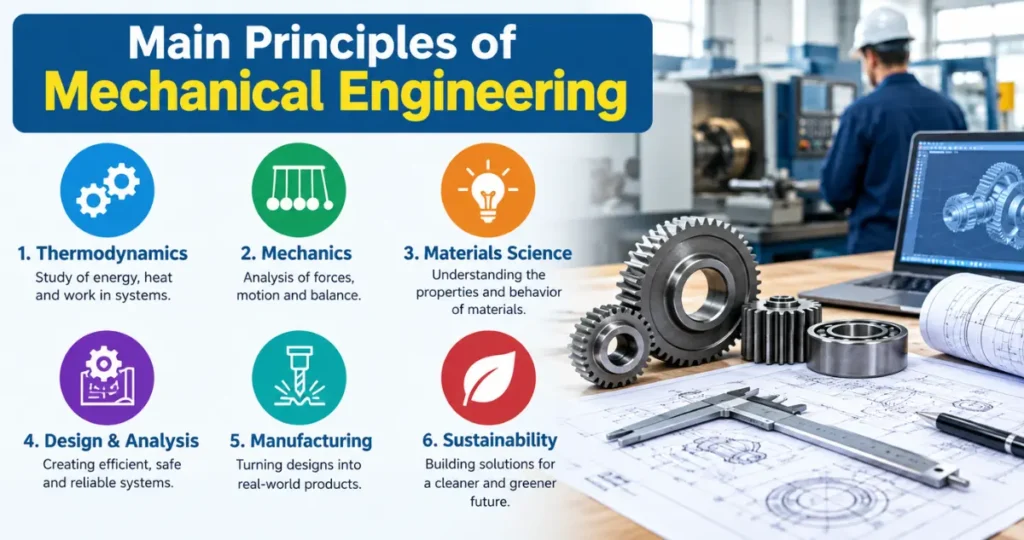
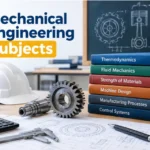
Mechanical engineering is built on several fundamental areas of mathematics, physics, and engineering science. These principles allow engineers to understand how physical systems behave and how they can be designed.
Mechanics
Mechanics is one of the central areas of mechanical engineering. It deals with forces, motion, loads, and the behavior of physical bodies.
Statics focuses on objects that are stationary or in equilibrium. Engineers use statics to understand forces acting on structures, supports, frames, machines, and components.
Dynamics focuses on objects in motion. It involves concepts such as velocity, acceleration, force, momentum, and movement.
Mechanics is essential for designing and analyzing gears, shafts, brackets, machine frames, vehicles, lifting equipment, mechanisms, and countless other systems.
Thermodynamics
Thermodynamics deals with heat, temperature, energy, work, and the conversion of energy from one form to another.
Mechanical engineers use thermodynamics when working with engines, turbines, refrigeration systems, heat pumps, power-generation equipment, and many industrial processes.
For example, an engineer designing an engine needs to understand how energy enters the system, how it is converted into useful work, and how heat is transferred or rejected.
Thermodynamics is also important in modern technologies such as electric-vehicle thermal management, energy storage, renewable-energy systems, and advanced heating and cooling technologies.
Fluid Mechanics
Fluid mechanics studies the behavior of liquids and gases.
Mechanical engineers use it to understand pressure, velocity, flow rate, turbulence, viscosity, and other characteristics of fluids.
Applications include pumps, compressors, turbines, hydraulic systems, pipelines, cooling systems, aircraft, ventilation equipment, and many industrial processes.
Fluid mechanics can also be combined with computer simulation to predict how air, water, fuel, or another fluid will behave inside or around a designed system.
Heat Transfer
Heat transfer focuses on the movement of thermal energy from one location or material to another.
The three fundamental modes of heat transfer are conduction, convection, and radiation.
Mechanical engineers apply these principles to engines, radiators, heat exchangers, boilers, refrigeration equipment, furnaces, electronics cooling systems, and many other technologies.
Understanding heat transfer is particularly important when a product must operate within a specific temperature range.
Materials Science
Materials play a major role in mechanical engineering because the performance of a product depends heavily on the material from which it is made.
Mechanical engineers consider properties such as strength, stiffness, hardness, toughness, density, corrosion resistance, thermal resistance, wear resistance, and manufacturability.
Steel, aluminum, copper, titanium, polymers, ceramics, and composite materials are commonly used in engineering applications.
Material selection involves balancing technical performance with weight, cost, manufacturing requirements, service conditions, and expected product life.
Machine Design
Machine design brings several areas of mechanical engineering together.
Engineers design components such as gears, shafts, springs, bearings, fasteners, couplings, brakes, linkages, and other mechanical parts.
A good design must satisfy functional requirements while also considering strength, durability, manufacturing, maintenance, cost, dimensions, materials, and operating conditions.
Machine design is therefore more than drawing a component. It involves calculations, engineering judgment, modeling, testing, and an understanding of how the component will perform as part of a complete system. To know more about Mechanical Engineering you may also read the article Technical Branch Definition: Types, Examples & Career Guide.
What Are the Major Areas of Mechanical Engineering?
The broad nature of mechanical engineering allows professionals to specialize in many different areas.
Automotive Engineering
Automotive engineering applies mechanical engineering principles to vehicles and transportation systems.
Mechanical engineers may work on engines, transmissions, suspension systems, braking systems, vehicle structures, thermal systems, aerodynamics, manufacturing, and testing.
The growth of electric vehicles has also created new mechanical engineering challenges involving battery cooling, thermal management, lightweight structures, electric powertrains, and advanced manufacturing.
Aerospace Engineering
Mechanical engineers contribute to aircraft and spacecraft development through work involving structures, propulsion, materials, thermal systems, manufacturing, testing, and mechanical components.
Aerospace applications require careful engineering because factors such as weight, temperature, pressure, vibration, and material performance can strongly influence the performance of an aircraft or spacecraft.
Manufacturing Engineering
Manufacturing engineering focuses on how products are produced efficiently and consistently.
Mechanical engineers can work with machining, forming, casting, welding, assembly, tooling, production equipment, automation, robotics, and advanced manufacturing processes.
Modern manufacturing increasingly combines mechanical systems with sensors, software, computer-controlled machines, robotics, and data analysis.
Robotics and Automation
Robotics is another important area where mechanical engineering overlaps with electronics, computer science, and control engineering.
Mechanical engineers design physical robot structures, joints, mechanisms, actuators, grippers, and other components.
Robots are used in manufacturing, logistics, healthcare, agriculture, inspection, research, and space exploration.
Energy Engineering
Mechanical engineers play an important role in systems that generate, convert, store, and use energy.
They can work with gas turbines, steam turbines, engines, heat pumps, energy-storage systems, wind-energy systems, solar technologies, and other energy technologies.
Energy engineering also involves improving efficiency and reducing energy losses.
HVAC Engineering
Heating, ventilation, and air-conditioning systems depend heavily on thermodynamics, fluid mechanics, heat transfer, and system design.
Mechanical engineers can design systems that control temperature, humidity, airflow, and indoor environmental conditions in homes, offices, hospitals, factories, transportation systems, and other buildings.
Biomedical Applications
Mechanical engineering principles can also be applied to healthcare.
Engineers may work on prosthetic limbs, artificial joints, rehabilitation equipment, medical instruments, biomechanics, implants, and other technologies.
The University of Washington identifies biomechanics, prosthetics, medical devices, and health-related technologies among areas where mechanical engineering knowledge can be applied.
How Is Mechanical Engineering Used in Everyday Life?
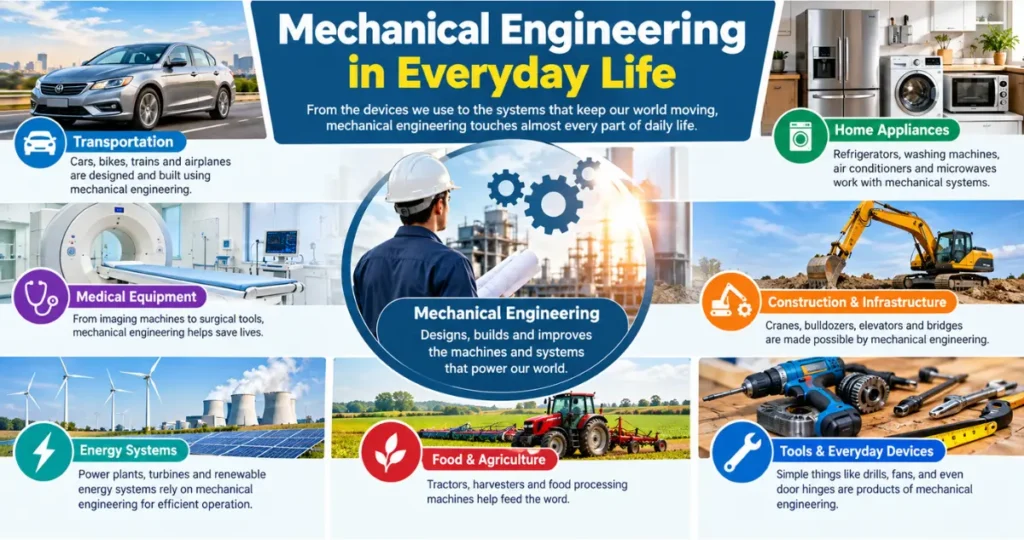
Mechanical engineering is present in many products and systems people use every day.
A refrigerator depends on compressors, heat transfer, thermodynamics, fluid flow, materials, controls, and mechanical components. A washing machine contains motors, rotating components, bearings, vibration-control systems, and structural elements.
Cars contain numerous mechanical systems, including suspension components, braking systems, steering mechanisms, cooling systems, powertrain components, and structural parts.
Elevators depend on motors, cables, pulleys, brakes, mechanical structures, and control systems.
Air-conditioning systems rely on compressors, heat exchangers, fans, refrigerants, pumps, and other components.
Industrial facilities use pumps, compressors, conveyors, turbines, gearboxes, valves, motors, and automated machinery.
Even products that appear simple can contain considerable mechanical engineering. Power tools, sports equipment, kitchen appliances, bicycles, medical devices, printers, cameras, and manufacturing equipment all involve mechanical design principles.
This wide range of applications explains why mechanical engineering is often described as one of the broadest engineering disciplines. Columbia University notes that mechanical engineering extends across industries including automotive, aerospace, energy, robotics, manufacturing, electronics, biotechnology, and more.
What Tools Do Mechanical Engineers Use?
Modern mechanical engineers use a combination of mathematical methods, physical testing, engineering software, and manufacturing technologies.
Computer-aided design, commonly called CAD, is one of the most important tools. Engineers use CAD software to create two-dimensional drawings and three-dimensional models of components and complete assemblies.
Computer-aided engineering tools allow engineers to analyze designs before physical products are manufactured.
Finite element analysis, or FEA, can be used to study stress, deformation, vibration, temperature, and other physical effects.
Computational fluid dynamics, or CFD, can be used to simulate fluid movement, pressure, temperature, and airflow.
Simulation can reduce the need for repeated physical prototypes by allowing engineers to identify potential design problems earlier.
Mechanical engineers also work with measuring instruments, sensors, laboratory equipment, testing machines, manufacturing equipment, and data-analysis tools.
Modern mechanical engineering increasingly includes digital twins, automation, robotics, advanced simulation, additive manufacturing, artificial intelligence, and data-driven engineering.
Michigan Tech notes that modern mechanical engineering education and practice involve CAD, modeling, simulation, manufacturing, testing, robotics, mechatronics, and other modern engineering tools.
What Skills Does a Mechanical Engineer Need?
Mechanical engineering requires a combination of technical, analytical, creative, and communication skills.
Mathematics and physics provide the foundation. Mechanical engineers need to understand concepts such as calculus, differential equations, mechanics, energy, forces, heat, fluids, and material behavior.
Problem-solving is equally important because engineering problems often involve multiple constraints. An engineer may need to balance performance, weight, cost, manufacturability, efficiency, durability, and other requirements.
Design skills are also valuable. Engineers need to convert technical requirements into practical products and systems.
Computer skills have become increasingly important because modern engineering relies heavily on CAD, simulation, data analysis, programming, and digital manufacturing tools.
Communication and teamwork are essential as well. Mechanical engineers frequently work with electrical engineers, civil engineers, software developers, technicians, designers, manufacturers, managers, suppliers, and customers.
Other useful skills include creativity, attention to detail, technical writing, project management, testing, troubleshooting, decision-making, and time management.
The BLS identifies creativity, mathematics, mechanical knowledge, problem-solving, and listening among important qualities and skills for mechanical engineers.
How Do You Become a Mechanical Engineer?
The typical academic route begins with a bachelor’s degree in mechanical engineering or a closely related engineering field.
Mechanical engineering programs generally include mathematics, physics, mechanics, thermodynamics, fluid mechanics, heat transfer, materials, machine design, manufacturing, engineering analysis, and computer-based design.
Students often gain practical experience through laboratory work, internships, co-op programs, research, engineering competitions, and senior design projects.
Accreditation is also an important consideration when choosing an engineering program. ABET’s current criteria for mechanical engineering programs require coverage of engineering principles, mathematics, basic science, modeling, analysis, design, physical systems, and both thermal and mechanical systems.
Professional requirements vary by country. In the United States, the BLS states that mechanical engineers typically need a bachelor’s degree in mechanical engineering or mechanical engineering technology. Engineers who offer services directly to the public may also be subject to professional licensing requirements.
A master’s degree or doctorate can be useful for advanced technical positions, specialized research, university teaching, and certain engineering leadership roles.
Where Do Mechanical Engineers Work?
Mechanical engineers work across a wide range of industries.
Common areas include automotive, aerospace, manufacturing, energy, robotics, construction, healthcare, transportation, electronics, engineering consulting, research, and industrial equipment.
A mechanical engineer may work for a vehicle manufacturer, aircraft company, machinery manufacturer, engineering consultancy, energy company, technology company, research organization, or government agency.
The BLS reports that U.S. mechanical engineers work especially in architectural and engineering services, machinery manufacturing, transportation equipment manufacturing, scientific research and development, and computer and electronic product manufacturing.
The international nature of the field also provides opportunities to work with multinational companies and engineering projects in different countries.
IMechE lists industries such as aerospace, automotive, manufacturing, power, process industries, and railways among the areas where mechanical engineers work.
What Is the Salary and Job Outlook for Mechanical Engineers?
Mechanical engineering salaries vary considerably depending on country, location, experience, education, industry, specialization, and employer.
For a current U.S. reference point, the Bureau of Labor Statistics reports that the median annual wage for mechanical engineers was $104,110 in May 2025. The lowest 10 percent earned less than $73,990, while the highest 10 percent earned more than $164,340.
The BLS projects employment of mechanical engineers to grow by 11% from 2025 to 2035, which is much faster than the average for all occupations. It projects approximately 17,800 openings per year over that period.
These figures represent the United States and should not be interpreted as worldwide salary or employment figures.
The continued development of automation, advanced manufacturing, robotics, transportation technologies, energy systems, and new products can create demand for engineers who can design, develop, test, and improve physical systems.
Why Is Mechanical Engineering Important?
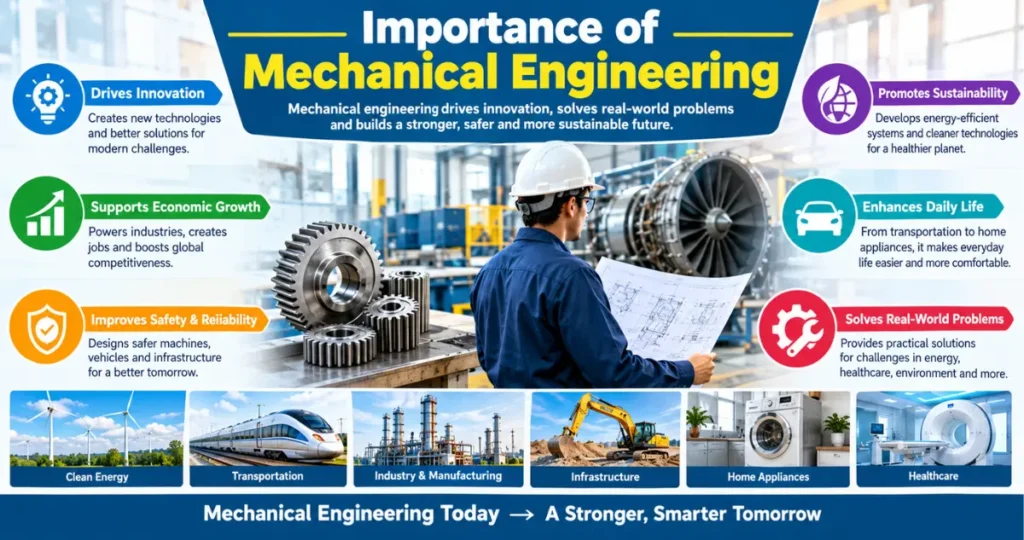
Mechanical engineering is important because modern society depends on physical products, machines, transportation systems, manufacturing equipment, energy technologies, and countless other mechanical systems.
Transportation depends on engines, motors, braking systems, suspension systems, structures, thermal systems, and manufacturing processes.
Manufacturing depends on machines, production equipment, robotics, tooling, automation, and mechanical systems.
Energy production and conversion rely heavily on turbines, pumps, compressors, heat exchangers, engines, and other mechanical technologies.
Healthcare increasingly uses engineering in prosthetics, medical devices, biomechanics, rehabilitation equipment, and other technologies.
Agriculture depends on tractors, harvesting equipment, irrigation machinery, processing systems, and other mechanical technologies.
Mechanical engineering also contributes to consumer products, electronics manufacturing, construction equipment, environmental technologies, and emerging technologies.
Its importance comes from its ability to connect scientific principles with practical physical solutions.
Mechanical Engineering and Modern Manufacturing
Manufacturing has changed significantly with the development of automation, robotics, computer-controlled machinery, additive manufacturing, sensors, and advanced materials.
Mechanical engineers are involved in designing both the products being manufactured and the equipment used to manufacture them.
Traditional processes such as machining, casting, forming, welding, and assembly continue to be important. These processes are increasingly supported by computer-controlled equipment, robotics, automated inspection, and digital production systems.
Additive manufacturing has introduced another approach by allowing certain components to be produced layer by layer from digital designs.
Mechanical engineers working in manufacturing need to understand product design, materials, production processes, machine capabilities, quality requirements, and production efficiency.
The connection between mechanical design and manufacturing is important because a product that performs well in theory may still be difficult or expensive to manufacture. Good engineering considers how a design can realistically be produced at the required quality and cost.
What Is the Future of Mechanical Engineering?
The future of mechanical engineering is closely connected with emerging technologies such as robotics, automation, electric vehicles, renewable energy, advanced materials, additive manufacturing, artificial intelligence, and digital engineering.
Electric vehicles are creating new engineering challenges involving batteries, thermal management, electric motors, lightweight structures, cooling systems, and manufacturing.
Robotics is expanding beyond traditional factory automation into logistics, healthcare, agriculture, inspection, and other applications.
Advanced materials are allowing engineers to develop products with combinations of strength, low weight, thermal resistance, and other desirable properties.
Additive manufacturing is expanding the range of geometries that engineers can create and is becoming useful for prototyping and specialized production.
Artificial intelligence and machine learning are also becoming part of engineering workflows. Engineers can use computational methods to analyze large amounts of data, optimize designs, identify patterns, and improve certain development processes.
Digital twins can provide virtual representations of physical products or systems, allowing engineers to study performance and monitor behavior using data from real-world equipment.
Sustainability is another major area. Engineers are increasingly considering energy efficiency, material use, product life, repairability, recycling, and resource consumption during design and manufacturing.
These developments are expanding mechanical engineering rather than replacing its foundations. Mechanics, thermodynamics, fluid mechanics, materials, design, and manufacturing remain central to the discipline.
Is Mechanical Engineering a Good Career?
Mechanical engineering can be a strong career choice for people who enjoy mathematics, physics, technology, machines, design, and problem-solving.
One of its biggest advantages is versatility. A mechanical engineering graduate can potentially work in automotive, aerospace, manufacturing, energy, robotics, healthcare, transportation, HVAC, product development, research, consulting, and other fields.
The field also offers different career directions. Some engineers remain highly technical, while others move into project management, engineering management, consulting, research, business development, or entrepreneurship.
Mechanical engineering education can also provide transferable skills. Analytical thinking, problem-solving, design, quantitative reasoning, technical communication, and project work can be useful outside traditional engineering roles.
The discipline does require serious study. Students normally spend substantial time learning mathematics, physics, engineering science, design, analysis, and laboratory methods.
For someone who enjoys understanding how things work and developing practical solutions to physical problems, mechanical engineering can provide a broad foundation for a long-term professional career.
Mechanical Engineering vs. Mechanical Engineering Technology
Mechanical engineering and mechanical engineering technology are closely related but can have different educational and professional emphases.
Mechanical engineering programs generally place greater emphasis on mathematical analysis, engineering theory, modeling, advanced design, and the underlying principles used to solve complex engineering problems.
Mechanical engineering technology programs often place greater emphasis on practical implementation, testing, measurement, manufacturing, installation, operation, and maintenance.
The exact difference depends on the institution and program.
ABET‘s current criteria distinguish engineering and engineering technology programs by their educational focus and outcomes. Mechanical engineering technology programs can prepare graduates for areas such as design, manufacturing, testing, technical work, installation, maintenance, and other practical applications involving mechanical systems.
Students should therefore compare individual programs rather than assuming that every degree with a similar name has the same curriculum or career outcomes.
Frequently Asked Questions About Mechanical Engineering
What is mechanical engineering in simple words?
Mechanical engineering is the branch of engineering that deals with designing, analyzing, developing, manufacturing, testing, and improving machines, mechanical components, thermal systems, and other physical products.
What does a mechanical engineer do?
A mechanical engineer can design products and machines, analyze forces and motion, select materials, develop prototypes, perform testing, improve manufacturing processes, investigate failures, and work on the development of mechanical systems.
Is mechanical engineering only about machines?
No. Mechanical engineering is much broader than machines. It includes areas such as energy, transportation, robotics, manufacturing, aerospace, HVAC, medical technology, biomechanics, materials, and automation.
What subjects are important for mechanical engineering?
Mathematics and physics are important foundations. Mechanical engineering programs commonly include mechanics, thermodynamics, fluid mechanics, heat transfer, materials science, machine design, manufacturing, controls, engineering analysis, and computer-aided design.
Where can mechanical engineers work?
Mechanical engineers can work in automotive, aerospace, manufacturing, energy, robotics, healthcare, transportation, construction, electronics, research, engineering consulting, and many other industries.
What tools do mechanical engineers use?
Common tools include CAD software, engineering simulation programs, finite element analysis, computational fluid dynamics, measurement equipment, testing systems, manufacturing tools, sensors, and data-analysis software.
What degree is needed to become a mechanical engineer?
A bachelor’s degree in mechanical engineering or a related engineering field is a common entry route. Specific educational and licensing requirements vary by country and professional role.
Is mechanical engineering a good career?
Mechanical engineering can be a good career for people interested in mathematics, physics, technology, design, machines, and practical problem-solving. Its broad range of applications allows engineers to work across many industries.
What is the future of mechanical engineering?
Mechanical engineering is evolving alongside robotics, automation, electric vehicles, renewable energy, advanced materials, additive manufacturing, artificial intelligence, and digital engineering. Traditional engineering principles remain important while their applications continue to expand.
Conclusion
Mechanical engineering is a broad engineering discipline focused on understanding, designing, developing, manufacturing, testing, and improving physical systems. It combines mathematics, physics, mechanics, thermodynamics, fluid mechanics, heat transfer, materials science, machine design, manufacturing, and modern digital tools.
The answer to what is mechanical engineering therefore extends far beyond engines and traditional machinery. Mechanical engineers can contribute to automobiles, aircraft, robots, energy systems, manufacturing equipment, medical devices, heating and cooling systems, consumer products, and many other technologies.
The field covers the complete journey of a product, from an initial idea and engineering analysis to design, prototyping, testing, manufacturing, and improvement.
Its broad scope also gives mechanical engineers many career options. They can specialize in automotive engineering, aerospace, manufacturing, robotics, energy, HVAC, biomedical applications, product development, or other technical areas.
As industries adopt automation, electrification, advanced materials, additive manufacturing, artificial intelligence, and digital engineering, mechanical engineering continues to evolve. Its fundamental principles remain essential because every physical product or machine still needs to obey the laws of mechanics, energy, materials, heat, and motion.