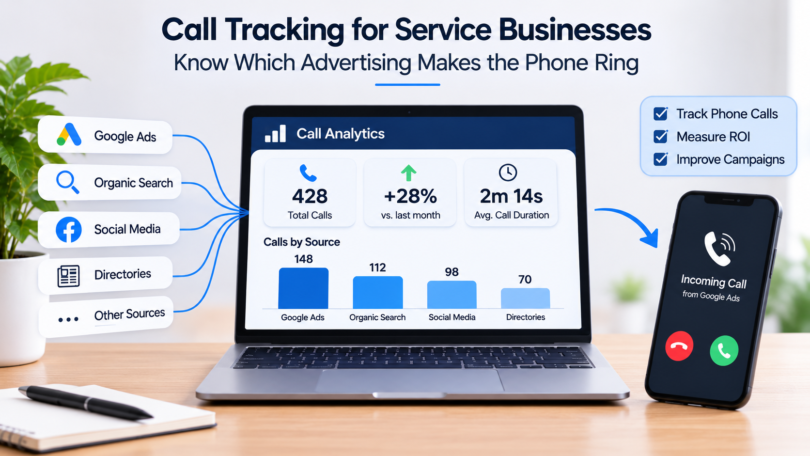

For trades, clinics, legal practices and most local services, the majority of enquiries arrive by phone. Yet the majority of marketing measurement counts only form submissions, which means these businesses optimise on a minority of their own results.
What call tracking actually does
At its simplest, it assigns different phone numbers to different marketing sources. Calls route to your real line as normal, but the system records which number was dialled and therefore where the caller came from.
Approach How it works Best for
Static numbers One number per channel: print, directory, website Offline and channel-level attribution
Dynamic insertion The number on the page changes per visitor source Campaign and keyword-level attribution
Click-to-call events Records taps on the number, no call routing A free first step, mobile only
Start with the free version
Before paying for anything, record taps on your phone number as an event in analytics. It will not tell you what happened on the call, and it misses desktop users who dial manually, but it costs nothing and immediately reveals whether phone volume is significant enough to justify a paid tool.
On most service websites it is, and the result surprises people: a page they assumed was underperforming turns out to be the largest source of enquiries in the business.
What dynamic tracking adds
With dynamic numbers, a visitor arriving from a search ad sees a different number from someone arriving through organic search. Attribution then works at campaign and often keyword level, and that data can be fed back into advertising platforms as conversions.
That feedback loop is where the real gain sits. Once phone calls count as conversions, automated bidding starts optimising towards the campaigns that produce them rather than towards form fills alone. Setting this up cleanly alongside consent banners and analytics is fiddly, and is usually handled as part of tag management and tracking configuration rather than bolted on separately.
Practical considerations
Keep your main number consistent on your business profile and directories. Mismatched numbers across listings damage local search performance.
Choose the same area code. Local callers trust local numbers, and a distant prefix measurably reduces call volume.
Retain call recordings only with proper notice and in line with local law. Announcements are mandatory in many jurisdictions.
Set a minimum call duration before counting it as a conversion. Thirty to sixty seconds filters out wrong numbers and immediate hang-ups.
Qualification, not just counting
A recorded call volume of forty tells you little if fifteen were sales calls, eight were existing customers and five were misdials. Introduce a simple tagging habit: whoever answers marks each call as new enquiry, existing customer, or irrelevant. Five seconds per call produces a qualified number that changes decisions.
This also exposes a problem measurement alone cannot fix. Many businesses discover that a meaningful share of calls are missed entirely during busy periods, and the cheapest available growth turns out to be answering the phone more reliably rather than buying more advertising.
Cost and when it is worth it
Entry-level tools start around the price of a couple of clicks per month, scaling with call volume and the number of tracked sources. The threshold is straightforward: if you spend meaningfully on advertising and more than a third of your enquiries arrive by phone, the cost is trivial compared with the budget currently being allocated blind.