
Introduction
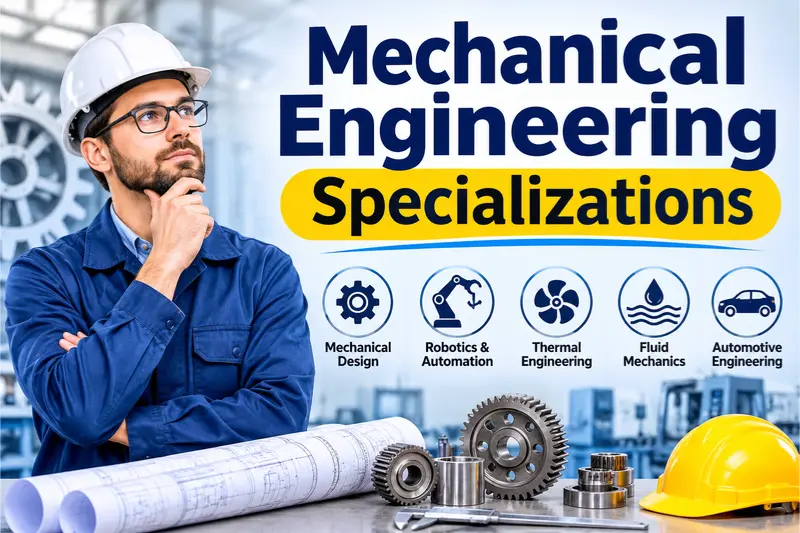
Mechanical engineering is one of the broadest engineering disciplines, offering opportunities in product design, manufacturing, aerospace, automotive technology, energy systems, robotics, materials science, and many other technical fields. However, mechanical engineers do not necessarily follow the same professional path. They can develop expertise in particular areas according to their interests, academic choices, technical abilities, and career objectives.
Mechanical Engineering Specializations are focused areas of study or professional practice within the broader mechanical engineering discipline. They allow students and engineers to develop deeper knowledge of particular technologies, engineering systems, and industrial applications.
For example, someone interested in aircraft and spacecraft may choose aerospace-related engineering, while another student who enjoys designing machines may prefer mechanical design engineering. Similarly, people interested in sustainable technologies may explore renewable energy, whereas those fascinated by automated machines may pursue robotics and mechatronics.
The choice of specialization can influence the subjects students study, the technical software they learn, the projects they complete, and the industries in which they eventually work.
This guide explores 15 important Mechanical Engineering Specializations, including their definitions, meanings, practical examples, applications, and career relevance. It also explains the technical abbreviations, initialisms, and acronyms frequently encountered in these fields.
What Are Mechanical Engineering Specializations?
Mechanical Engineering Specializations are focused academic or professional areas within mechanical engineering that allow individuals to concentrate on particular engineering technologies, systems, applications, or research topics.
In simple terms, specialization means developing deeper knowledge and practical expertise in one particular area rather than studying every mechanical engineering subject at the same level of detail.
For example, a mechanical engineering student interested in designing automobile components may concentrate on automotive engineering. Another student interested in energy conversion, engines, turbines, and heat-transfer systems may choose thermal engineering.
Specializations can be offered as formal university degree options, concentrations, postgraduate programs, technical electives, or research areas. Their names and availability differ between educational institutions.
According to Oregon State University, mechanical engineering students can explore focused academic options such as aerospace engineering, computational engineering, energy and fluid systems, materials design and manufacturing, product design and manufacturing, and robotic control.
Therefore, a specialization does not always require a completely separate undergraduate degree. Students can often build expertise through elective courses, internships, laboratory work, research projects, and additional professional training.
Meaning of Mechanical Engineering Specializations
The meaning of Mechanical Engineering Specializations is the process of concentrating academic learning or professional expertise on a particular branch, technology, or application of mechanical engineering.
Consider a simple example: two students graduate with bachelor’s degrees in mechanical engineering. The first student enjoys designing machine components and develops expertise in CAD software, machine design, and product development. The second student is interested in energy conversion and concentrates on thermodynamics, fluid mechanics, and heat transfer.
Although both have the same broad engineering degree, their technical interests and professional expertise are different.
The first graduate may pursue mechanical design engineering, while the second may develop a career in thermal or energy engineering.
Consequently, specialization helps students connect their engineering education with the type of work they want to perform.
15 Major Mechanical Engineering Specializations
Mechanical engineering includes numerous academic and professional areas. The following 15 specializations represent important fields that students and graduates can explore.
1. Mechanical Design Engineering
Mechanical design engineering focuses on developing mechanical components, machines, products, assemblies, and complete engineering systems. It involves applying scientific principles, engineering calculations, material selection, and design methods to create products that perform their intended functions safely and efficiently.
Design engineers consider factors such as strength, dimensions, tolerances, operating conditions, manufacturing requirements, maintenance, cost, and reliability.
For example, designing a gearbox requires knowledge of gears, shafts, bearings, lubrication, mechanical loads, material properties, and manufacturing processes. An engineer must ensure that the components operate together without excessive wear or premature failure.
Another example is designing a pump housing. The engineer must consider fluid pressure, material strength, sealing arrangements, dimensions, manufacturing limitations, and operating conditions.
Computer-Aided Design (CAD) software is widely used in this specialization. Engineers may work with SolidWorks, CATIA, Autodesk Inventor, Creo, and other design platforms.
Students interested in this area should develop a strong understanding of engineering mechanics, strength of materials, machine design, manufacturing processes, and technical drawing.
2. Thermal Engineering
Thermal engineering deals with heat, temperature, energy conversion, thermodynamic systems, and heat-transfer processes. It is one of the important Mechanical Engineering Specializations for students interested in engines, power generation, refrigeration, and energy-efficient equipment.
Thermal engineers analyze how energy moves through systems and how equipment can operate efficiently under different temperature and pressure conditions.
For example, a thermal engineer working in a power plant may evaluate boilers, steam turbines, condensers, heat exchangers, and cooling systems. Another engineer may work on improving the thermal performance of an automobile engine or electric vehicle battery.
Heating, Ventilation, and Air Conditioning (HVAC) is another important application of thermal engineering. Engineers design and analyze heating and cooling systems used in commercial buildings, hospitals, industrial facilities, and residential properties.
Important subjects include thermodynamics, heat transfer, fluid mechanics, refrigeration, combustion, and energy systems.
3. Manufacturing Engineering
Manufacturing engineering focuses on converting raw materials into finished products through efficient production methods. It involves selecting manufacturing processes, developing production systems, improving product quality, and reducing unnecessary costs.
Manufacturing engineers work with machining, casting, forging, welding, forming, fabrication, assembly, and advanced manufacturing technologies.
For example, an engineer working in an automobile manufacturing facility may improve the production process for engine components. The engineer might evaluate machining operations, production equipment, assembly procedures, material utilization, and product quality.
Another example is developing a manufacturing process for industrial pump components. The engineer must select suitable materials, machining methods, production equipment, and inspection procedures.
Computer-Aided Manufacturing (CAM) and Computer Numerical Control (CNC) are important technologies in this specialization. Modern manufacturing also incorporates robotics, automation, sensors, and digital production systems.
Students interested in manufacturing should focus on manufacturing processes, materials science, production engineering, metrology, CAD/CAM, and quality control.
4. Automotive Engineering
Automotive engineering applies mechanical engineering principles to the design, development, testing, manufacturing, and improvement of vehicles.
It includes traditional automobile systems as well as modern electric and hybrid vehicle technologies.
Automotive engineers may work on engines, transmissions, braking systems, suspension, steering mechanisms, vehicle structures, aerodynamics, cooling systems, and vehicle testing.
For example, an automotive engineer may help develop an improved suspension system that increases vehicle stability and passenger comfort. Another engineer may work on battery cooling arrangements for an electric vehicle.
The development of electric vehicles has expanded the importance of battery thermal management, lightweight materials, electric drivetrains, energy efficiency, and advanced manufacturing.
Important subjects include mechanics, machine design, thermodynamics, fluid mechanics, materials science, vehicle dynamics, and manufacturing technology.
5. Aerospace Engineering
Aerospace engineering involves the design, development, manufacturing, testing, and operation of aircraft and spacecraft systems.
Although aerospace engineering is a distinct engineering discipline, it shares many fundamental principles with mechanical engineering, particularly mechanics, thermodynamics, fluid dynamics, materials, structures, and propulsion.
Mechanical engineers can contribute to aerospace projects involving aircraft structures, propulsion components, landing systems, thermal management, mechanical assemblies, and testing equipment.
For example, an engineer working on an aircraft project may evaluate the strength and weight of structural components under different loading conditions. Another may contribute to cooling systems or mechanical equipment used in aircraft engines.
Aerospace-related work requires strong analytical abilities and knowledge of engineering materials, fluid mechanics, thermodynamics, structural analysis, and manufacturing.
Students interested in this field may also explore postgraduate aerospace engineering programs and specialized university research opportunities.
6. Robotics and Mechatronics Engineering
Robotics and mechatronics engineering combine mechanical systems with electronics, sensors, control systems, actuators, and computer technology.
Robotics focuses on developing machines capable of performing tasks through programmed or controlled movements. Mechatronics integrates different engineering technologies to create intelligent mechanical systems.
For example, an industrial robotic arm used in automobile manufacturing requires mechanical structures, motors, actuators, sensors, control systems, and programming.
Similarly, a medical rehabilitation robot combines mechanical design, electronic components, sensors, and control technologies to assist human movement.
Mechanical engineers contribute to robot structures, joints, mechanical transmissions, actuators, movement mechanisms, and physical system integration.
Students interested in this specialization should develop knowledge of machine design, engineering mechanics, electronics, control systems, sensors, programming, and automation.
7. Energy Engineering and Renewable Energy
Energy engineering focuses on developing, analyzing, and improving systems used to generate, convert, distribute, and utilize energy.
Mechanical engineers contribute to both conventional and renewable energy technologies, including power plants, wind turbines, solar thermal systems, energy storage equipment, and industrial energy systems.
For example, an engineer working in wind energy may analyze turbine components such as shafts, bearings, gearboxes, blades, and mechanical braking systems.
Another engineer may work on improving the efficiency of industrial boilers or developing heat-recovery systems that reduce energy consumption.
Renewable energy is also creating opportunities in sustainable manufacturing, hydrogen technologies, thermal storage, and energy-efficient mechanical equipment.
Important subjects include thermodynamics, fluid mechanics, heat transfer, energy conversion, machine design, and environmental engineering.
8. Fluid Mechanics and Hydraulic Engineering
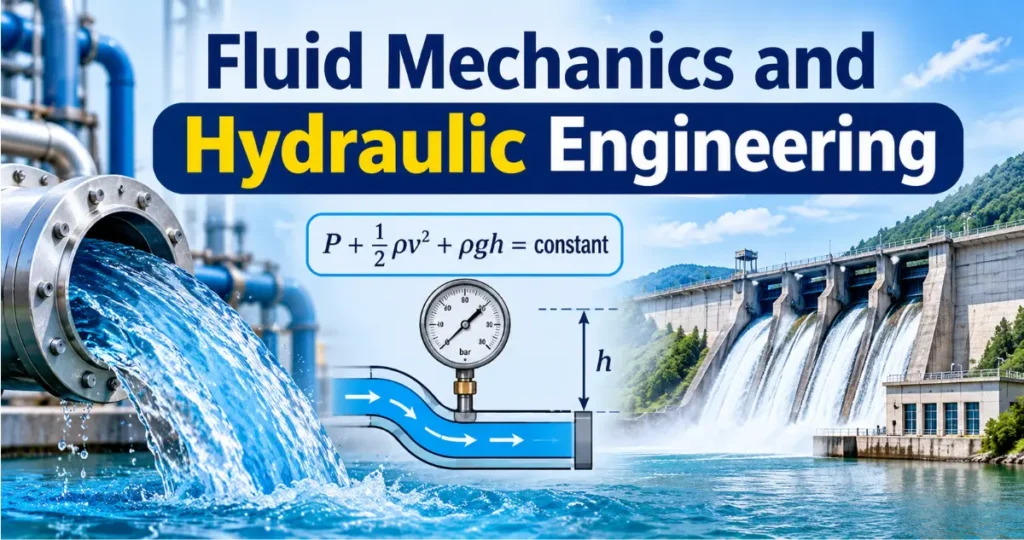
Fluid mechanics studies the behavior of liquids and gases under different physical conditions. Hydraulic engineering applies fluid principles to practical systems involving liquid movement, pressure, power transmission, and equipment operation.
This specialization is relevant to pumps, compressors, turbines, hydraulic machinery, pipelines, lubrication systems, and industrial fluid-handling equipment.
For example, an engineer designing an industrial pumping system must calculate flow rates, pressure losses, pump performance, pipe dimensions, and operating requirements.
Another example involves developing hydraulic systems used in construction equipment, where pressurized fluid transfers power to cylinders and mechanical components.
Computational Fluid Dynamics (CFD) is an important engineering tool in this field. It allows engineers to analyze fluid flow, pressure distribution, turbulence, and heat-transfer behavior through numerical simulations.
Students should focus on fluid mechanics, thermodynamics, hydraulics, mathematics, and computational analysis.
9. Materials Engineering and Metallurgy
Materials engineering focuses on understanding, selecting, developing, and improving materials used in mechanical products and industrial systems.
It involves metals, alloys, polymers, ceramics, composites, and other engineering materials.
Mechanical engineers specializing in materials investigate properties such as strength, hardness, toughness, fatigue resistance, corrosion resistance, thermal stability, and wear behavior.
For example, an engineer designing a high-temperature turbine component must select materials capable of maintaining suitable mechanical properties under demanding operating conditions.
Similarly, a marine equipment engineer may investigate corrosion-resistant materials for components exposed to seawater.
Metallurgy is an important related area that studies metals, their structures, properties, processing, and performance.
This specialization is particularly relevant to manufacturing, aerospace, automotive, power generation, oil and gas, and industrial equipment.
10. Computational Engineering and Simulation
Computational engineering applies mathematical models, numerical methods, computer programs, and simulation technologies to analyze mechanical systems and engineering problems.
It allows engineers to investigate the behavior of components and systems without depending entirely on physical prototypes.
For example, an engineer may use Finite Element Analysis (FEA) to examine stress and deformation in a machine component under different loading conditions.
Similarly, Computational Fluid Dynamics (CFD) can be used to investigate airflow around an automobile or fluid movement through an industrial pump.
Computer-Aided Engineering (CAE) software supports engineering analysis, modelling, optimization, and simulation.
These methods are useful in product development, structural analysis, thermal engineering, aerospace, automotive engineering, and manufacturing.
Students interested in computational engineering should develop skills in mathematics, programming, numerical methods, CAD, FEA, CFD, and engineering analysis.
11. Industrial Automation and Control Engineering
Industrial automation and control engineering focus on controlling machines, production equipment, and industrial processes through automated systems.
This specialization combines mechanical engineering with electrical systems, sensors, controllers, instrumentation, and software.
For example, an automated manufacturing line may use sensors to detect products, Programmable Logic Controllers (PLCs) to control operations, and robotic equipment to perform assembly tasks.
Mechanical engineers working in automation may develop machine mechanisms, select actuators, integrate equipment, improve production systems, and troubleshoot mechanical problems.
Automation is particularly important in automotive manufacturing, food processing, pharmaceuticals, packaging, power generation, and other industrial sectors.
Students should develop knowledge of control systems, mechatronics, electrical fundamentals, machine design, sensors, PLCs, and industrial automation.
12. HVAC and Refrigeration Engineering
HVAC and refrigeration engineering focuses on systems used for heating, ventilation, air conditioning, cooling, and temperature control.
This field is an important professional direction for mechanical engineers because buildings, hospitals, industrial plants, commercial facilities, and data centers require properly designed thermal and ventilation systems.
For example, an HVAC engineer may design an air-conditioning system for a hospital by calculating cooling loads, selecting equipment, planning air distribution, and evaluating ventilation requirements.
Another engineer may develop an industrial refrigeration system used for food storage or manufacturing processes.
HVAC engineering requires knowledge of thermodynamics, heat transfer, fluid mechanics, refrigeration cycles, air distribution, equipment selection, and energy efficiency.
Students interested in this area can also develop expertise in building energy modelling and sustainable cooling technologies.
13. Marine Engineering
Marine engineering involves the design, operation, maintenance, and improvement of mechanical and propulsion systems used in ships, offshore installations, and other marine applications.
Mechanical engineering principles are important in marine engines, propulsion machinery, pumps, compressors, boilers, heat exchangers, auxiliary systems, and deck machinery.
For example, a marine engineer may work on the maintenance and performance of a ship’s propulsion engine. Another may specialize in pumps, compressors, cooling systems, fuel systems, or other machinery installed onboard vessels.
Marine engineering also includes applications involving offshore equipment, shipbuilding, marine power systems, and specialized industrial machinery.
Students interested in this specialization should develop strong knowledge of thermodynamics, fluid mechanics, machine design, power systems, maintenance, and equipment reliability.
14. Biomedical and Biomechanical Engineering
Biomedical and biomechanical engineering apply engineering principles to healthcare, medical equipment, biological systems, and human movement.
Biomechanical engineering examines the mechanical behavior of biological structures, including bones, joints, muscles, and tissues.
Mechanical engineers can contribute to the development of prosthetic limbs, rehabilitation equipment, artificial joints, medical instruments, and assistive devices.
For example, an engineer designing a prosthetic limb must consider mechanical strength, weight, movement, material selection, durability, and user comfort.
Another application involves developing rehabilitation equipment that helps patients regain mobility through controlled mechanical movement.
This specialization often requires collaboration with biomedical engineers, healthcare professionals, researchers, and materials specialists.
Students interested in this area may benefit from studying mechanics, materials science, biomechanics, mechanical design, and relevant biological sciences.
15. Research and Development Engineering
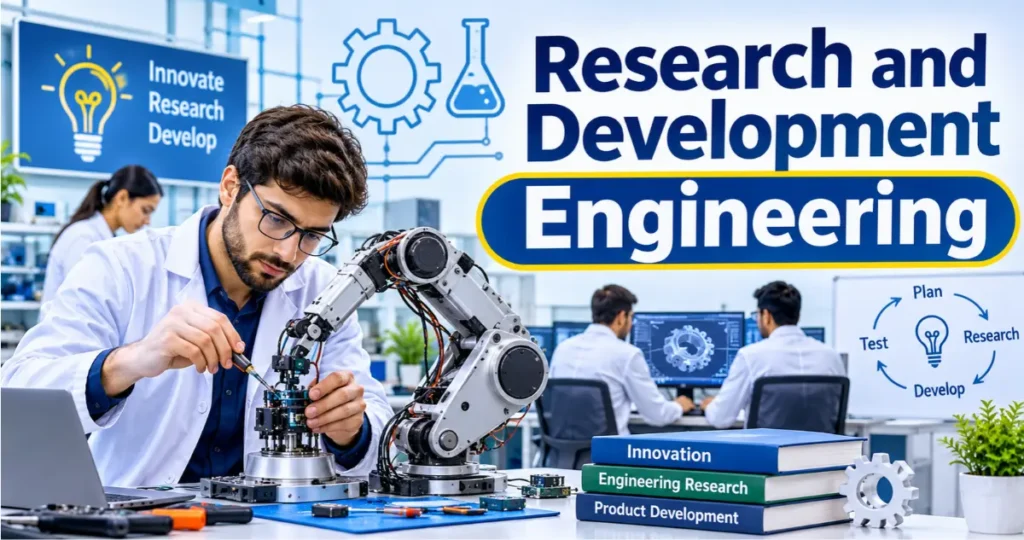
Research and Development (R&D) engineering focuses on investigating new technologies, developing innovative products, improving existing systems, and solving complex engineering problems.
Mechanical engineers working in R&D may contribute to new materials, energy systems, robotics, automotive technologies, advanced manufacturing, industrial machinery, and medical devices.
For example, an R&D engineer may investigate a lightweight material for automotive applications to improve vehicle efficiency.
Another may develop a new cooling technology for electronic equipment or conduct research into more efficient energy-conversion systems.
Research positions are available in universities, laboratories, manufacturing companies, technology organizations, and specialized engineering institutions.
Some advanced research positions require postgraduate qualifications, particularly when the work involves independent scientific research or specialized technical development.
How to Choose the Right Mechanical Engineering Specialization
Choosing among Mechanical Engineering Specializations requires considering personal interests, academic strengths, technical abilities, and future professional goals.
Students should not select an area simply because it appears popular. Instead, they should understand what engineers actually do in that field and whether its everyday responsibilities match their interests.
For example, students who enjoy creating products and machine components may find mechanical design interesting. Those who enjoy mathematics, energy systems, and heat-transfer calculations may prefer thermal engineering.
Similarly, students fascinated by automated equipment may explore robotics and mechatronics, while those interested in production processes may choose manufacturing engineering.
University course availability is another important consideration. Some institutions offer formal specializations, whereas others provide technical electives, research groups, or postgraduate options.
Students should examine the official curriculum, laboratory facilities, faculty research areas, internship opportunities, and industry connections before making a decision.
Practical experience can also help. Internships, technical projects, laboratory assignments, and industry training allow students to understand the actual requirements of different engineering fields.
Important Skills for Mechanical Engineering Specializations
Although each specialization requires different technical knowledge, several fundamental skills are useful across the mechanical engineering profession.
Engineering mathematics: Mathematics supports calculations, modelling, optimization, simulation, and analysis of mechanical systems.
Mechanical design: Understanding components, assemblies, materials, loads, dimensions, and engineering drawings is important in many fields.
Computer-Aided Design: CAD knowledge helps engineers create and modify technical drawings and three-dimensional models.
Engineering analysis: The ability to evaluate forces, motion, heat, fluid flow, material behavior, and system performance supports effective engineering decisions.
Problem-solving: Mechanical engineers regularly investigate technical problems, equipment failures, design limitations, and manufacturing difficulties.
Communication: Engineers must explain technical information through drawings, reports, presentations, and professional discussions.
Practical experience: Laboratory work, workshops, internships, and engineering projects help connect theoretical knowledge with real industrial applications.
The most suitable combination of skills depends on the chosen specialization and the requirements of the employer or academic program.
Important Abbreviations, Initialisms, and Acronyms in Mechanical Engineering
Mechanical engineers regularly encounter technical abbreviations, initialisms, and acronyms in engineering drawings, software, technical documents, research papers, and industrial workplaces.
Understanding these terms helps students follow engineering discussions and recognize technologies associated with different specializations.
Some important examples include:
CAD – Computer-Aided Design: Software-based methods used to create and modify engineering drawings and three-dimensional models. Commonly associated with mechanical design and product development.
CAM – Computer-Aided Manufacturing: Computer-based technologies that support manufacturing planning, machining, and production operations.
CAE – Computer-Aided Engineering: Digital tools used for engineering analysis, modelling, simulation, and product optimization.
CFD – Computational Fluid Dynamics: Numerical methods used to analyze fluid movement, pressure, turbulence, and heat transfer.
CNC – Computer Numerical Control: Automated control of machine tools through programmed instructions.
FEA – Finite Element Analysis: A numerical engineering technique used to evaluate structural, thermal, and other physical behavior.
FEM – Finite Element Method: A numerical method used to solve engineering and mathematical problems by dividing a system into smaller elements.
HVAC – Heating, Ventilation, and Air Conditioning: Technologies used to regulate temperature, airflow, ventilation, and indoor environmental conditions.
PLC – Programmable Logic Controller: An industrial control device used to automate machinery and production processes.
R&D – Research and Development: Activities involving the investigation, testing, and development of new products, technologies, and engineering solutions.
FMEA – Failure Mode and Effects Analysis: A structured method for identifying potential failures and evaluating their possible consequences.
CMM – Coordinate Measuring Machine: Equipment used to measure the physical dimensions and geometrical characteristics of manufactured components.
These terms are relevant to several Mechanical Engineering Specializations, but their importance varies by field.
For example, CAD and FEA are particularly useful in mechanical design, CFD is important in fluid and thermal analysis, while CNC and CAM are frequently associated with manufacturing.
Fullipedia also provides dedicated resources for students who want to explore engineering terminology alphabetically:
- Mechanical Engineering Initialisms – Alphabet A
- Mechanical Engineering Initialism – Alphabet B
- Mechanical Engineering Initialism – Alphabet C
- Mechanical Engineering Initialism – Alphabet D
- Mechanical Engineering Initialism – Alphabet E
- Mechanical Engineering Initialism – Alphabet F
These references can help readers understand technical short forms encountered during engineering education and professional practice.
Mechanical Engineering Specializations in the United States
The United States offers academic and professional opportunities across automotive engineering, aerospace, manufacturing, energy, robotics, product development, and advanced materials.
Universities provide different specialization options depending on their degree programs and research priorities.
For example, Oregon State University describes academic options in aerospace, computational engineering, energy and fluid systems, materials design and manufacturing, product design and manufacturing, and robotic control.
Students considering postgraduate education can also explore the Drexel University Mechanical Engineering and Mechanics program, which identifies areas such as robotics, thermal and fluid sciences, mechanics and materials, computational simulation, and biomechanics.
Professional opportunities depend on qualifications, experience, employer requirements, location, and industry conditions.
The U.S. Bureau of Labor Statistics provides additional information about mechanical engineering education, occupational responsibilities, and employment prospects.
Mechanical Engineering Specializations in India
India has a broad mechanical engineering education and industrial environment supported by automotive manufacturing, industrial equipment, power generation, infrastructure, aerospace, production technology, and engineering services.
Students can explore specialization opportunities through undergraduate electives, postgraduate programs, technical training, internships, and research projects.
For example, Chitkara University discusses different types of mechanical engineering, while Chandigarh University provides information about mechanical engineering branches and related career opportunities.
The availability of a particular specialization depends on the institution and academic program.
Students interested in manufacturing may explore production and design-related programs, while those interested in energy systems may consider thermal and fluid sciences. Similarly, students interested in automation can look for mechatronics, robotics, and control-related opportunities.
Before choosing a university, students should examine its official curriculum, postgraduate options, laboratory facilities, research activities, and industry partnerships.
Future Trends in Mechanical Engineering Specializations
Mechanical engineering continues to develop as industries introduce new materials, digital technologies, advanced manufacturing systems, and sustainable energy solutions.
Several technological developments are influencing the future direction of Mechanical Engineering Specializations.
Artificial intelligence: AI-supported tools can help engineers analyze data, optimize designs, identify patterns, and improve certain engineering processes.
Electric vehicles: The development of electric mobility is creating new applications involving battery cooling, lightweight structures, vehicle thermal management, and manufacturing.
Advanced manufacturing: Additive manufacturing, automated production, CNC technologies, and digital manufacturing are changing how mechanical products are developed and manufactured.
Robotics: Industrial automation and intelligent robotic systems are expanding the connection between mechanical engineering, electronics, and computer technology.
Renewable energy: Wind energy, energy storage, solar thermal systems, and efficient power technologies are creating new engineering challenges and applications.
Advanced materials: Lightweight alloys, composites, advanced polymers, and high-performance materials are supporting developments in automotive, aerospace, healthcare, and industrial equipment.
Digital simulation: FEA, CFD, digital modelling, and simulation technologies allow engineers to analyze increasingly complex systems before physical production.
These developments do not eliminate the importance of traditional engineering fundamentals. Mechanics, thermodynamics, materials science, manufacturing, fluid mechanics, and machine design remain essential for understanding and developing physical systems.
Is Specialization Necessary in Mechanical Engineering?
Specialization is not always compulsory immediately after completing a mechanical engineering degree. Many graduates begin their careers in general engineering positions and develop deeper expertise through professional experience.
However, developing a particular technical focus can help students understand their preferred career direction and prepare for relevant opportunities.
For example, a graduate who wants to work in product development may strengthen CAD, machine design, and FEA skills. Someone interested in industrial manufacturing may concentrate on CNC, CAM, production planning, and quality control.
Similarly, a student interested in energy technologies may study thermodynamics, heat transfer, fluid mechanics, and renewable energy systems.
The decision depends on professional objectives, academic opportunities, industry requirements, and personal interests.
Can Mechanical Engineers Change Their Specialization?
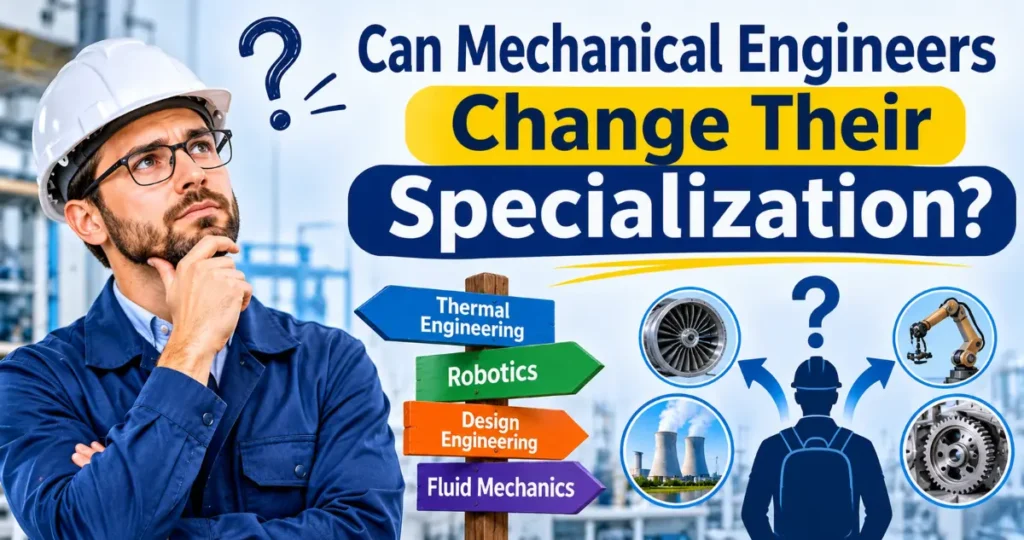
Yes. Mechanical engineers can change their professional focus as they gain experience, develop new skills, and encounter different industrial opportunities.
For example, an engineer who begins in manufacturing may later move into quality engineering, project management, automation, or product development.
Similarly, someone working in maintenance may develop expertise in reliability engineering, equipment monitoring, vibration analysis, or industrial asset management.
Changing specialization may require additional training, relevant practical experience, postgraduate education, or knowledge of particular technologies.
The broad foundation of mechanical engineering can make it possible to move between related technical areas, although some specialist positions require substantial additional preparation.
Conclusion
Mechanical Engineering Specializations allow students and professionals to develop focused expertise in different areas of a broad engineering discipline.
From mechanical design, manufacturing, automotive, aerospace, and thermal engineering to robotics, renewable energy, materials, computational engineering, and biomedical applications, each specialization offers different technical challenges and practical opportunities.
The right choice depends on individual interests, academic strengths, available university programs, professional goals, and the technologies someone wants to work with.
Students should examine course structures, practical training, industry requirements, and future developments before selecting a particular area. They should also build strong foundations in mathematics, mechanics, materials, thermodynamics, fluid mechanics, and engineering design.
Ultimately, a mechanical engineering degree provides a broad foundation, while specialization helps individuals develop the knowledge and abilities required for their preferred technical direction.