
The early years of education play an important role in shaping how children communicate, explore ideas, build relationships and approach new challenges. From preschool through primary school, children develop at different rates and benefit from learning experiences that support their intellectual, social, emotional and physical growth.
For schools, providing a consistent and engaging educational experience requires more than a collection of classroom activities. Teachers need clear learning objectives, age-appropriate resources and practical ways to monitor progress. A thoughtfully designed curriculum can bring these elements together while giving educators enough flexibility to respond to individual children’s needs.
Understanding the Importance of Early Childhood Education
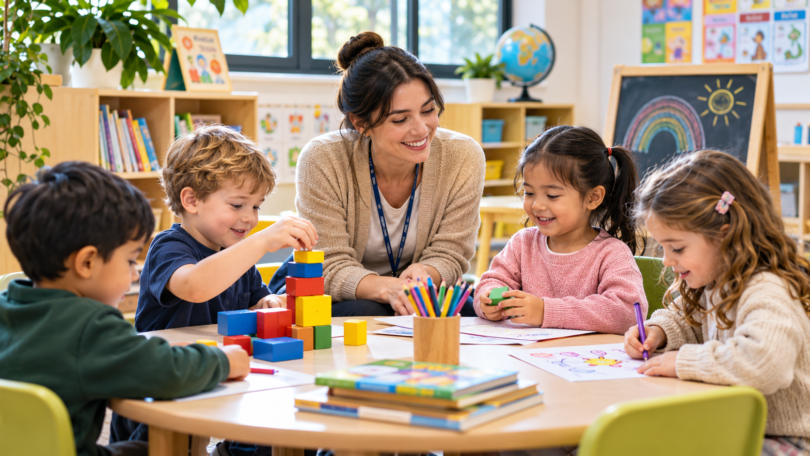
Young children learn through a combination of play, observation, interaction and guided activities. Everyday experiences such as listening to stories, building with blocks, drawing pictures and participating in group games can introduce important skills.
Early childhood education helps children develop several foundational abilities:
- Language and communication: Listening, speaking, storytelling and vocabulary development.
- Early numeracy: Recognising patterns, counting, comparing quantities and exploring basic mathematical concepts.
- Social development: Sharing, cooperating, taking turns and understanding other people’s feelings.
- Physical coordination: Developing fine motor skills through drawing, cutting, building and other practical activities.
- Creative thinking: Exploring music, art, movement and imaginative play.
- Independence: Making choices, solving simple problems and becoming more confident in everyday tasks.
These areas are closely connected. For example, a group building activity can encourage mathematical thinking while also developing communication, cooperation and problem-solving skills.
What Makes an Effective Preschool Curriculum?
A strong preschool curriculum should provide structure without making learning unnecessarily rigid. Teachers need a clear understanding of what children are expected to explore, but they should also be able to adapt activities to suit different abilities, interests and learning styles.
Several features are particularly valuable.
Age-Appropriate Learning Objectives
Activities should reflect children’s developmental stages. Younger children may benefit from sensory exploration, movement and simple interactions, while older preschoolers may be ready for more structured language, numeracy and problem-solving activities.
Learning objectives help teachers select suitable experiences and understand the purpose behind each activity.
Learning Through Play
Play is an essential part of early childhood education. It allows children to experiment, practise new skills and make connections between ideas.
A well-planned curriculum incorporates both child-led exploration and teacher-guided activities. This balance gives children opportunities to discover things independently while ensuring that important learning goals are addressed.
Consistency Across Learning Areas
Children benefit when different subjects and experiences reinforce one another. A lesson about animals, for instance, might include reading a story, counting animal figures, creating artwork and discussing habitats.
An integrated approach makes learning more meaningful because children can connect ideas across different activities.
Supporting Learning Beyond Preschool
As children progress into primary education, their learning needs become more varied. They begin developing stronger reading, writing and mathematical abilities while exploring science, society, creative subjects and more complex relationships.
A curriculum that supports a wider age range can help schools maintain continuity during this transition.
Rather than treating each educational stage as completely separate, educators can build on skills children have already developed. This helps create a more coherent learning journey, although activities and expectations must still be adapted to children’s ages and individual progress.
For schools looking to organise learning across multiple age groups, the IPC Curriculum is an example of a structured educational framework designed for children from birth to age 12. A broad curriculum can help schools coordinate learning activities, planning and assessment across different stages of development.
The Role of Teachers in Delivering a Successful Curriculum
Even the most comprehensive curriculum depends on effective teaching. Educators interpret learning objectives, observe children’s responses and decide when to introduce new challenges or revisit earlier concepts.
Teachers also need to recognise that children do not all learn in the same way. Some may develop language skills quickly but need additional support with social interaction. Others may demonstrate strong practical abilities while requiring more time to become confident with early literacy.
Regular observation and assessment can help educators identify these differences. Rather than relying only on formal tests, teachers can use classroom discussions, children’s work, play-based observations and practical activities to understand progress.
Professional development is equally important. Training helps teachers explore new teaching strategies, improve classroom management and use curriculum resources more effectively.
How Technology Can Support Curriculum Planning
Technology is increasingly becoming part of school administration and lesson preparation. When used appropriately, digital tools can reduce repetitive tasks and help educators organise learning resources.
For example, digital curriculum platforms may provide:
- Ready-to-use classroom activities and lesson resources.
- Planning tools for organising weekly or term-based teaching.
- Assessment features for recording children’s progress.
- Communication tools for sharing relevant updates with parents.
- Resources that help teachers adapt activities to different learning needs.
Artificial intelligence can also assist with lesson planning by suggesting activities or helping educators organise ideas. However, AI-generated suggestions should always be reviewed by teachers to ensure they are age-appropriate, accurate and suitable for the children involved.
Technology should support professional judgement, not replace the relationships and observations that make early childhood education effective.
Building Strong Partnerships Between Schools and Parents
Children’s development is influenced by experiences both inside and outside the classroom. When parents and teachers communicate regularly, they can work together to support learning and reinforce positive habits.
Schools can help families stay involved by sharing information about classroom topics, discussing developmental progress and suggesting simple activities that children can enjoy at home.
For example, parents might encourage counting during everyday routines, read stories together or ask children to describe what they have learned during the school day.
Communication should be practical and constructive. Families need clear information about children’s progress, including their strengths and areas where additional support may be helpful.
Creating a Positive Foundation for Lifelong Learning
A successful curriculum does more than prepare children for the next school year. It helps them develop curiosity, confidence, communication skills and a willingness to explore unfamiliar ideas.
For schools, achieving this requires a thoughtful combination of structured learning objectives, engaging activities, skilled teachers, meaningful assessment and family involvement.
When these elements work together, children are better supported throughout their educational journey. A flexible, well-organised curriculum can give educators the tools to create consistent learning experiences while recognising that every child develops in their own way.