

Introduction
Choosing a medical branch after MBBS is one of the most important career decisions for a doctor in India. Salary, career growth, specialization opportunities, reputation, and job demand are important factors, but work-life balance is equally important for a sustainable medical career.
Some specialties involve frequent emergencies, night duties, unpredictable schedules, and intensive patient care. Others can provide more predictable working patterns, greater outpatient exposure, fewer emergency calls, or more flexibility in private practice.
So, which medical branch has the best work-life balance in India?
There is no single specialty that guarantees the same lifestyle for every doctor. However, Dermatology is often considered one of the strongest options for work-life balance, particularly because many dermatology careers are outpatient-focused and may involve fewer emergency duties than several acute-care specialties. A 2026 Indian cross-specialty study of 100 female doctors found significantly lower work-related stress and lower personal-life interference among dermatologists compared with the non-dermatology group.
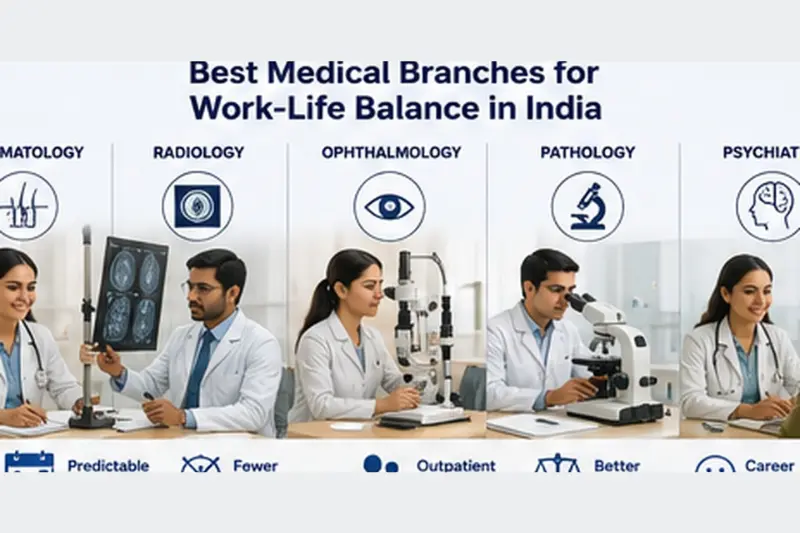
Other specialties that may offer comparatively favorable lifestyle patterns include Radiodiagnosis, Ophthalmology, Pathology, Psychiatry, and some outpatient-oriented careers. The actual experience depends on the hospital, city, patient volume, employment model, subspecialization, and individual career choices.
For a broader overview of postgraduate options, see Best MD Branches After MBBS in India.
What Does Work-Life Balance Mean for Doctors?
Work-life balance means having enough time and energy for professional responsibilities while maintaining personal, family, social, and recreational life.
For doctors, work-life balance can include:
- Predictable working hours
- Reasonable patient workload
- Fewer emergency calls
- Manageable night duties
- Sufficient family and personal time
- Opportunities for holidays and leave
- Lower risk of chronic occupational stress
- Flexibility in choosing a practice model
- Time for continuing education and professional development
Work-life balance does not mean working fewer hours all the time. A doctor can work hard and still have good balance if the schedule is predictable and compatible with personal priorities.
Research involving doctors in India has highlighted long working hours, insufficient rest, lack of family time, and workplace pressures as important contributors to work-life imbalance. A 2025 scoping review covering research on doctors in India reported that only about one-quarter achieved good work-life balance across the studies reviewed.
Which Medical Branch Has the Best Work-Life Balance in India?
If work-life balance is your primary career priority, Dermatology is one of the strongest choices to consider. However, Radiodiagnosis, Ophthalmology, Pathology, and Psychiatry can also provide attractive lifestyle characteristics depending on the practice setting.
The following specialties should not be treated as an absolute ranking. Instead, they represent branches that may offer better lifestyle characteristics than highly emergency-intensive specialties in certain career settings.
1. Dermatology
Dermatology is frequently associated with favorable work-life balance because much of the work can be outpatient-based.
Dermatologists diagnose and treat conditions involving the skin, hair, nails, and related structures. Many consultations can be scheduled during regular clinic hours, and the specialty generally has fewer emergency situations than branches such as Emergency Medicine, General Medicine, Anesthesiology, or Obstetrics and Gynaecology.
A recent Indian study published in the Indian Journal of Dermatology, Venereology and Leprology compared 50 female dermatologists with 50 doctors from other specialties. Dermatologists had significantly lower personal-life interference from work and lower work-related stress scores. The researchers concluded that the dermatologists in their sample experienced better work-life balance, while also noting the study’s small sample size and limitations.
Dermatology can also provide flexibility through different career models, including hospitals, outpatient clinics, private practice, academic medicine, and selected cosmetic or procedural services.
Why Dermatology Can Offer Good Work-Life Balance
- Large outpatient component
- Generally fewer emergency calls
- More predictable clinic schedules in many settings
- Private-practice opportunities
- Possibility of flexible consultation hours
- Strong patient follow-up component
- Opportunities in medical and procedural dermatology
However, dermatology is not automatically stress-free. Doctors may face high patient volumes, administrative responsibilities, business pressures, and the demands of running a private clinic.
For a detailed comparison of MD specialties, read Best MD Branches After MBBS in India.
2. Radiodiagnosis
Radiodiagnosis can be attractive to doctors who prefer technology-driven diagnostic work and relatively structured working environments.
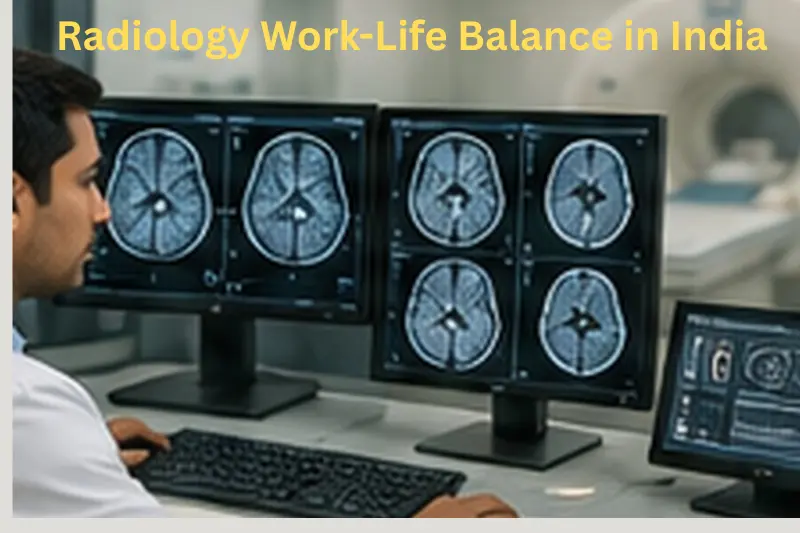
Radiologists interpret imaging studies such as X-rays, ultrasound, CT, and MRI. The specialty involves close collaboration with clinicians and can be highly technology-intensive.
The lifestyle can vary considerably. A radiologist working in a scheduled diagnostic center may have a different routine from one working in a major tertiary-care hospital where emergency imaging is required around the clock.
Teleradiology and digital imaging have also created additional models of work, although availability and suitability depend on the individual career setting.
Why Radiodiagnosis May Offer Good Work-Life Balance
- Strong technology-based workflow
- Less continuous bedside care than many clinical specialties
- Potential for structured reporting schedules
- Opportunities in diagnostic centers
- Possibility of teleradiology in suitable roles
- Limited physical patient handling compared with many procedural specialties
Emergency radiology and interventional radiology can be considerably more demanding. Interventional radiology, in particular, involves procedures and patient-care responsibilities, so it should not automatically be grouped with the lifestyle of purely diagnostic radiology. Indian research has specifically examined work-family-health balance among interventional radiologists, highlighting that this subspecialty has its own workload and stress considerations.
3. Ophthalmology
Ophthalmology combines clinical consultations, diagnostic testing, procedures, and microsurgery.
It can offer a relatively structured lifestyle in many practice settings, particularly when doctors develop outpatient and elective surgical practices.
An Indian survey of 297 ophthalmologists found that more than half of respondents reported career satisfaction, while 26.94% said they were satisfied but wished they had more time for family. About one-quarter of respondents reported burnout. The researchers nevertheless concluded that Indian ophthalmologists had personally and professionally satisfying careers with relatively low burnout.

Why Ophthalmology Can Be Attractive for Work-Life Balance
- Large outpatient component
- Many elective procedures
- Opportunities for private practice
- Combination of clinical and surgical work
- Potential for scheduled surgical lists
- Possibility of building a specialized practice
Work-life balance can change when ophthalmologists work in high-volume hospitals, emergency eye services, or demanding academic environments.
4. Pathology
Pathology is another specialty worth considering for doctors who prefer diagnostic science, laboratory medicine, microscopy, and analytical work rather than continuous bedside care.
Pathologists examine tissues, cells, blood, and other specimens to help diagnose diseases. Their work is essential to modern healthcare even though direct patient interaction may be lower than in many clinical specialties.

Why Pathology May Offer Lifestyle Advantages
- Laboratory-based work
- Generally less emergency bedside responsibility
- Structured diagnostic workflow in many settings
- Opportunities in hospitals and diagnostic laboratories
- Academic and research opportunities
- Potential for private diagnostic practice
However, pathology also has workload pressures. Diagnostic accuracy carries significant responsibility, and high-volume laboratories can be demanding. A review of pathologists’ professional lifestyle has discussed occupational stress, burnout, working conditions, and the need to improve professional well-being.
Therefore, Pathology may provide a different type of work-life balance rather than simply an easier career.
5. Psychiatry
Psychiatry can be attractive to doctors who prefer consultation-based medicine, detailed communication, and long-term patient relationships.
Psychiatrists evaluate and treat mental and behavioral health conditions. Much of the work involves scheduled consultations, clinical interviews, diagnosis, counseling, medication management, and follow-up.
Potential Lifestyle Benefits
- Consultation-based practice
- Scheduled follow-up appointments
- Opportunities for outpatient practice
- Possibility of flexible private practice
- Less operative workload
- Strong scope for long-term patient relationships

However, Psychiatry should not be considered automatically low-stress. Mental health professionals can experience emotional demands, complex cases, high patient loads, and burnout.
An Indian study involving 101 mental health professionals at a tertiary neuropsychiatry center found average-to-below-average work-life balance among 64% of participants and identified job nature, income, family situation, stress, and psychological distress as important factors.
This is an important reminder that the nature of a specialty alone does not determine work-life balance.
For comparison with other postgraduate pathways, see MD vs MS: Which Is Better After MBBS in India?.
Work-Life Balance Comparison of Medical Branches
| Medical Branch | Emergency Work | Schedule Predictability | Patient Interaction | Work-Life Balance Potential |
|---|---|---|---|---|
| Dermatology | Low in many settings | High | High | Excellent |
| Radiodiagnosis | Low–Moderate | Moderate–High | Low–Moderate | Very Good |
| Ophthalmology | Low–Moderate | High | High | Very Good |
| Pathology | Low | High in many settings | Low | Very Good |
| Psychiatry | Low–Moderate | High in outpatient settings | High | Good |
| Family Medicine | Low–Moderate | Moderate–High | Very High | Good |
| General Medicine | Moderate–High | Moderate | Very High | Moderate |
| Pediatrics | Moderate–High | Moderate | Very High | Moderate |
| Anesthesiology | High | Variable | Moderate | Challenging |
| Emergency Medicine | Very High | Low–Moderate | High | Challenging |
| Obstetrics & Gynaecology | High | Low–Moderate | High | Challenging |
This table is a practical comparison rather than a formal national ranking. Workload can change substantially according to the hospital, location, patient volume, seniority, and practice model.
For a wider list of branches and pathways, read Medical Branches List After NEET in India: Courses & Career Options.
Why Dermatology Often Ranks Highly for Work-Life Balance
Dermatology stands out because its typical outpatient structure can make schedules more predictable.
Many dermatology consultations are planned rather than emergency-driven. A doctor may be able to organize appointments, procedures, follow-ups, and administrative tasks within defined clinic hours.
The specialty can also offer several career models. A dermatologist may work in a hospital, join a clinic, establish private practice, teach, conduct research, or combine clinical and procedural dermatology.
The 2026 Indian study provides useful supporting evidence, although it should not be interpreted as proof that every dermatologist has better work-life balance than every other specialist. The study was limited to 100 female doctors and acknowledged regional and sampling limitations.
Work-life balance should therefore be considered a potential advantage of Dermatology, not a guaranteed outcome.

Which Medical Branches Have Fewer Emergency Duties?
Emergency responsibility is one of the strongest factors affecting lifestyle.
Branches such as Emergency Medicine, Anesthesiology, Obstetrics & Gynaecology, General Medicine, and some surgical specialties can involve significant emergency responsibilities.
By contrast, many outpatient-oriented careers can provide more predictable schedules.
Dermatology, Ophthalmology, Psychiatry, Pathology, and non-emergency diagnostic roles in Radiology may offer fewer routine emergency demands in particular practice settings.
However, hospitals with 24-hour emergency services may require specialists from many branches to participate in on-call duties.
Which Medical Branch Is Best for a Predictable Schedule?
A predictable schedule is particularly valuable for doctors who prioritize family time, personal commitments, travel, hobbies, or a structured daily routine.
Dermatology, Pathology, Ophthalmology, Psychiatry, and some Radiodiagnosis roles can provide more predictable schedules depending on the employment setting.
Outpatient private practice can offer additional control over appointment timings, but running a private practice also introduces administrative, financial, staffing, and business responsibilities.
A predictable schedule therefore does not necessarily mean a stress-free career.
Which Medical Branch Is Best for Family Life?
Doctors who prioritize family life should examine more than working hours.
Important factors include:
- Number of night duties
- Frequency of emergency calls
- Weekend responsibilities
- Ability to take planned leave
- Patient volume
- Commute
- Practice location
- Flexibility after specialization
- Administrative workload
- Emotional demands of the specialty
A branch with fewer night duties may still be stressful if patient volume is extremely high.
Similarly, a specialty with occasional emergencies may still provide excellent balance if the overall schedule is predictable.
For additional guidance on selecting a specialty, see How to Choose a Medical Branch After MBBS.
Which Medical Branch Has the Least Stress?
There is no medical branch that can honestly be described as stress-free.
Stress can arise from different sources:
Clinical Stress: Complex diagnoses, difficult cases, and treatment decisions.
Emergency Stress: Unexpected deterioration, night calls, and urgent procedures.
Administrative Stress: Documentation, staffing, scheduling, and management responsibilities.
Emotional Stress: Dealing with suffering, chronic illness, death, or difficult conversations.
Financial Stress: Practice expenses, employment uncertainty, or business responsibilities.
Academic Stress: Research, teaching, examinations, publications, and professional development.
The best branch for stress management depends on which type of pressure you personally handle well.
Does Work-Life Balance Change After Residency?
Yes. Residency and independent practice can be very different.
During postgraduate training, residents work within institutional schedules and clinical responsibilities. The NMC’s postgraduate regulatory framework establishes structured training requirements for postgraduate medical education, while actual duty patterns depend on the institution and specialty. The current NMC framework includes the Post-Graduate Medical Education Regulations, 2023 and related standards.
After residency, doctors may have more control over their work environment and career model.
A specialist can potentially move into:
- Private practice
- Hospital employment
- Academic medicine
- Government service
- Diagnostic centers
- Corporate healthcare
- Research
- Telemedicine
- Subspecialty practice
This means a demanding residency does not necessarily predict the exact lifestyle a doctor will have later.
Work-Life Balance During MD and MS Residency
Students should be careful when choosing a specialty purely because they expect excellent work-life balance after residency.
The residency period can be demanding even in specialties that later offer more flexible careers.
The NMC’s postgraduate framework emphasizes structured postgraduate training, competency development, clinical responsibilities, academic activities, and professional development.
Therefore, students should separately evaluate:
- Residency workload
- Post-residency workload
- Emergency duties
- Long-term practice flexibility
- Career growth
- Income potential
- Personal interests
A specialty can have a demanding residency but offer greater flexibility later.
For comparison of surgical options, read Best MS Branches in India: Scope, Career & Future Prospects.
How Hospital Type Affects Work-Life Balance
The same specialty can feel completely different in different hospitals.
A specialist in a large tertiary-care government hospital may see a high patient volume and manage complex cases. A specialist in a private outpatient clinic may have fewer patients and more predictable appointments.
Corporate hospitals can have structured systems but may also involve administrative and productivity expectations.
Academic institutions combine clinical responsibilities with teaching, research, examinations, conferences, and administrative activities.
Therefore, when evaluating a branch, do not ask only:
“Is this specialty good for work-life balance?”
Ask:
“What type of workplace would allow me to practice this specialty with the lifestyle I want?”
How Private Practice Can Improve Flexibility
Private practice can provide greater control over working hours.
A doctor may choose:
- Clinic opening hours
- Appointment duration
- Number of patients
- Days of operation
- Location
- Services offered
- Staff structure
However, private practice also comes with responsibilities that employed doctors may not have.
These include rent, equipment, staff management, marketing, compliance, patient acquisition, accounting, and business decisions.
Therefore, private practice can increase flexibility but does not automatically reduce workload.
Work-Life Balance vs Salary
One of the biggest mistakes medical students make is choosing a specialty based entirely on salary.
A higher earning potential can be attractive, but income often comes with additional workload, specialization, patient volume, procedural responsibilities, business risks, or longer working hours.
A doctor should consider the relationship between:
Income + Working Hours + Stress + Career Satisfaction + Personal Time
A specialty with slightly lower earning potential but excellent personal satisfaction may be a better long-term choice than a high-income career that creates constant exhaustion.
For salary-focused comparisons, see Which Medical Branch Has Highest Salary in India.
How to Choose the Right Medical Branch for Work-Life Balance
If work-life balance is one of your main priorities, use a structured approach before choosing a branch.
Step 1: Identify Your Preferred Work Environment
Do you prefer:
- Hospital work?
- Outpatient clinic?
- Diagnostic center?
- Laboratory?
- Operating room?
- Academic institution?
- Private practice?
Your answer can immediately eliminate some specialties.
Step 2: Evaluate Emergency Responsibilities
Ask residents how often they receive night calls and emergency duties.
A specialty with frequent emergencies may be unsuitable if predictable personal time is your highest priority.
Step 3: Examine Patient Interaction
Some doctors love continuous patient interaction. Others prefer diagnostic or laboratory work.
Choose according to your personality and professional preferences.
Step 4: Consider Long-Term Practice Options
Look beyond residency. Determine whether the specialty allows hospital employment, private practice, academic careers, research, or other flexible options.
Step 5: Talk to Practicing Specialists
Online articles can provide general information, but conversations with residents and practicing doctors can reveal the realities of daily work.
Ask about actual working hours, emergency duties, patient load, weekend work, leave, administrative pressure, and career flexibility.
Step 6: Compare Your Priorities
Create a simple scorecard for:
- Work-life balance
- Income
- Career growth
- Patient interaction
- Emergency duties
- Private practice
- Technology
- Research
- Teaching
- Long-term interest

The best specialty is the one that performs well across your personal priorities.
MD vs MS: Which Offers Better Work-Life Balance?
There is no universal answer.
Some MD specialties may offer comparatively predictable lifestyles, while several MS specialties involve surgical procedures, emergency responsibilities, and longer or less predictable working hours.
However, even within MD, lifestyle varies significantly. Dermatology, Psychiatry, Pathology, and selected Radiodiagnosis careers can have different schedules from General Medicine or Emergency Medicine.
Within MS, Ophthalmology may provide a different lifestyle from General Surgery or Obstetrics & Gynaecology.
The correct comparison is therefore specialty versus specialty, not simply MD versus MS.
For a detailed qualification comparison, see MD vs MS: Which Is Better After MBBS in India?.
Best Medical Branches for Work-Life Balance: Practical Ranking
If lifestyle is the primary criterion, a practical shortlist could look like this:
1. Dermatology — Excellent potential for predictable outpatient work and flexible practice.
2. Radiodiagnosis — Strong technology-oriented career with potentially structured schedules, depending on the role.
3. Ophthalmology — Combination of outpatient care and elective procedures with good practice flexibility.
4. Pathology — Laboratory-focused career with comparatively limited routine emergency bedside work.
5. Psychiatry — Consultation-based career with opportunities for scheduled outpatient practice.
6. Family Medicine — Potential for structured primary-care practice and long-term patient relationships.
This is not an official ranking and should not be interpreted as a guarantee. Individual doctors may experience completely different levels of workload within the same specialty.
Frequently Asked Questions
Which medical branch has the best work-life balance in India?
Dermatology is one of the strongest choices to consider for work-life balance because many careers are outpatient-focused and may involve fewer emergency duties. Radiodiagnosis, Ophthalmology, Pathology, and Psychiatry can also offer favorable lifestyle characteristics depending on the practice setting.
Is Dermatology the best branch for work-life balance?
Dermatology can be an excellent option for doctors prioritizing work-life balance, particularly in outpatient and private-practice settings. However, no specialty guarantees a particular lifestyle.
Is Radiology good for work-life balance?
Radiodiagnosis can provide a structured, technology-focused career and may offer good work-life balance in certain settings. Emergency imaging, hospital on-call duties, and interventional radiology can create higher workloads.
Is Ophthalmology good for work-life balance?
Ophthalmology can provide good work-life balance because it combines scheduled outpatient consultations with many elective procedures. Workload still depends on the hospital, surgical volume, and practice model.
Is Pathology good for work-life balance?
Pathology can offer a comparatively structured career for doctors who prefer laboratory-based diagnostic work. However, high-volume laboratories and diagnostic responsibilities can still be demanding.
Is Psychiatry a low-stress medical branch?
Psychiatry may provide predictable outpatient schedules in some settings, but it is not stress-free. Emotional demands, complex cases, patient volume, and workplace conditions can influence stress and burnout.
Which medical branch has fewer night duties?
Outpatient-oriented and laboratory-based roles may have fewer routine night duties, but the actual schedule depends on the institution and employment model.
Which medical branch is best for family life?
Dermatology, Ophthalmology, Pathology, Psychiatry, and some Radiodiagnosis roles can provide favorable conditions for family life, particularly when the practice has predictable hours.
Which medical branch is best for private practice?
Several specialties can support private practice. Dermatology, Ophthalmology, Psychiatry, Family Medicine, and General Medicine can provide different private-practice models. Success depends on location, expertise, patient demand, reputation, and ethical professional practice.
Should I choose a medical branch only for work-life balance?
No. Work-life balance should be one major factor, not the only factor. Clinical interest, career goals, income expectations, training quality, patient interaction, future opportunities, and personal strengths should also influence the decision.
Conclusion
So, which medical branch has the best work-life balance in India?
There is no universal answer, but Dermatology is one of the strongest choices for doctors who prioritize lifestyle and predictable working patterns. Recent Indian evidence also provides support for comparatively better work-life balance among dermatologists in the studied group.
Radiodiagnosis, Ophthalmology, Pathology, and Psychiatry are other specialties worth considering when work-life balance is an important career objective.
The most important point is that specialty alone does not determine lifestyle. Hospital type, city, patient volume, emergency duties, private practice, seniority, subspecialization, and personal career decisions can significantly change a doctor’s daily routine.
A successful medical career should provide more than professional achievement. It should also allow enough time for health, family, personal interests, relationships, and long-term well-being.
Before choosing a branch after MBBS, compare the actual work involved, speak with residents and practicing specialists, review current postgraduate regulations, and consider how the specialty fits your own definition of a fulfilling life.
For official postgraduate medical education information, consult the National Medical Commission’s current rules and regulations. The NMC currently lists the Post-Graduate Medical Education Regulations, 2023 and related postgraduate standards.