
Introduction
Mechanical engineering positions offer opportunities to design machines, improve manufacturing processes, maintain industrial equipment, develop energy systems, and solve technical problems across different industries. From automotive manufacturing and aerospace to renewable energy, robotics, marine engineering, and heating, ventilation, and air conditioning (HVAC), mechanical engineering professionals contribute to technologies used worldwide.
The range of available positions depends on education, practical experience, technical skills, industry requirements, and the country in which someone intends to work. Some professionals focus on computer-based design, while others supervise production lines, inspect machinery, test prototypes, or manage engineering projects. Therefore, understanding individual job titles can help students, graduates, and experienced professionals choose a suitable career direction.
If you are exploring this field for the first time, start with What Is Mechanical Engineering? to understand its fundamental principles and applications. You can also read Mechanical Engineering Scope: Career, Jobs, Industries & Future for a broader overview of the profession.
This guide explains 15 common mechanical engineering positions, their responsibilities, qualifications, technical terminology, and opportunities in the United States, India, and other international markets.
What Are Mechanical Engineering Positions?
Mechanical engineering positions are professional roles involving the design, development, analysis, testing, manufacturing, installation, maintenance, or management of mechanical and thermal systems. These positions exist in engineering consultancies, factories, automotive companies, power plants, construction projects, aerospace organizations, research laboratories, and many other workplaces.
For example, a mechanical design engineer develops components and assemblies, whereas a maintenance engineer works to keep equipment reliable and operational. Similarly, a production engineer improves manufacturing efficiency, while a thermal engineer evaluates heat transfer, cooling systems, and energy performance.
Although these professionals share a foundation in mathematics, physics, mechanics, and engineering design, their everyday responsibilities can differ considerably.
A job title also does not always describe exactly the same work at every company. One employer may use the title mechanical project engineer for someone who coordinates equipment installation, while another may assign that professional responsibility for design reviews, budgets, schedules, and technical documentation. Consequently, applicants should examine job descriptions instead of relying on titles alone.
15 Common Mechanical Engineering Positions
1. Mechanical Design Engineer
A mechanical design engineer develops mechanical components, products, assemblies, and equipment. Typical projects include gears, shafts, pumps, compressors, machine frames, automotive components, industrial tools, and consumer products.
These professionals create engineering drawings, select materials, calculate dimensions, evaluate tolerances, and check whether a design meets performance and safety requirements. They may also work with manufacturing teams to ensure that components can be produced economically and assembled correctly.
Computer-Aided Design (CAD) software is central to many design positions. Engineers may use tools such as SolidWorks, Autodesk Inventor, CATIA, or Siemens NX, depending on the employer and industry.
A bachelor’s degree in mechanical engineering is commonly preferred for engineer-level positions. Employers may also consider relevant experience, design portfolios, internships, and practical software proficiency.
2. Mechanical Project Engineer
Mechanical project engineers coordinate technical activities involved in engineering projects. Their responsibilities can include equipment specifications, technical reviews, contractor coordination, installation planning, procurement support, progress monitoring, and project documentation.
For example, a project engineer working on an industrial plant may coordinate the installation of pumps, compressors, piping-related equipment, and ventilation systems. The engineer must ensure that technical requirements align with project schedules, approved specifications, and applicable safety standards.
Project management knowledge is valuable because these positions often require communication with clients, suppliers, technicians, contractors, and other engineering disciplines. Experience with scheduling tools, cost tracking, risk assessment, and reporting can improve an applicant’s prospects.
This position may suit mechanical engineers who enjoy organizing complex tasks and working with multidisciplinary teams rather than concentrating exclusively on design calculations.
3. Mechanical Maintenance Engineer
A mechanical maintenance engineer helps maintain the reliability and availability of machinery and industrial equipment. Typical responsibilities include inspecting equipment, diagnosing failures, planning preventive maintenance, investigating recurring faults, and coordinating repairs.
Employers may operate pumps, compressors, turbines, conveyors, hydraulic systems, production machinery, or other mechanical assets. Maintenance engineers analyze symptoms such as abnormal vibration, overheating, leakage, unusual noise, excessive wear, and declining performance.
Predictive maintenance increasingly involves condition-monitoring technologies and data analysis. Vibration Analysis (VA), infrared thermography, oil analysis, and other inspection techniques can help identify developing problems before equipment fails.
Applicants may need a mechanical engineering degree or a relevant technical qualification, depending on the position. Knowledge of maintenance planning, equipment manuals, lubrication, bearings, alignment, and failure analysis is particularly useful.
4. Production Engineer
Production engineers improve the processes used to manufacture products and mechanical components. Their work involves production planning, machine utilization, workflow improvement, process troubleshooting, quality coordination, and waste reduction.
For example, a production engineer at an automotive factory may analyze why an assembly line repeatedly stops, investigate rejected components, or reorganize production steps to improve output. The objective is to produce reliable products while controlling costs, minimizing delays, and maintaining workplace safety.
Computer Numerical Control (CNC) machines, machining operations, assembly methods, industrial automation, and manufacturing documentation may feature prominently in this role.
Employers often seek candidates with knowledge of manufacturing processes, engineering drawings, measurement tools, and continuous improvement methods. Lean Manufacturing and Six Sigma training can also be beneficial, although specific requirements vary by employer.
5. Manufacturing Engineer
Manufacturing engineers focus on how products can be manufactured efficiently, consistently, and economically. While production engineers may concentrate on day-to-day output, manufacturing engineers frequently develop or improve the processes, tools, fixtures, and systems used to produce components.
Their responsibilities may include selecting manufacturing methods, designing fixtures, improving machining sequences, evaluating production equipment, and introducing automation. They also collaborate with design engineers to make products easier to manufacture and assemble.
Computer-Aided Manufacturing (CAM) software can help engineers plan machining operations and generate instructions for CNC equipment. Other useful technologies include robotics, additive manufacturing, metrology systems, and automated inspection equipment.
A degree in mechanical or manufacturing engineering is a common pathway. Practical knowledge of materials, machining, tooling, production planning, and quality assurance is also important.
6. Quality Control Engineer
A quality control engineer evaluates whether products, components, and manufacturing processes meet specified requirements. The work can involve inspections, measurements, test procedures, defect investigations, documentation, and corrective actions.
In mechanical manufacturing, a quality engineer may inspect machined components, investigate dimensional deviations, review supplier quality, or determine why a product repeatedly fails testing.
Computerized Measuring Machines, coordinate-measuring equipment, calibrated instruments, and statistical analysis may be used to verify product conformity. Quality professionals must also understand applicable standards and customer specifications.
Quality Control (QC) generally emphasizes inspection and verification, whereas Quality Assurance (QA) focuses more broadly on the systems and processes designed to prevent quality problems. Some employers combine these responsibilities under a single title.
Candidates benefit from knowledge of engineering drawings, geometric dimensioning and tolerancing, root-cause analysis, measurement systems, and quality management principles.
7. Thermal Engineer

Thermal engineers study heat transfer, temperature control, energy conversion, and the thermal performance of equipment. Their work may involve engines, boilers, heat exchangers, refrigeration systems, batteries, turbines, and industrial heating processes.
For example, a thermal engineer may evaluate why a machine overheats, improve the cooling performance of an electric vehicle battery, or calculate the heat-transfer requirements of an industrial process.
Thermodynamics, heat transfer, fluid mechanics, and numerical analysis provide the technical foundation for these positions. Engineers may use simulation software to predict temperature distributions and assess different design alternatives.
Thermal engineering opportunities exist in energy production, automotive technology, aerospace, electronics cooling, industrial processing, and building services.
8. HVAC Engineer
Heating, Ventilation, and Air Conditioning (HVAC) engineers design, evaluate, install, or improve systems that regulate indoor temperature, ventilation, humidity, and air quality.
Their projects may include commercial buildings, hospitals, factories, residential developments, laboratories, data centers, and industrial facilities. Responsibilities can include load calculations, equipment selection, duct design, ventilation assessment, energy analysis, commissioning, and troubleshooting.
Engineers must consider building requirements, operating conditions, energy consumption, maintenance access, and relevant regulations. Depending on the project, they may coordinate with architects, electrical engineers, plumbing specialists, and construction teams.
Knowledge of refrigeration cycles, psychrometrics, heating and cooling loads, ventilation standards, and HVAC design software is useful. Some positions require additional certifications or experience with local building codes.
9. Automotive Engineer
Automotive engineers develop, test, and improve vehicle systems and components. Mechanical engineering graduates may work on engines, transmissions, suspension systems, braking mechanisms, vehicle structures, thermal management, and manufacturing processes.
The automotive industry is also changing as manufacturers develop electric vehicles, hybrid powertrains, advanced battery cooling, lightweight structures, and more efficient production systems.
A mechanical engineer in this sector may analyze vehicle performance, investigate component failures, conduct durability tests, or coordinate prototype development. Computer-Aided Engineering (CAE), Finite Element Analysis (FEA), and Computational Fluid Dynamics (CFD) can support these activities.
Employers often value knowledge of materials, dynamics, thermodynamics, design software, testing methods, and manufacturing systems. Relevant internships and hands-on project experience can be especially useful for graduates.
10. Aerospace Mechanical Engineer
Aerospace mechanical engineers contribute to the design, analysis, testing, and maintenance of mechanical systems used in aircraft, spacecraft, propulsion equipment, and associated ground systems.
Their work may involve thermal control, structural components, mechanisms, fluid systems, landing gear, manufacturing processes, or engine-related equipment. Engineers must work within demanding performance, reliability, weight, and safety requirements.
FEA can help evaluate structural stresses, while CFD can be used to investigate airflow, cooling, and fluid behavior. Engineers may also participate in environmental testing, vibration analysis, failure investigations, and design verification.
A mechanical engineering degree can provide a suitable foundation for many roles, although specialized positions may require aerospace knowledge, advanced qualifications, security clearance, or country-specific eligibility.
11. Robotics and Automation Engineer
Robotics and automation engineers develop or integrate systems that use machines, sensors, actuators, and control technologies to perform tasks with limited manual intervention.
Mechanical engineering professionals in this area may design robotic mechanisms, select motors and gearboxes, improve machine motion, develop automated assembly equipment, or support industrial robot installation.
The work combines mechanical design with control engineering, electronics, software, and manufacturing knowledge. Programmable Logic Controllers (PLCs), Computer Numerical Control (CNC), sensors, actuators, and industrial communication systems are common concepts in many automation environments.
Mechanical engineers can enter this field by developing additional skills in robotics, mechatronics, motion control, simulation, and industrial automation. Practical projects involving robotic arms, automated fixtures, or production equipment can demonstrate relevant competence.
12. Research and Development Engineer
Research and Development (R&D) engineers investigate new technologies, develop prototypes, evaluate concepts, and improve existing products or systems.
Their work may involve testing advanced materials, developing energy-efficient machinery, studying new manufacturing methods, improving mechanical performance, or evaluating emerging technologies.
Unlike some production-focused positions, R&D work can involve greater uncertainty because the outcome of an experiment or design investigation may not be known in advance. Engineers must develop test plans, analyze results, document findings, and revise their approaches when evidence does not support the original hypothesis.
A bachelor’s degree may be sufficient for certain applied engineering roles. Research-intensive positions can require a master’s degree, PhD, specialized expertise, or experience with laboratory testing and numerical simulation.
13. Reliability Engineer
Reliability engineers study how equipment performs over time and how failures can be prevented or reduced. Their work is important in power generation, manufacturing, transportation, process industries, and other environments where equipment failure can cause significant downtime or safety concerns.
Responsibilities may include failure analysis, reliability calculations, maintenance strategy development, component life assessment, and the identification of recurring equipment problems.
Failure Mode and Effects Analysis (FMEA) is a structured method used to identify possible failures, assess their effects, and prioritize preventive actions. Other methods may include Root Cause Analysis (RCA), Reliability-Centered Maintenance (RCM), and condition monitoring.
Mechanical engineers interested in this career should understand materials, fatigue, wear, lubrication, rotating equipment, statistical reasoning, and maintenance practices.
14. Sales and Application Engineer
Sales engineers and application engineers help customers identify technical products or systems that meet their requirements. In mechanical industries, these products may include pumps, compressors, motors, bearings, hydraulic equipment, industrial tools, and manufacturing machinery.
Application engineers often focus on selecting or configuring equipment for a particular use, preparing technical proposals, evaluating performance requirements, and supporting installation or troubleshooting. Sales engineers may also manage customer relationships, explain product benefits, and coordinate commercial discussions.
These roles combine engineering knowledge with communication, problem-solving, and customer service. They can suit professionals who enjoy understanding technical problems and explaining practical solutions.
A mechanical engineering qualification is useful for many positions, although employers may also accept relevant technical experience. Knowledge of product specifications, sizing calculations, technical documentation, and customer requirements is valuable.
15. Mechanical Engineering Manager
Mechanical engineering managers supervise engineering teams, coordinate technical projects, allocate resources, and help ensure that engineering work meets organizational objectives.
Their responsibilities may include design reviews, staffing decisions, project planning, budget management, quality oversight, performance evaluation, and coordination with senior management or clients.
Unlike entry-level engineering roles, management positions generally require substantial practical experience and evidence of leadership. Some employers prefer candidates with project management qualifications or postgraduate business education, but requirements differ.
A successful engineering manager needs technical judgment, communication skills, decision-making ability, and an understanding of commercial priorities. The role may be a long-term career goal for engineers who want to combine technical expertise with team leadership.
Mechanical Engineering Positions by Experience Level
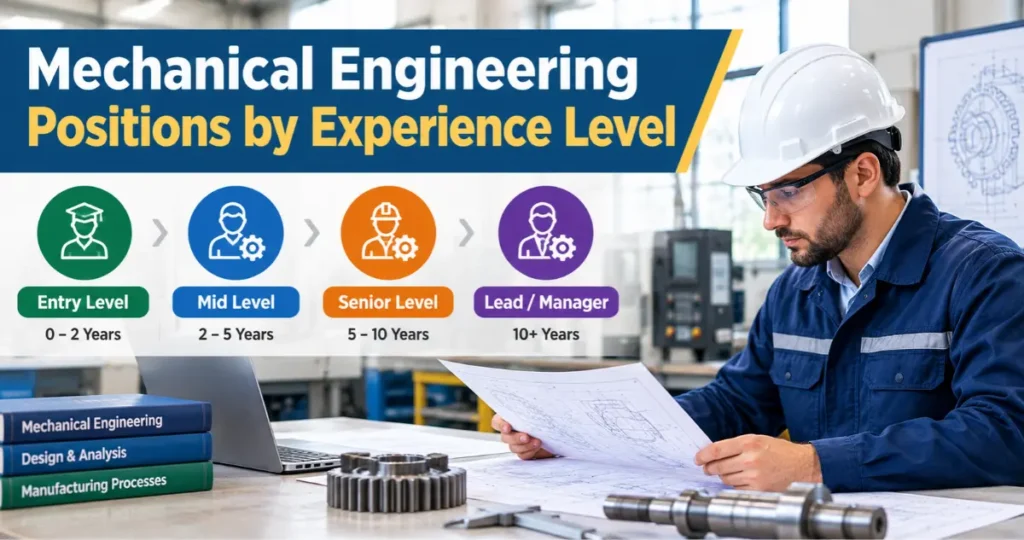
The right job title depends partly on professional experience. Employers use different naming conventions, but the following categories provide a useful starting point.
Entry-level positions may include Graduate Mechanical Engineer, Junior Design Engineer, Trainee Production Engineer, Maintenance Engineer Trainee, CAD Engineer, and Engineering Technician. These roles help candidates develop practical knowledge under appropriate supervision.
Mid-level positions may include Mechanical Design Engineer, Project Engineer, Manufacturing Engineer, Reliability Engineer, HVAC Engineer, and Quality Engineer. Professionals at this stage may manage individual work packages, solve complex technical problems, or coordinate smaller projects.
Senior positions can include Senior Mechanical Engineer, Lead Design Engineer, Principal Engineer, Engineering Project Manager, and Mechanical Engineering Manager. These roles often involve technical authority, mentoring, risk management, client coordination, and major project responsibilities.
Applicants should remember that titles are not standardized globally. A senior engineer at one company may have responsibilities similar to a lead engineer at another. Reviewing the stated duties, experience requirements, and reporting structure is therefore more useful than judging a vacancy by title alone.
Mechanical Engineering Positions in the United States
The United States offers mechanical engineering opportunities in manufacturing, engineering services, transportation equipment, research and development, energy systems, aerospace, and other industries.
According to the U.S. Bureau of Labor Statistics Occupational Outlook Handbook, mechanical engineers typically need a bachelor’s degree in mechanical engineering or mechanical engineering technology. The agency’s published 2025–2035 projections anticipate employment growth of 11% for mechanical engineers, with approximately 17,800 openings annually on average over that period.
These figures describe the U.S. mechanical engineer occupation as a whole, rather than the number of vacancies for every individual job title. Actual opportunities vary by state, industry, employer, experience level, and economic conditions.
Applicants can explore official occupation information, qualifications, and employment statistics through the Bureau of Labor Statistics and O*NET Online. Job searches can also include employer career pages, university career services, engineering recruiters, and professional networks.
Some positions, particularly those involving public engineering services, government contracts, or regulated industries, may have additional licensing, citizenship, security, or eligibility requirements. Applicants should check the conditions for each role.
Mechanical Engineering Positions in India
India has mechanical engineering opportunities across automotive manufacturing, industrial machinery, infrastructure, power generation, engineering services, consumer products, manufacturing technology, and research.
Common job titles include Graduate Engineer Trainee (GET), Mechanical Design Engineer, Production Engineer, Maintenance Engineer, Quality Engineer, Project Engineer, HVAC Engineer, and Manufacturing Engineer.
Graduate Engineer Trainee programs are particularly relevant to recent graduates. Depending on the employer, these programs may combine classroom instruction, plant rotations, supervised assignments, and practical engineering work.
Candidates can search company career pages, engineering recruitment platforms, professional networks, and official government recruitment notices. Public-sector opportunities may be available through relevant organizations and recruitment processes, depending on the position and current vacancies.
A degree in mechanical engineering is commonly required for engineer-level jobs, but eligibility varies. Certain technical positions may accept a diploma, while research, specialist, or leadership roles can require postgraduate qualifications or substantial experience.
Practical knowledge of CAD software, manufacturing processes, maintenance, quality systems, technical drawing, and industrial safety can strengthen an application. Internships, final-year projects, workshops, and relevant training can also help candidates demonstrate their abilities.
Mechanical Engineering Positions in Other Countries
Beyond the United States and India, mechanical engineers work in Canada, the United Kingdom, Australia, Germany, the United Arab Emirates, Saudi Arabia, Singapore, and many other markets.
International opportunities may be concentrated in manufacturing, automotive engineering, energy, construction, marine industries, industrial maintenance, aerospace, and engineering consultancy. However, the mix of available jobs differs by country and region.
In the Middle East, for example, some mechanical engineering roles are associated with industrial facilities, energy projects, building services, equipment maintenance, and construction. European markets include opportunities in advanced manufacturing, automotive technology, industrial automation, energy efficiency, and research.
Candidates considering international employment should review local qualification-recognition rules, work authorization, language requirements, professional registration, and employer sponsorship policies. Experience that is valuable in one country may need additional documentation or assessment elsewhere.
For globally focused job searches, use the precise job title alongside the country or city. Search terms such as “mechanical design engineer jobs in Germany” or “maintenance engineer vacancies in the UAE” can produce more relevant results than a broad search alone.
Qualifications Required for Mechanical Engineering Positions
Many engineer-level positions require a bachelor’s degree in mechanical engineering or a closely related discipline. Nevertheless, education requirements vary according to the nature of the job, the employer, and local regulations.
A mechanical engineering degree commonly covers engineering mathematics, mechanics, thermodynamics, fluid mechanics, materials science, machine design, manufacturing, and engineering analysis. These subjects provide the foundation for understanding how mechanical systems behave and how they can be designed or improved.
For a more detailed explanation of the academic pathway, read Mechanical Engineering Subjects: Complete Guide to Core, Elective & Practical Courses.
A diploma or associate-level qualification may be suitable for certain technician, drafting, maintenance, and manufacturing-support roles. Specialized positions in research, advanced simulation, or academic engineering may require postgraduate education.
Professional licensing is another consideration. In the United States, entry-level mechanical engineering jobs do not universally require a Professional Engineer (PE) license, although licensing can be necessary for particular responsibilities, especially when offering regulated engineering services to the public. Requirements differ by state and type of work.
In India and other countries, applicants should verify whether the specific role requires professional registration, statutory qualifications, industry certifications, or other credentials. Never assume that one country’s licensing rules apply worldwide.
Essential Skills for Mechanical Engineering Positions
Technical knowledge is only one part of a successful engineering career. Employers also look for skills that help candidates solve problems, communicate clearly, and work effectively with colleagues.
Computer-Aided Design (CAD) is useful for mechanical design, drafting, product development, and equipment engineering. Computer-Aided Engineering (CAE) supports analysis and simulation, while Computer-Aided Manufacturing (CAM) helps connect digital designs with production processes.
Computational Fluid Dynamics (CFD) is used to investigate fluid flow and heat transfer, whereas Finite Element Analysis (FEA) helps evaluate structural, thermal, and other engineering problems. The importance of each tool depends on the job.
Other valuable capabilities include technical drawing interpretation, materials selection, engineering calculations, troubleshooting, data analysis, quality control, project documentation, and an understanding of workplace safety.
Communication is equally important. Mechanical engineers often explain technical findings to manufacturing teams, customers, managers, suppliers, and professionals from other disciplines. Clear reports and accurate documentation can prevent costly misunderstandings.
Problem-solving, teamwork, adaptability, and continuous learning are especially valuable as industries introduce new software, manufacturing methods, automation systems, and energy technologies.
Mechanical Engineering Abbreviations, Initialisms, and Acronyms
Mechanical engineering professionals frequently encounter abbreviations, initialisms, and acronyms in job descriptions, engineering drawings, technical specifications, software documentation, maintenance reports, and manufacturing instructions.
Although these terms are sometimes used interchangeably, they have distinct meanings. An abbreviation is a shortened form of a word or phrase. An initialism uses initial letters pronounced separately, while an acronym is formed from initial letters or word parts and pronounced as a word. Technical usage can vary, so context matters.
The following examples are particularly relevant when applying for or working in mechanical engineering positions.
CAD — Computer-Aided Design: Software used to create, modify, and document engineering drawings and three-dimensional models. It is especially relevant to mechanical design and product development positions.
CAE — Computer-Aided Engineering: Computer-based engineering analysis and simulation tools used to evaluate designs and predict performance.
CAM — Computer-Aided Manufacturing: Technologies that support manufacturing planning and the production of components, including workflows involving CNC machines.
CFD — Computational Fluid Dynamics: Numerical methods used to study fluid flow, pressure, and heat transfer. Thermal, aerospace, and fluid-system engineers may use CFD.
CNC — Computer Numerical Control: Automated control of machine tools through programmed instructions. CNC knowledge is useful in manufacturing and production-related positions.
FEA — Finite Element Analysis: An engineering analysis technique used to investigate structural behavior, stresses, deformation, heat transfer, and other physical problems.
FEM — Finite Element Method: The numerical method underlying many finite element calculations. Although FEA and FEM are closely related, they do not always refer to precisely the same thing.
HVAC — Heating, Ventilation, and Air Conditioning: Systems used to manage indoor temperature, ventilation, humidity, and air quality.
FMEA — Failure Mode and Effects Analysis: A structured approach for identifying possible failures, evaluating their consequences, and prioritizing preventive measures.
QA — Quality Assurance: Processes and systems intended to help ensure that products and activities meet established requirements.
QC — Quality Control: Inspection, testing, and verification activities used to assess whether products meet specified criteria.
R&D — Research and Development: Activities involving the investigation, design, testing, and improvement of products, processes, or technologies.
RCA — Root Cause Analysis: A structured investigation used to identify the underlying causes of a failure or recurring problem.
PLC — Programmable Logic Controller: An industrial control device used to automate machinery and manufacturing processes.
BOM — Bill of Materials: A structured list of the components, materials, and quantities required to manufacture or assemble a product.
Readers who want to expand their engineering vocabulary can explore Mechanical Engineering Initialisms – Alphabet A, Alphabet B, Alphabet C, and Alphabet F.
These resources provide additional technical terminology and explanations. Understanding relevant short forms can help candidates interpret vacancy announcements, recognize software requirements, and communicate more confidently in professional environments.
How to Find Legitimate Mechanical Engineering Vacancies
Finding a suitable vacancy requires more than searching for a job title. Applicants should evaluate the employer, responsibilities, qualifications, location, and application process before submitting personal information.
Start with official company career pages, established job platforms, professional engineering networks, university placement services, and recognized recruitment agencies. For U.S. occupational information, the Bureau of Labor Statistics and O*NET Online are useful starting points for understanding job duties and occupational requirements.
Use targeted searches such as “entry-level mechanical design engineer,” “mechanical maintenance engineer jobs,” “graduate mechanical engineer vacancies,” or “HVAC engineer jobs.” Add the desired location and, where appropriate, the preferred industry.
Next, tailor your résumé to the position. Highlight relevant engineering projects, internships, technical software, equipment experience, certifications, and measurable achievements. A design applicant should emphasize CAD modeling and drawing interpretation, while a maintenance applicant should highlight troubleshooting, preventive maintenance, and equipment reliability.
Check job descriptions carefully for required qualifications, experience, working arrangements, salary information where available, and application deadlines. Verify that the company and recruiter are genuine, especially when an opportunity is advertised through an unfamiliar website or social media account.
Be cautious if a recruiter demands payment to guarantee employment, offers a position without a credible selection process, or requests sensitive financial information prematurely. Legitimate hiring procedures vary, but pressure to pay recruitment fees or provide banking credentials is a serious warning sign.
Finally, track applications and prepare for technical interviews. Review engineering fundamentals, relevant software, practical problem-solving, safety considerations, and examples of projects you have completed. Preparation should reflect the actual requirements of each vacancy rather than relying on generic interview answers.
Career Development and Future Opportunities

Mechanical engineering continues to evolve as industries adopt automation, advanced manufacturing, electrification, digital design, and more efficient energy systems. These changes can create opportunities for engineers who combine core mechanical knowledge with relevant modern skills.
Industrial automation connects mechanical equipment with sensors, controllers, robotics, and digital monitoring. Engineers who understand these systems may be well positioned for roles involving manufacturing improvement, equipment integration, and process optimization.
Electric vehicles and energy storage create technical challenges involving thermal management, lightweight materials, mechanical packaging, testing, and production. Renewable energy and industrial energy efficiency also require engineering expertise in rotating machinery, heat transfer, fluid systems, and equipment reliability.
Digital engineering tools are becoming increasingly important in design and analysis. Engineers who can interpret simulation results, validate models, and connect digital designs with practical manufacturing requirements can contribute across multiple industries.
However, no specialization guarantees employment. Career prospects depend on regional demand, economic conditions, employer requirements, professional experience, and the ability to demonstrate relevant skills.
A sensible development plan begins with a target position. Identify the qualifications and software used in genuine vacancies, compare them with your current abilities, and address the most important gaps through structured learning, supervised projects, internships, or relevant work experience.
Conclusion
Mechanical engineering positions cover a wide range of responsibilities, from mechanical design, production, and maintenance to quality control, thermal systems, robotics, aerospace, research, reliability, and engineering management. Each role offers a different combination of technical challenges, workplace responsibilities, and professional development opportunities.
For applicants in the United States, India, and other countries, the best starting point is to understand the requirements of the specific position rather than assuming every mechanical engineering job follows the same career path. A relevant qualification, practical experience, technical software knowledge, problem-solving ability, and clear communication can all contribute to employability.
Abbreviations, initialisms, and acronyms are also an important part of professional engineering communication. Terms such as CAD, CAE, CAM, CFD, CNC, FEA, HVAC, FMEA, and RCA frequently appear in technical documentation and vacancy descriptions. Fullipedia’s Mechanical Engineering Initialisms resources offer further explanations for readers who want to develop their technical vocabulary.
By researching employers, selecting suitable job titles, building relevant skills, and preparing carefully for applications and interviews, aspiring and experienced engineers can make more informed decisions about their next professional opportunity.