
Introdution
Mechanical engineering is a broad engineering discipline that combines mathematics, physics, materials, mechanics, energy, manufacturing, design, automation, and computer-based engineering tools. Students who choose this field study a wide range of Mechanical Engineering Subjects before moving toward specialized areas such as automotive engineering, robotics, thermal engineering, manufacturing, aerospace, energy systems, or mechanical design.
The exact course structure varies by university and country, but most mechanical engineering programs contain a common technical foundation. Mathematics and basic sciences normally appear early, followed by mechanics, materials, thermodynamics, fluid mechanics, manufacturing, machine design, controls, and other advanced courses. The U.S. Bureau of Labor Statistics also notes that mechanical engineering education commonly includes mathematics, physical sciences, engineering, and design.
If you are new to the field, you may first read What is Mechanical Engineering to understand the discipline itself. This article focuses specifically on the Mechanical Engineering Subjects students may encounter during an undergraduate degree.
What Are Mechanical Engineering Subjects?
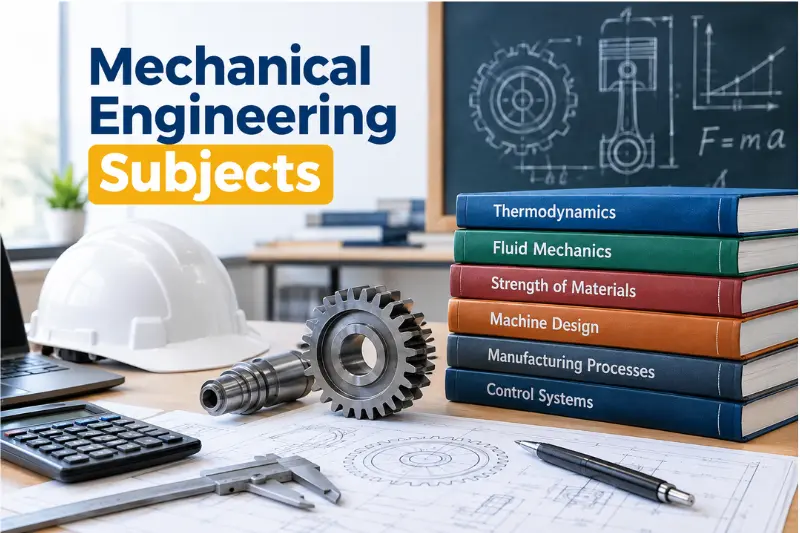
Mechanical Engineering Subjects are the academic courses taught in a mechanical engineering degree to develop knowledge and practical skills related to machines, mechanical systems, materials, energy, manufacturing, design, and engineering analysis.
Some subjects establish basic engineering knowledge, while others develop specialized abilities. For example, engineering mathematics provides the mathematical foundation required for later study, while subjects such as thermodynamics and fluid mechanics explain energy and fluid behavior. Machine design then applies mechanics, materials, and engineering analysis to the design of components and systems.
A typical curriculum can therefore be viewed as a progression from fundamental knowledge to engineering analysis, practical application, design, simulation, and specialization.
Professional organizations also emphasize the importance of relevant and high-quality engineering education. The ASME Engineering Education program focuses on the quality and relevance of mechanical engineering degree programs and their connection with professional life.
How Are Mechanical Engineering Subjects Structured?
A four-year mechanical engineering program is commonly divided into eight semesters, although the exact structure depends on the institution. The first part of the degree usually contains mathematics, physics, chemistry, engineering graphics, computing, workshops, and introductory engineering courses.
Students then progress toward subjects such as engineering mechanics, strength of materials, thermodynamics, fluid mechanics, manufacturing processes, materials science, machine theory, heat transfer, machine design, controls, and computer-based engineering.
The final part of the degree often provides greater choice through technical electives, advanced laboratories, design courses, internships, research, and a final-year project.
Modern programs can also include programming, sensors, automation, mechatronics, sustainable manufacturing, modelling, and simulation. These additions reflect the increasing connection between mechanical engineering and digital technologies.
The U.S. Bureau of Labor Statistics describes mechanical engineering as a broad field involving the design, development, building, and testing of mechanical and thermal devices.
First-Year Mechanical Engineering Subjects
The first year generally builds the academic and engineering foundation required for more advanced Mechanical Engineering Subjects.
Engineering Mathematics
Engineering mathematics is one of the most important early subjects. Students may study calculus, differential equations, linear algebra, vectors, complex numbers, statistics, and numerical methods.
Mathematics is used throughout mechanical engineering. Thermodynamic calculations, fluid-flow equations, vibration analysis, machine design, heat transfer, control systems, and numerical simulation all require mathematical methods.
A student who develops strong mathematical fundamentals usually finds later engineering analysis easier to understand.
Engineering Physics
Engineering physics introduces physical principles that are directly relevant to engineering. Topics can include mechanics, motion, force, energy, electricity, waves, optics, and material behavior.
Physics helps students connect theoretical principles with real engineering systems. For example, concepts involving force and energy later appear in mechanics, machine dynamics, thermodynamics, and machine design.
Engineering Chemistry
Depending on the university, engineering chemistry may be included during the first year. Students can learn about materials, corrosion, fuels, polymers, metals, chemical reactions, and industrial applications.
The subject becomes particularly useful when studying engineering materials, lubrication, corrosion prevention, fuels, batteries, coatings, and manufacturing.
Engineering Graphics and Drawing
Engineering graphics teaches students how to communicate technical information through drawings and graphical representations.
Students may learn orthographic projection, sectional views, dimensioning, geometric construction, assembly drawings, and basic computer-based drafting.
Computer-Aided Design, commonly abbreviated as CAD, is now an important part of modern mechanical engineering workflows. Fullipedia’s Mechanical Engineering Initialism – Alphabet C includes CAD, CAM, CAE, CFD, CNC, and other mechanical engineering terminology.
Workshop Practice
Workshop practice gives students practical exposure to tools, machines, materials, fabrication, machining, welding, fitting, casting, and other manufacturing activities.
The purpose is not simply to teach students how to operate workshop equipment. It also helps them understand how engineering drawings become physical components and why manufacturing methods influence design.
Second-Year Mechanical Engineering Subjects
The second year generally introduces the core technical subjects that form the foundation of mechanical engineering analysis.
Engineering Mechanics
Engineering mechanics deals with the behavior of bodies under forces and moments.
Students normally encounter statics and dynamics. Statics focuses on bodies in equilibrium, while dynamics examines motion and the forces associated with moving bodies.
Free Body Diagrams, or FBDs, are particularly important because they allow engineers to represent forces and moments acting on a body before performing calculations. Mechanical engineering students can explore FBD and related terms through Fullipedia’s Mechanical Engineering Initialism – Alphabet F.
Strength of Materials
Strength of materials, also called mechanics of materials in many programs, explains how components behave under loads.
Students may study stress, strain, tension, compression, shear, bending, torsion, deflection, columns, and combined loading.
This subject is fundamental to mechanical design because engineers need to determine whether a shaft, beam, bracket, pressure vessel, frame, or other component can withstand expected loads.
Engineering Materials
Engineering materials introduces the properties, selection, processing, and applications of metals, polymers, ceramics, composites, and other engineering materials.
Students learn why one material may be suitable for a high-temperature application while another may be preferred for lightweight construction, corrosion resistance, wear resistance, or manufacturability.
Material selection later becomes an important part of machine design and product development.
Thermodynamics
Thermodynamics is one of the central Mechanical Engineering Subjects.
It deals with energy, heat, work, temperature, properties of substances, thermodynamic systems, and energy conversion.
Students may study laws of thermodynamics, entropy, power cycles, refrigeration cycles, boilers, turbines, compressors, engines, and related systems.
Thermodynamics is particularly important for students interested in power generation, automotive engineering, refrigeration and air conditioning, energy systems, and thermal equipment.
Fluid Mechanics
Fluid mechanics studies liquids and gases at rest and in motion.
Topics can include fluid properties, pressure, continuity, momentum, Bernoulli’s equation, pipe flow, boundary layers, pumps, turbines, and flow measurement.
Fluid mechanics is used in applications ranging from water pumps and hydraulic systems to aircraft, automobiles, pipelines, HVAC systems, turbines, and industrial equipment.
Students interested in computational fluid analysis may later encounter CFD, or Computational Fluid Dynamics. Fullipedia’s Mechanical Engineering Initialism – Alphabet C provides a dedicated reference for CFD and related engineering initialisms.
Manufacturing Processes
Manufacturing processes explains how raw materials are converted into useful mechanical components.
Common topics include casting, forging, rolling, extrusion, machining, welding, forming, heat treatment, additive manufacturing, and finishing processes.
The subject connects design decisions with actual production. A component may work perfectly on paper but still be difficult or expensive to manufacture. Mechanical engineers therefore need to understand both design requirements and manufacturing limitations.
Electrical and Electronics Fundamentals
Mechanical engineering programs may also include introductory electrical and electronics subjects.
Students can learn about circuits, electrical machines, sensors, measurement systems, basic electronics, and instrumentation.
This knowledge becomes increasingly valuable when mechanical systems incorporate motors, sensors, controllers, actuators, and electronic monitoring.
Third-Year Mechanical Engineering Subjects
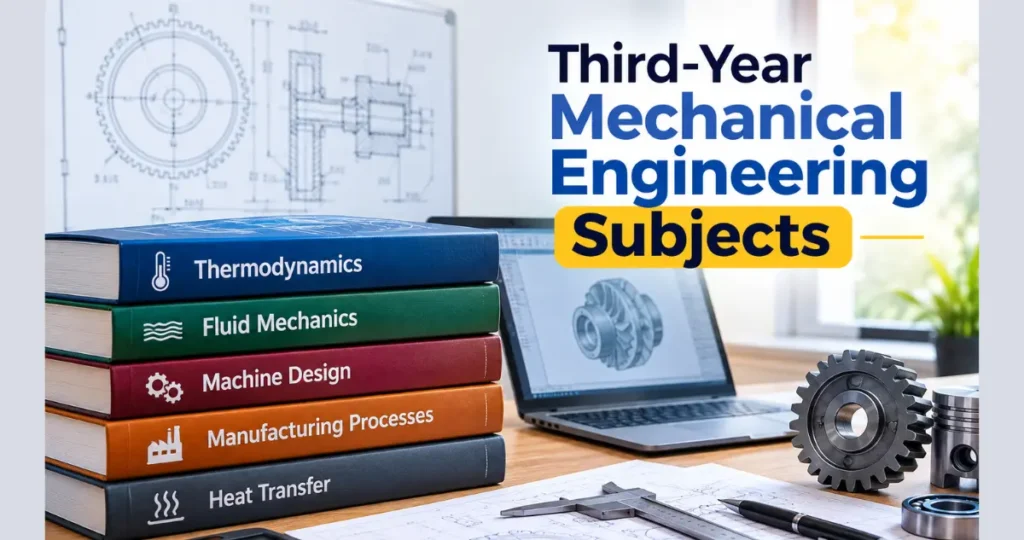
The third year usually moves from basic engineering principles toward integrated mechanical systems, analysis, design, manufacturing, and automation.
Theory of Machines
Theory of machines examines the motion and forces associated with mechanical mechanisms.
Students may study mechanisms, gears, cams, governors, flywheels, balancing, vibration, and machine dynamics.
The subject helps students understand how individual machine components work together to create controlled movement.
Machine Design
Machine design applies mechanics, material science, manufacturing knowledge, and engineering calculations to the development of mechanical components.
Students may design shafts, keys, couplings, bearings, gears, springs, brakes, clutches, joints, pressure vessels, and other components.
Design calculations commonly consider strength, stiffness, fatigue, wear, manufacturability, cost, reliability, and operating conditions.
The Factor of Safety, often abbreviated as FOS, is an important concept in mechanical design. Fullipedia’s Mechanical Engineering Initialism – Alphabet F includes FOS and other design-related initialisms.
Heat Transfer
Heat transfer focuses on the movement of thermal energy from one location or body to another.
The main modes are conduction, convection, and radiation.
Students apply heat-transfer principles to heat exchangers, engines, refrigeration equipment, boilers, electronic cooling, industrial furnaces, and thermal management systems.
Mass Transfer
Some mechanical engineering programs include mass transfer as part of thermal and fluid sciences.
The subject deals with the movement of substances within systems and can be relevant to combustion, drying, cooling, chemical processing, and energy-related applications.
Computer-Aided Design
Computer-Aided Design enables engineers to create, modify, analyze, and document digital models of components and assemblies.
Students may work with three-dimensional modelling, assemblies, engineering drawings, tolerances, design modifications, and product visualization.
CAD skills are valuable because modern mechanical engineers frequently use computer technology to create and analyze designs. The BLS specifically identifies computer-aided design as part of mechanical engineering work.
Computer-Aided Manufacturing
Computer-Aided Manufacturing, or CAM, connects digital design information with manufacturing operations.
CAM systems can support CNC machining, toolpath generation, production planning, and automated manufacturing.
CNC, meaning Computer Numerical Control, is another common term in this area. CAD, CAM, CAE, CFD, and CNC are included in Fullipedia’s Mechanical Engineering Initialism – Alphabet C.
Mechatronics
Mechatronics combines mechanical engineering with electronics, control systems, sensors, actuators, and computing.
A modern automated machine may contain mechanical structures, electric motors, sensors, controllers, and software. Mechatronics helps students understand how these elements operate together.
This subject is particularly useful for students interested in robotics, automation, smart manufacturing, industrial machinery, and modern product development.
Industrial Engineering and Production
Some programs include industrial engineering or production-related subjects that introduce manufacturing planning, productivity, quality, process optimization, facilities, and operations.
These subjects help students understand what happens beyond the design stage and how engineering systems can be produced efficiently.
Final-Year Mechanical Engineering Subjects
Final-year courses often allow students to apply their previous knowledge to advanced topics and larger engineering problems.
Robotics and Automation
Robotics and automation introduce the design, control, movement, sensing, and programming of automated systems.
Students may work with robotic arms, automated production systems, mobile robots, sensors, actuators, and machine-control systems.
Mechanical engineering plays an important role in robotics because robot structures, joints, drives, mechanisms, and physical interaction with the environment require mechanical design.
Computational Engineering and Simulation
Computational methods allow engineers to study complex systems before building physical prototypes.
Finite Element Analysis, or FEA, is used to analyze structures and components under conditions such as loading, temperature, or vibration. The concept is covered in Fullipedia’s Mechanical Engineering Initialism – Alphabet F.
Computational Fluid Dynamics can similarly be used to investigate fluid flow and heat-transfer problems.
Simulation can reduce the number of physical prototypes required and help engineers identify potential design problems earlier.
Renewable Energy Engineering
Renewable energy subjects may cover solar energy, wind energy, hydropower, biomass, energy storage, and other sustainable technologies.
Mechanical engineers can contribute to the design and analysis of turbines, thermal systems, energy conversion equipment, structures, and manufacturing systems associated with renewable energy.
Automotive Engineering
Automotive subjects may cover engines, vehicle dynamics, transmissions, braking systems, suspension, steering, aerodynamics, electric vehicles, and vehicle thermal management.
The exact depth depends on the university and whether automotive engineering is offered as a specialization or elective.
Aerospace-Related Subjects
Some mechanical engineering programs provide aerospace electives covering aerodynamics, propulsion, aircraft structures, materials, vibration, or thermal systems.
These subjects apply many mechanical engineering fundamentals to aircraft and spacecraft.
Final-Year Project
A final-year project allows students to combine knowledge from several Mechanical Engineering Subjects.
A project might involve designing a machine, developing a robotic system, improving a manufacturing process, building a prototype, analyzing a thermal system, developing a simulation, or investigating a material.
The project develops engineering judgement because students must define a problem, identify requirements, select methods, perform analysis, create or test a solution, and communicate the results.
Practical and Laboratory Mechanical Engineering Subjects
Mechanical engineering education is not limited to classroom theory. Laboratory work gives students opportunities to observe engineering principles in practice.
Common laboratories include:
Engineering Mechanics Laboratory: Demonstrates force, motion, equilibrium, and mechanical principles.
Strength of Materials Laboratory: Includes tests related to tensile strength, hardness, impact, bending, torsion, and material behavior.
Thermodynamics Laboratory: Demonstrates engines, boilers, compressors, refrigeration systems, and thermal measurements.
Fluid Mechanics Laboratory: Includes experiments involving pressure, flow, pumps, turbines, and fluid measurements.
Heat Transfer Laboratory: Demonstrates conduction, convection, radiation, and heat exchanger performance.
Manufacturing Laboratory: Provides exposure to machining, welding, casting, forming, and other production methods.
CAD/CAM Laboratory: Develops digital design and computer-supported manufacturing skills.
Mechatronics and Automation Laboratory: Introduces sensors, actuators, controllers, robotics, and automated systems.
Laboratory work helps students connect equations and theoretical concepts with actual engineering equipment.
Mechanical Engineering Subjects and Modern Technology

Modern Mechanical Engineering Subjects increasingly overlap with digital engineering, automation, advanced manufacturing, data analysis, and simulation.
Mechanical engineers may now work with sensors, connected machines, automated manufacturing equipment, digital models, robotics, and computer simulations.
The BLS explains that mechanical engineers use computers to create and analyze designs, perform simulations, test how machines are likely to work, and generate specifications. It also notes that mechanical engineers increasingly integrate sensors, controllers, and machinery.
This development means students should not treat traditional subjects and modern technology as separate areas. Mechanics, thermodynamics, materials, manufacturing, programming, control, CAD, simulation, and automation can work together within the same engineering project.
Important Mechanical Engineering Subjects for Design
Students interested in mechanical design should pay particular attention to:
- Engineering Mathematics
- Engineering Mechanics
- Strength of Materials
- Engineering Materials
- Theory of Machines
- Machine Design
- Manufacturing Processes
- CAD
- CAE
- FEA
- Measurement and Instrumentation
Design engineers need to understand how forces affect components, how materials behave, how components are manufactured, and how a design can be represented and analyzed digitally.
A good designer therefore does more than create an attractive CAD model. The design must satisfy functional, structural, manufacturing, cost, maintenance, reliability, and operating requirements.
Important Mechanical Engineering Subjects for Manufacturing
Students interested in manufacturing can focus on:
- Engineering Materials
- Manufacturing Processes
- Machine Tools
- CAD
- CAM
- CNC
- Metrology
- Production Engineering
- Automation
- Quality Control
Modern manufacturing increasingly combines mechanical processes with computerized control and automation.
For example, a production line may use CAD models to define components, CAM software to generate manufacturing instructions, CNC equipment to produce parts, and coordinate measuring equipment to verify dimensions.
Fullipedia’s Mechanical Engineering Initialism – Alphabet C is useful for students who encounter technical terms such as CAD, CAM, CAE, CFD, CNC, and CMM.
Important Mechanical Engineering Subjects for Thermal Engineering
Students interested in thermal systems should focus on:
- Thermodynamics
- Fluid Mechanics
- Heat Transfer
- Combustion
- Thermal Engineering
- Refrigeration and Air Conditioning
- Power Plant Engineering
- Energy Engineering
- Computational Methods
These subjects are relevant to engines, turbines, compressors, boilers, heat exchangers, refrigeration systems, HVAC equipment, and renewable energy systems.
Important Mechanical Engineering Subjects for Robotics and Automation
Students interested in robotics and automation should develop knowledge in:
- Engineering Mechanics
- Theory of Machines
- Machine Design
- Mechatronics
- Control Systems
- Sensors and Instrumentation
- CAD
- Programming
- Robotics
- Manufacturing Automation
Mechanical engineering provides the physical foundation of robotic systems, while electronics, controls, and programming provide additional capabilities.
Which Mechanical Engineering Subjects Are Most Important?
There is no single subject that is most important for every student.
The importance of a subject depends on the student’s specialization and career direction.
For a design student, strength of materials, machine design, engineering materials, manufacturing, CAD, and FEA can be particularly valuable.
For a thermal engineer, thermodynamics, fluid mechanics, heat transfer, combustion, and energy systems may receive greater attention.
For manufacturing, manufacturing processes, materials, CAD/CAM, CNC, metrology, production, and automation can be especially useful.
For robotics, mechanics, machine design, mechatronics, control systems, sensors, programming, and robotics become important.
The foundation subjects should not be ignored simply because they appear less specialized. Advanced engineering depends on concepts learned earlier in the degree.
How Difficult Are Mechanical Engineering Subjects?
Mechanical Engineering Subjects can be challenging because they combine mathematics, scientific principles, engineering theory, graphical communication, laboratory work, and problem-solving.
Subjects such as thermodynamics, fluid mechanics, dynamics, strength of materials, heat transfer, and machine design often require students to understand concepts rather than memorize formulas.
A useful approach is to study the physical meaning behind each equation.
For example, when studying fluid mechanics, a student should understand what pressure, velocity, density, flow rate, and energy represent before applying an equation.
Similarly, in strength of materials, understanding how a component reacts to loading makes stress and strain calculations much easier to interpret.
How to Study Mechanical Engineering Subjects Effectively
Students can improve their performance by combining theoretical study with problem-solving and practical observation.
Understand the fundamentals: Learn the concepts before memorizing formulas.
Practice numerical problems: Engineering subjects become clearer when calculations are practiced regularly.
Draw diagrams: Free Body Diagrams, mechanisms, thermodynamic cycles, fluid systems, and engineering sketches can make complex problems easier to understand.
Use CAD and simulation tools: Digital tools help connect theoretical knowledge with engineering applications.
Review laboratory work: Laboratory experiments can reinforce classroom concepts.
Study real machines: Looking at engines, pumps, compressors, gears, bearings, robots, and manufacturing machines can make theoretical subjects more meaningful.
Learn technical terminology: Mechanical engineering contains thousands of abbreviations, acronyms, and initialisms. Fullipedia’s Mechanical Initialisms A–Z category provides an A–Z reference for mechanical engineering terminology.
Mechanical Engineering Abbreviations, Acronyms, and Initialisms
Mechanical engineering students encounter technical short forms throughout textbooks, laboratory manuals, engineering drawings, software interfaces, research papers, and industrial documentation.
Some frequently encountered examples include:
CAD — Computer-Aided Design
CAM — Computer-Aided Manufacturing
CAE — Computer-Aided Engineering
CFD — Computational Fluid Dynamics
CNC — Computer Numerical Control
CMM — Coordinate Measuring Machine
FEA — Finite Element Analysis
FBD — Free Body Diagram
FOS — Factor of Safety
These terms are not simply vocabulary. Understanding them helps students read engineering documentation and communicate more effectively.
For example, Fullipedia’s Mechanical Engineering Initialism – Alphabet B includes terms related to bearings, boilers, balancing, materials, and other engineering applications. The Alphabet C page includes CAD, CAM, CAE, CFD, CNC, and CMM, while the Alphabet F page includes FEA, FBD, FOS, FEM, FDM, FMS, and other technical terms.
You may also read as deemed appropriate Mechanical Engineering Initialisms – Alphabet A to explore engineering abbreviations and initialisms arranged alphabetically.
Mechanical Engineering Subjects and Career Preparation
Mechanical Engineering Subjects provide the academic foundation for many professional directions.
Graduates may work in mechanical design, manufacturing, automotive engineering, aerospace, energy, HVAC, robotics, automation, product development, research, engineering services, and other technical areas.
The U.S. Bureau of Labor Statistics states that mechanical engineers design, develop, build, and test mechanical and thermal devices and work across areas including engineering services, research and development, manufacturing, transportation equipment, and computer and electronic product manufacturing.
The connection between subjects and professional work becomes clearer when students understand how individual courses contribute to complete engineering tasks.
For example, designing a gearbox may require mechanics, strength of materials, machine design, engineering materials, manufacturing, CAD, and testing.
Developing an industrial robot may require mechanics, machine design, mechatronics, control, sensors, manufacturing, CAD, and programming.
Designing a refrigeration system may require thermodynamics, fluid mechanics, heat transfer, machine design, controls, and system analysis.
This is why mechanical engineering education contains many different subjects rather than relying on one area of study.
Skills Developed Through Mechanical Engineering Subjects
A strong mechanical engineering curriculum develops more than technical knowledge.
Students can develop:
Analytical skills: Understanding engineering problems and selecting appropriate methods.
Mathematical skills: Applying mathematical models to physical systems.
Design skills: Creating components and systems that meet defined requirements.
Problem-solving skills: Identifying causes of failure and developing engineering solutions.
Computer skills: Using CAD, simulation, modelling, analysis, and manufacturing software.
Practical skills: Working with tools, machines, laboratory equipment, and prototypes.
Communication skills: Preparing engineering drawings, reports, presentations, and technical documentation.
Teamwork: Working with engineers and professionals from different disciplines.
These skills are consistent with the broad nature of mechanical engineering work. The BLS identifies creativity, listening, mathematics, mechanical knowledge, and problem-solving among important skills for mechanical engineers.
Mechanical Engineering Subjects After Graduation
Learning does not end when students complete their undergraduate Mechanical Engineering Subjects.
Graduates may continue into master’s degrees, specialized certifications, research programs, professional training, or industry-based learning.
Possible postgraduate areas include:
- Mechanical Design
- Manufacturing Engineering
- Thermal Engineering
- Fluid Mechanics
- Automotive Engineering
- Aerospace Engineering
- Robotics
- Mechatronics
- Renewable Energy
- Industrial Engineering
- Materials Engineering
- Computational Engineering
- Energy Systems
Some engineers also develop management, project leadership, business, or interdisciplinary skills as their careers progress.
The BLS notes that mechanical engineers can pursue graduate degrees in engineering or business administration and may move into administrative or management roles with experience.
Why Mechanical Engineering Subjects Matter
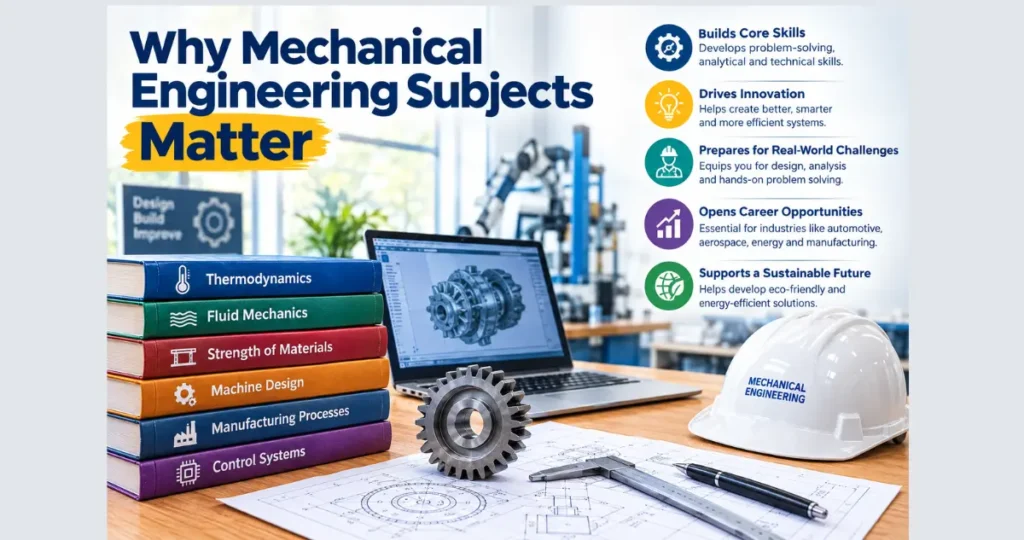
Mechanical Engineering Subjects matter because they collectively develop the knowledge required to understand, design, manufacture, analyze, test, and improve mechanical systems.
Mathematics provides analytical tools.
Physics explains fundamental behavior.
Mechanics explains forces and motion.
Materials science explains material behavior and selection.
Thermodynamics explains energy and heat.
Fluid mechanics explains the behavior of liquids and gases.
Manufacturing explains how components are produced.
Machine design combines several engineering principles into practical components.
CAD and simulation provide digital tools for modern engineering.
Mechatronics, controls, robotics, and automation connect mechanical engineering with intelligent systems.
No single subject provides the complete picture. Mechanical engineering becomes meaningful when students understand how these areas work together.
Final Thoughts on Mechanical Engineering Subjects
Mechanical Engineering Subjects form a connected academic pathway from basic mathematics and science to advanced engineering design, manufacturing, thermal systems, automation, simulation, and specialized applications.
Students normally begin with foundation subjects and gradually move toward engineering mechanics, strength of materials, thermodynamics, fluid mechanics, manufacturing, machine design, CAD, heat transfer, mechatronics, controls, robotics, and other advanced areas.
The exact curriculum differs between universities, so students should always check the official syllabus of the institution they plan to attend. However, the fundamental areas remain broadly connected across mechanical engineering programs.
Understanding these subjects also makes it easier to identify a suitable specialization. A student who enjoys machines and product development may prefer mechanical design. Someone interested in energy may choose thermal engineering. A student fascinated by automated machines may move toward mechatronics and robotics, while someone interested in production may focus on manufacturing.
Mechanical engineering therefore offers a broad academic foundation while allowing students to develop specialized interests as their education progresses.
For a broader introduction to the discipline, read What is Mechanical Engineering, and for technical terminology, explore Fullipedia’s Mechanical Initialisms A–Z resources. These references can help students connect their coursework with the technical language used throughout mechanical engineering education and professional practice.