
Introduction
Mechanical engineering jobs offer opportunities for students, recent graduates, experienced engineers, and technical professionals across manufacturing, automotive engineering, aerospace, energy, robotics, construction services, healthcare technology, and many other industries. Mechanical engineers help design, develop, test, manufacture, and maintain the machines and systems that support modern life. From electric vehicles and industrial robots to heating and cooling equipment, power-generation systems, and advanced manufacturing facilities, their work contributes to technological progress worldwide.
However, finding the right job requires more than earning an engineering degree. Candidates must understand available job titles, industry requirements, technical skills, professional qualifications, salary expectations, and recruitment processes. Opportunities also vary between countries, employers, experience levels, and engineering specializations.
This guide explores mechanical engineering jobs globally, with particular attention to the United States and India. It explains popular career options, entry-level opportunities, technical abbreviations, initialisms and acronyms, qualifications, salary research, and practical strategies for finding suitable vacancies.
What Are Mechanical Engineering Jobs?
Mechanical engineering jobs are professional positions involving the design, analysis, production, operation, testing, improvement, or maintenance of mechanical systems and equipment. Depending on the role, engineers may work in offices, design studios, research laboratories, manufacturing plants, power stations, construction projects, or industrial facilities.
Some professionals develop computer-based designs, while others supervise manufacturing processes, investigate equipment failures, improve energy efficiency, or manage technical projects. For example, a design engineer might develop a gearbox, a manufacturing engineer might improve its production process, and a maintenance engineer might investigate excessive vibration in operating equipment.
The U.S. Bureau of Labor Statistics (BLS) describes mechanical engineering as a broad profession involving the design, development, construction, and testing of mechanical and thermal devices. This range of responsibilities explains why graduates can pursue several different career paths rather than limiting themselves to a single occupation.
Readers who need a broader introduction to the discipline can explore What Is Mechanical Engineering?. This article focuses specifically on employment opportunities and the practical steps required to pursue them.
Types of Mechanical Engineering Jobs
Mechanical engineering includes multiple specializations, and each offers different responsibilities, technical requirements, and advancement opportunities. The most suitable position depends on a candidate’s education, interests, experience, and preferred working environment.
Mechanical Design Engineer Jobs
Mechanical design engineers develop components, assemblies, machines, and mechanical products. Their responsibilities can include preparing engineering drawings, selecting materials, calculating dimensions, evaluating loads, and checking whether a design meets performance and safety requirements.
Computer-Aided Design (CAD) software is widely used for creating two-dimensional drawings and three-dimensional models. Depending on the employer, candidates may encounter tools such as SolidWorks, Autodesk Inventor, CATIA, or Siemens NX.
Design engineers may work in automotive manufacturing, industrial machinery, consumer products, aerospace, medical equipment, and engineering consultancy. Employers commonly value knowledge of machine design, manufacturing methods, geometric dimensioning and tolerancing, and engineering documentation.
Manufacturing Engineer Jobs
Manufacturing engineers improve the processes used to produce components and finished products. They may develop production methods, reduce manufacturing costs, improve equipment utilization, investigate defects, and introduce automation.
Computer-Aided Manufacturing (CAM) and Computer Numerical Control (CNC) technologies are relevant to many modern manufacturing environments. Engineers may also work with machining, casting, welding, forming, assembly, and additive manufacturing.
These positions suit candidates who enjoy practical engineering, production planning, process improvement, and collaboration with shop-floor teams.
Mechanical Maintenance Engineer Jobs
Maintenance engineers help keep machinery and equipment reliable, safe, and operational. Their work may involve preventive maintenance, troubleshooting, breakdown investigations, spare-parts planning, equipment inspections, and reliability improvement.
Typical equipment includes pumps, compressors, motors, gearboxes, conveyors, turbines, boilers, and industrial production machinery. In some organizations, maintenance engineers also coordinate contractors and maintenance technicians.
Candidates may benefit from understanding vibration analysis, lubrication, alignment, equipment condition monitoring, and maintenance documentation. Knowledge of Computerized Maintenance Management Systems (CMMS) can also be useful.
Production Engineer Jobs
Production engineers help manufacturing facilities meet production targets while maintaining quality, safety, and efficiency. They monitor production performance, coordinate resources, investigate delays, and work with quality and maintenance teams to resolve operational problems.
The role often requires an understanding of manufacturing processes, workflow planning, root-cause analysis, and continuous improvement. Employers may also seek experience with Lean Manufacturing, Six Sigma, and production performance indicators.
Quality Engineer Jobs
Quality engineers develop and maintain processes that help ensure products meet defined specifications and customer requirements. They may investigate defects, analyze inspection results, conduct audits, review supplier performance, and support corrective actions.
Useful knowledge includes statistical process control, measurement systems, failure analysis, and quality management standards. International Organization for Standardization (ISO) standards are particularly relevant in organizations that operate formal quality management systems.
A mechanical engineering background can be valuable in automotive manufacturing, aerospace, industrial equipment, and other industries where product reliability and dimensional accuracy matter.
HVAC Engineer Jobs
Heating, Ventilation, and Air Conditioning (HVAC) engineers work with systems that regulate temperature, airflow, humidity, and indoor environmental conditions.
Their responsibilities may include heating and cooling load calculations, equipment selection, ductwork design, energy analysis, installation supervision, and commissioning. Opportunities exist in commercial buildings, hospitals, factories, hotels, data centers, and engineering consultancy firms.
Knowledge of thermodynamics, heat transfer, fluid mechanics, refrigeration, and building energy performance is important for this specialization.
Project Engineer Jobs
Project engineers coordinate engineering activities to help deliver projects within agreed schedules, budgets, specifications, and safety requirements. They may work with design teams, suppliers, contractors, clients, procurement personnel, and construction managers.
Typical responsibilities include reviewing drawings, tracking technical deliverables, monitoring progress, resolving engineering issues, and preparing reports.
Strong communication, planning, documentation, and problem-solving skills are important. Some positions also require familiarity with project management software, contract documentation, and risk assessment.
Thermal and Energy Engineer Jobs
Thermal engineers work with energy conversion, heat transfer, combustion, refrigeration, and thermal management systems. Their projects may involve boilers, turbines, heat exchangers, engines, industrial furnaces, and cooling equipment.
Energy-related opportunities also include improving equipment efficiency, evaluating renewable energy systems, and reducing industrial energy consumption. Candidates with strong thermodynamics and fluid mechanics knowledge may find these areas particularly interesting.
Automotive and Aerospace Engineering Jobs
Automotive engineers contribute to vehicle design, testing, manufacturing, powertrain development, thermal management, vehicle safety, and electric mobility. Aerospace-related mechanical engineering positions can involve structural components, propulsion systems, manufacturing processes, testing, and thermal analysis.
These positions may require specialist software, materials knowledge, simulation experience, and familiarity with industry-specific quality and safety requirements. Some roles also require citizenship, security clearance, or other eligibility conditions, depending on the employer and country.
Robotics and Automation Engineer Jobs
Robotics and automation engineers help develop and integrate automated equipment, robotic systems, sensors, actuators, and production machinery. Their work combines mechanical design with controls, electronics, programming, and system integration.
Useful skills can include programmable logic controllers (PLCs), computer-aided engineering (CAE), control systems, robotics programming, and troubleshooting. Candidates who combine mechanical fundamentals with automation experience may be well positioned for manufacturing and advanced engineering environments.
Mechanical Engineering Jobs for Freshers and Entry-Level Candidates
Entry-level mechanical engineering jobs are intended for candidates who have limited professional experience. These positions may be advertised as graduate engineer trainee, junior design engineer, graduate manufacturing engineer, maintenance engineer trainee, quality engineer trainee, or engineering technician, depending on the employer.
Fresh graduates should not assume that every entry-level role requires extensive industrial experience. Some employers provide structured training, supervised assignments, and opportunities to learn company-specific systems.
However, candidates can strengthen their applications by completing internships, practical projects, laboratory work, or industry-relevant training. A portfolio containing engineering drawings, CAD models, simulation reports, or documented project work can demonstrate practical ability more effectively than a list of software names alone.
For example, a candidate applying for a design position might present a gearbox assembly model, engineering drawings, material selections, and a brief explanation of design decisions. A manufacturing applicant could demonstrate a process-improvement project, while a maintenance applicant might describe a supervised equipment inspection or a root-cause analysis exercise.
Graduates should also understand the connection between academic study and professional work. Fullipedia’s guide to Mechanical Engineering Subjects explains the foundational courses that can support different engineering specializations.
When reviewing vacancies, check whether the employer accepts fresh graduates, requires internships, specifies a minimum grade, or expects a particular degree. Apply when your qualifications reasonably match the stated requirements rather than excluding yourself simply because you do not meet every preferred criterion.
Mechanical Engineering Jobs in the United States
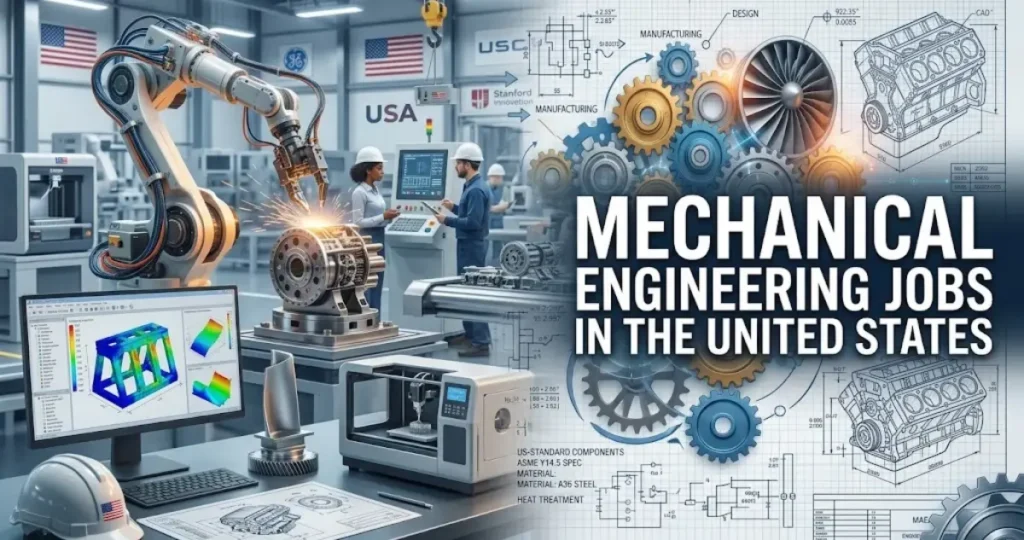
The United States offers mechanical engineering opportunities in manufacturing, engineering services, transportation equipment, research and development, energy, aerospace, building systems, and technology-related industries.
According to the BLS Occupational Outlook Handbook, mechanical engineers had a median annual wage of $104,110 in May 2025. The BLS projects employment growth of 11% between 2025 and 2035, with approximately 17,800 openings per year on average. These figures refer specifically to the United States and should not be treated as worldwide salary or employment estimates.
Potential job titles include mechanical design engineer, manufacturing engineer, product development engineer, reliability engineer, HVAC engineer, thermal engineer, test engineer, and mechanical project engineer.
Candidates can search for vacancies through employer career pages and reputable recruitment platforms. The BLS occupational profile is useful for understanding the profession, while USAJOBS provides information about federal employment opportunities. Eligibility and citizenship requirements vary by position, particularly in government and defense-related work.
Professional licensing also requires attention. In the United States, requirements depend on the type of engineering work and the state. Mechanical engineers who offer engineering services directly to the public may need a Professional Engineer (PE) license. Many industrial engineering positions do not require this license, so applicants should verify the applicable rules and job description.
International candidates should additionally review work authorization, visa eligibility, employer sponsorship, and any restrictions attached to the role before applying.
Mechanical Engineering Jobs in India
India offers opportunities in automotive manufacturing, industrial machinery, power generation, infrastructure, engineering services, production, maintenance, heating and cooling systems, and public-sector organizations.
Job titles vary by employer and may include Graduate Engineer Trainee (GET), Design Engineer, Production Engineer, Maintenance Engineer, Quality Engineer, Project Engineer, and Service Engineer. Some positions are open to fresh graduates, while others require specific industrial experience or technical certifications.
Candidates can explore private-sector opportunities through employer websites and established recruitment platforms. India’s official National Career Service (NCS) portal provides job-search, career guidance, and employment-related services. Government vacancies should also be checked through the official recruitment pages of the relevant public-sector organization.
Mechanical engineering graduates interested in public-sector employment may investigate vacancies advertised by organizations involved in energy, transportation, defense, manufacturing, and infrastructure. However, recruitment eligibility varies by examination, qualification, age limit, discipline, and notification.
For private-sector jobs, practical skills can make a difference. Employers may value CAD proficiency, production knowledge, maintenance troubleshooting, quality control, technical reporting, and the ability to work with industrial equipment.
Candidates should compare current job advertisements rather than relying on a single salary estimate. Compensation can vary significantly between cities, employers, industries, experience levels, and responsibilities. They should also verify whether a vacancy is genuinely open and whether the employer requires relocation or shift work.
Mechanical Engineering Jobs in Other Countries
Mechanical engineers can pursue international opportunities in Canada, the United Kingdom, Australia, Germany, the Gulf region, and other industrial markets. Demand differs by country, industry, economic conditions, and employer requirements.
In Canada, potential opportunities include manufacturing, building systems, energy, industrial equipment, and transportation. Applicants should consult the official Government of Canada’s Job Bank for occupational information and vacancies.
In the United Kingdom, engineers may find positions in manufacturing, automotive engineering, building services, energy, and technical consultancy. The UK government’s Find a Job service is one place to search for advertised roles.
In Australia, opportunities can involve mining equipment, manufacturing, energy, infrastructure, and industrial maintenance. Candidates can explore the official Workforce Australia employment service and review any applicable professional or immigration requirements.
The Gulf region, including the United Arab Emirates and Saudi Arabia, also employs mechanical engineers in building services, oil and gas, industrial operations, facilities management, and large construction projects. Applicants should examine contract terms, working conditions, employer credibility, visa arrangements, and the exact scope of responsibilities.
An engineering degree alone does not automatically authorize someone to work in another country. Recognition of qualifications, licensing rules, work permits, employer sponsorship, and language requirements should be checked before accepting an international offer.
Mechanical Engineering Abbreviations, Initialisms, and Acronyms Used in Jobs
Mechanical engineering professionals encounter technical short forms in job advertisements, engineering drawings, specifications, maintenance reports, and interviews. Understanding them can help applicants interpret job requirements and communicate more confidently.
An abbreviation is a shortened form of a word or phrase. An initialism is formed from initial letters pronounced individually, while an acronym is commonly pronounced as a word. In engineering, many initialisms and acronyms are used so frequently that professionals may recognize them without spelling out their full forms.
Common examples include:
- CAD — Computer-Aided Design: Software-based creation and modification of engineering drawings and models.
- CAM — Computer-Aided Manufacturing: Computer-supported planning and control of manufacturing activities.
- CAE — Computer-Aided Engineering: Computer-based tools used for engineering analysis and development.
- CFD — Computational Fluid Dynamics: Numerical analysis of fluid flow and related physical processes.
- FEA — Finite Element Analysis: A numerical technique used to analyze structures and other engineering systems.
- FEM — Finite Element Method: A mathematical method commonly used in numerical engineering analysis.
- CNC — Computer Numerical Control: Computer-controlled operation of machine tools.
- HVAC — Heating, Ventilation, and Air Conditioning: Systems for managing indoor temperature, airflow, and environmental conditions.
- PLC — Programmable Logic Controller: An industrial controller used to automate machinery and processes.
- CMMS — Computerized Maintenance Management System: Software used to organize maintenance activities, work orders, and equipment records.
- ISO — International Organization for Standardization: An international organization that develops standards used across many industries.
- R&D — Research and Development: Activities involving the investigation, development, and improvement of products, processes, and technologies.
- QA — Quality Assurance: Planned activities intended to help ensure that processes meet quality requirements.
- QC — Quality Control: Inspection and testing activities used to assess whether products or processes meet specifications.
- O&M — Operations and Maintenance: Activities involved in operating and maintaining equipment or facilities.
The exact tools and terms required depend on the position. A design engineer may use CAD, CAE, FEA, and GD&T (Geometric Dimensioning and Tolerancing), whereas a maintenance engineer may encounter CMMS, vibration analysis, and preventive maintenance terminology.
Candidates can expand their technical vocabulary through Fullipedia’s Mechanical Engineering Initialisms – Alphabet A, Alphabet B, Alphabet C, and Alphabet F.
These resources are useful for learning technical terminology alphabetically. Nevertheless, candidates should confirm the meaning of an unfamiliar abbreviation in the relevant job description, standard, drawing, or company documentation because some short forms have different meanings in different engineering contexts.
Qualifications Required for Mechanical Engineering Jobs
Educational requirements depend on the position, employer, and country. Many mechanical engineer positions require a bachelor’s degree in mechanical engineering or a closely related discipline. Some employers also accept mechanical engineering technology degrees, diplomas, or equivalent qualifications for particular technical roles.
Entry-level engineering jobs commonly require an appropriate degree, although specific academic grades, internships, or practical experience may also be requested. More specialized positions may require postgraduate education, professional registration, or experience with particular systems.
For example, design positions may emphasize machine design, materials, CAD, and engineering calculations. Thermal engineering positions may require thermodynamics, fluid mechanics, and heat-transfer knowledge. Manufacturing positions may prioritize process planning, production systems, quality control, and practical manufacturing experience.
Professional licensing and registration requirements differ across jurisdictions. Applicants should check the rules of the relevant regulator before assuming that an overseas qualification or professional title will be accepted.
Beyond formal education, employers often assess communication, analytical thinking, technical writing, teamwork, safety awareness, and problem-solving. These abilities are important because engineering work involves coordinating with technicians, suppliers, customers, managers, and other specialists.
Technical Skills That Improve Job Prospects
Developing relevant technical skills can help candidates compete for mechanical engineering jobs. However, the best skills to learn depend on the target position rather than a universal list of software or certifications.
CAD proficiency is useful for many design-related roles. Candidates should learn to create accurate models and drawings, interpret dimensions, manage assemblies, and explain their design decisions.
Simulation skills can support more advanced analysis. Knowledge of CAE, FEA, and CFD may be valuable when an employer uses numerical methods to investigate structural behavior, thermal performance, or fluid flow. Understanding engineering fundamentals remains essential because software output must be interpreted and checked rather than accepted automatically.
Manufacturing candidates may benefit from knowledge of CNC machining, manufacturing processes, process planning, metrology, and quality tools. Maintenance candidates may focus on equipment reliability, alignment, lubrication, condition monitoring, troubleshooting, and maintenance planning.
Programming and data analysis can also be useful in selected roles. Depending on the position, engineers may work with Python, MATLAB, spreadsheets, data acquisition systems, or industrial automation tools.
In addition, professional communication matters. Engineers frequently prepare reports, explain technical problems, document design changes, and communicate with people who have different levels of technical knowledge.
Candidates should build a focused skill set around two or three related job types rather than claiming expertise in every engineering specialization. Practical projects, internships, supervised training, and clearly documented examples can help demonstrate competence.
Mechanical Engineering Salaries and Career Growth
Mechanical engineering salaries vary by country, city, employer, experience, industry, qualifications, and specialization. Consequently, a salary figure from the United States cannot be applied directly to India, the United Kingdom, the Gulf region, or the global labor market.
In the United States, the BLS reports occupational wage data for mechanical engineers and publishes employment projections. Candidates can use the BLS mechanical engineers profile to examine the reporting period, wage distribution, industries, and employment outlook.
In India and other countries, applicants should compare recent vacancies, employer salary disclosures, recruitment reports, and relevant official labor-market sources. They should distinguish between basic salary, total compensation, allowances, bonuses, overtime, benefits, and relocation support.
Experience can influence career progression. A graduate may start as a trainee or junior engineer and later move into a specialist, senior engineer, project leadership, or engineering management position. Advancement depends on demonstrated performance, technical capability, business needs, and available opportunities rather than a fixed timetable.
Specialization can also influence career development. Engineers who gain relevant expertise in product design, automation, energy systems, reliability, manufacturing, or project delivery may qualify for more specialized responsibilities.
Before comparing offers, candidates should consider the complete employment package, working hours, training, location, professional development, job security, and long-term career prospects rather than choosing solely on the advertised salary.
How to Find Mechanical Engineering Jobs Online
A focused job search is usually more effective than repeatedly searching only for the broad phrase “mechanical engineering jobs.” Candidates should combine their target job title with a location, experience level, or specialization.
For example, searches may include “entry-level mechanical design engineer,” “mechanical maintenance engineer jobs in Texas,” “graduate engineer trainee mechanical India,” “HVAC engineer vacancies,” or “manufacturing engineer jobs.”
Candidates can search official employer career pages, recognized recruitment platforms, professional networks, and government employment portals. The U.S. Department of Labor’s CareerOneStop also provides career exploration and employment resources for the US market.
A well-prepared application should contain a readable resume or CV, relevant qualifications, technical skills, internships, projects, and measurable achievements where appropriate. Applicants should adapt their application to the vacancy without exaggerating experience or claiming certifications they do not hold.
For instance, a resume bullet describing how a candidate helped reduce a documented production delay is more informative than simply stating “good problem-solving skills.” Fresh graduates can describe academic projects, laboratory work, internships, and supervised practical experience honestly.
Candidates should also track applications, interview dates, follow-up messages, and employer responses. Before sharing personal documents or paying any fee, verify the recruiter and vacancy through reliable channels. Legitimate recruitment processes should be checked carefully, especially when a job offer involves overseas travel, visa sponsorship, or an unfamiliar agency.
How to Prepare for Mechanical Engineering Job Interviews
Interview preparation should reflect the responsibilities of the position. Candidates applying for design roles may need to explain engineering drawings, material selection, tolerances, design calculations, and CAD projects.
Manufacturing applicants may be asked about production processes, machining, quality control, process improvement, and workplace safety. Maintenance candidates may need to discuss troubleshooting, preventive maintenance, equipment failures, and systematic root-cause investigation.
Technical interviews may also test fundamental subjects such as engineering mechanics, thermodynamics, fluid mechanics, heat transfer, materials, and machine design. Applicants should revise the concepts most relevant to the advertised position rather than attempting to memorize every subject in the curriculum.
Behavioral questions are equally important. Employers may ask candidates to explain how they handled a difficult technical problem, collaborated with a team, responded to a mistake, or managed competing deadlines. Clear examples help demonstrate judgment and communication skills.
Candidates should prepare thoughtful questions about the role’s daily responsibilities, training, equipment, reporting structure, safety procedures, performance expectations, and opportunities for professional development.
Above all, be honest about practical experience. It is better to explain a concept you understand well and acknowledge a knowledge gap than to claim expertise that cannot be demonstrated.
Future Outlook for Mechanical Engineering Jobs
Mechanical engineering continues to evolve as industries adopt automation, digital design, advanced manufacturing, electric mobility, robotics, and energy-efficient systems. These developments influence the skills employers seek and the types of engineering problems professionals may be asked to solve.
Automation creates opportunities involving machinery integration, production efficiency, robotic systems, and equipment reliability. Digital engineering tools can support product development, simulation, and design optimization. Renewable energy and electrification also create engineering challenges involving thermal management, mechanical components, manufacturing, and system performance.
At the same time, traditional engineering fundamentals remain important. Machines and industrial systems still require sound design, reliable materials, effective maintenance, safe operation, and careful testing. New software does not remove the need for engineers to understand the physical principles behind their calculations and decisions.
The BLS provides country-specific evidence for US employment prospects, while other countries require their own labor-market sources. Global demand should therefore not be summarized by one growth percentage or salary figure.
For students and professionals, a practical strategy is to strengthen core engineering knowledge while developing skills that match a chosen specialization. Staying familiar with relevant technical standards, software, industrial practices, and emerging technologies can support long-term career development.
Frequently Asked Questions About Mechanical Engineering Jobs
What are the most common mechanical engineering jobs?
Common roles include mechanical design engineer, manufacturing engineer, production engineer, maintenance engineer, quality engineer, HVAC engineer, project engineer, thermal engineer, and automation engineer. Availability varies by country, employer, and industry.
Can fresh graduates get mechanical engineering jobs?
Yes. Graduates can apply for trainee programs, junior engineering positions, internships, and other entry-level roles. Practical projects, relevant skills, and a clear resume can improve their applications.
Which countries offer mechanical engineering opportunities?
Opportunities exist in the United States, India, Canada, the United Kingdom, Australia, Germany, the Gulf region, and other markets. Requirements, salaries, work authorization, and industry demand differ between countries.
Which skills are useful for mechanical engineering jobs?
Useful skills depend on the role but may include CAD, engineering calculations, manufacturing processes, FEA, CFD, quality control, maintenance planning, technical documentation, communication, and problem-solving.
Are mechanical engineering jobs available without a bachelor’s degree?
Some technician, drafting, maintenance, manufacturing, and technical support positions accept diplomas, associate degrees, vocational qualifications, or relevant experience. Requirements depend on the position and local regulations. Professional engineering roles may require a recognized bachelor’s degree or additional qualifications.
Do mechanical engineers need a professional license?
Licensing requirements vary by country and type of work. In the United States, certain professional engineering services require a PE license, while many industrial positions do not. Applicants should verify the rules applicable to their intended role and location.
How can I find legitimate mechanical engineering vacancies?
Use official employer websites, reputable job platforms, and government employment services. Verify the employer, job description, recruitment process, and any visa or licensing requirements before accepting an offer or sharing sensitive documents.
Conclusion
Mechanical engineering jobs offer a wide range of opportunities across design, manufacturing, maintenance, quality, energy, automotive engineering, HVAC, automation, and project delivery. The right position depends on a candidate’s education, practical abilities, professional interests, experience, and preferred country or industry.
For applicants in the United States, India, and other markets, the most effective approach is to identify relevant job titles, develop the required technical skills, research local employment conditions, and apply through reliable recruitment channels. Understanding engineering abbreviations, initialisms, and acronyms can also help candidates interpret technical requirements and communicate more confidently.
By combining sound engineering fundamentals with practical experience, continuous learning, and a focused job-search strategy, candidates can work toward suitable entry-level positions and build rewarding long-term careers.