
Introduction
Choosing a medical specialty after MBBS requires more than comparing salary figures or looking at which branch is popular among students. Students need to understand the nature of clinical work, postgraduate training, patient interaction, career opportunities, work environment, and long-term professional development. Psychiatry Career Scope has become an important consideration for medical students interested in mental health, behavioural science, communication, and long-term patient care.
Psychiatry is a medical specialty concerned with the assessment, diagnosis, treatment, and prevention of mental, emotional, and behavioural disorders. A psychiatrist is a medical doctor who evaluates patients through clinical history, mental-status examination, physical assessment when appropriate, and relevant investigations.
The National Medical Commission lists MD Psychiatry among its postgraduate medical programmes. Its competency-based postgraduate curriculum describes training that prepares physicians to diagnose and treat psychiatric disorders, provide preventive and rehabilitative care, and develop skills relevant to consultation, teaching, and research.
Students who are still comparing postgraduate options can also explore Medical Specialization After MBBS in India to understand how different medical specialties fit into the broader postgraduate career pathway.
What Is Psychiatry?
Psychiatry is a branch of medicine focused on mental health and behavioural conditions. Psychiatrists assess patients using clinical interviews, psychiatric history, mental-status examination, and other relevant clinical information.
Psychiatric practice can involve conditions such as:
- Depression
- Anxiety disorders
- Bipolar disorder
- Schizophrenia and other psychotic disorders
- Substance-use disorders
- Personality disorders
- Child and adolescent psychiatric conditions
- Eating disorders
- Stress-related conditions
- Behavioural disorders
- Neuropsychiatric conditions
Psychiatry is not limited to medication. Depending on the patient’s condition, treatment may involve medication, psychological interventions, family involvement, rehabilitation, lifestyle-related support, multidisciplinary care, and long-term monitoring.
Psychiatry is also different from psychology. Psychiatry is a medical specialty, while psychology is a separate professional field with its own education, training, and scope of practice.
Psychiatry Career Scope After MBBS
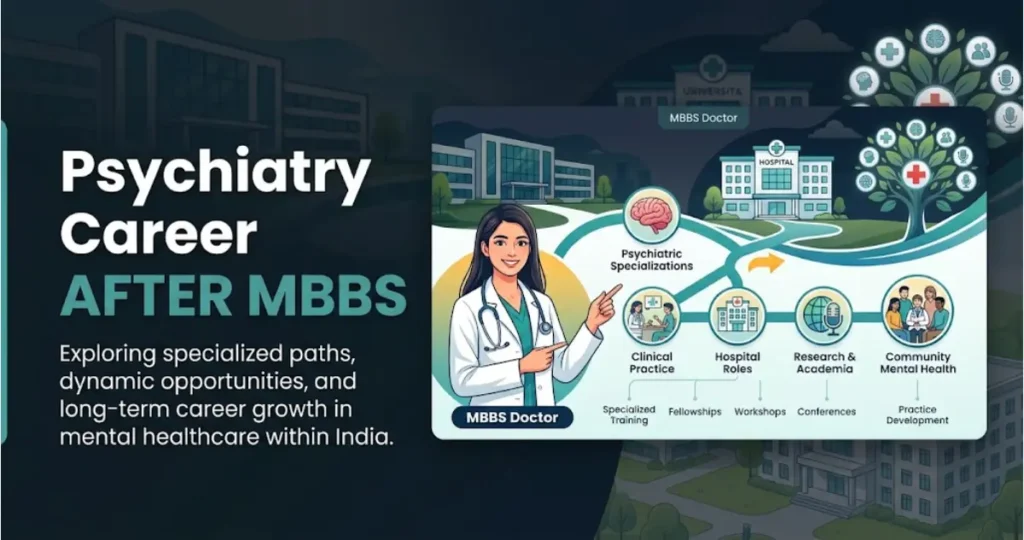
The Psychiatry Career Scope after MBBS includes postgraduate clinical training followed by opportunities in hospitals, medical colleges, mental-health institutions, community programmes, research, private practice, and other healthcare settings.
The National Medical Commission’s postgraduate curriculum resources include MD Psychiatry among recognized postgraduate medical programmes. National Medical Commission — PG Curriculum
A medical student considering psychiatry should evaluate whether the specialty matches their interests and preferred style of clinical practice.
Psychiatry may suit students who enjoy:
- Detailed patient interaction
- Clinical reasoning
- Behavioural science
- Long-term patient relationships
- Communication
- Multidisciplinary care
- Community healthcare
- Mental-health research
- Teaching and academic medicine
Students should not choose psychiatry only because of assumptions about salary or working hours. Psychiatric practice can involve complex cases, emergency situations, emotionally demanding consultations, long-term follow-up, and significant professional responsibility.
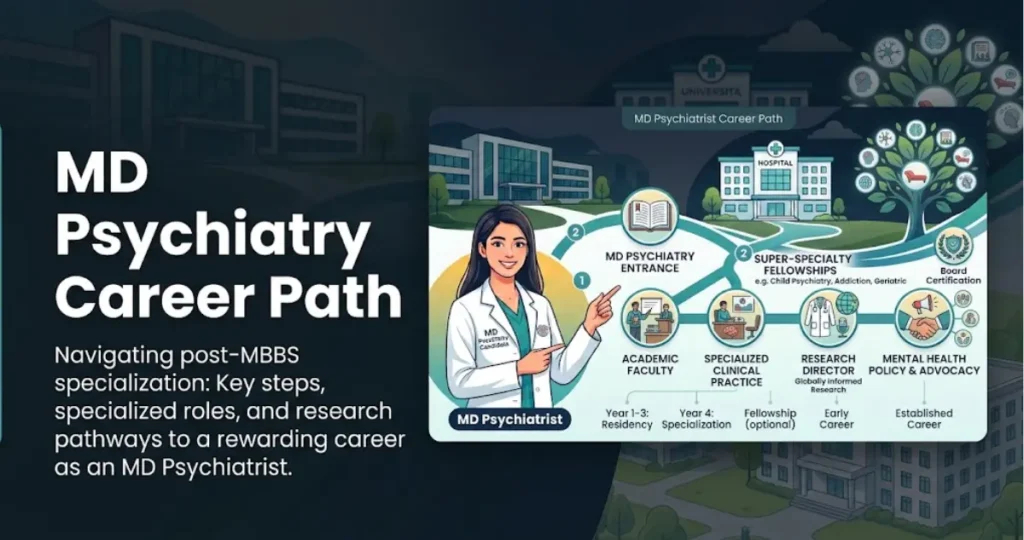
MD Psychiatry as a Career Path
MD Psychiatry is an important postgraduate pathway for doctors who want specialist training in psychiatry.
The NMC competency-based MD Psychiatry curriculum states that postgraduate training aims to prepare specialists who can diagnose and treat psychiatric disorders, provide preventive and rehabilitative care, address community mental-health needs, and develop appropriate teaching and research skills. NMC MD Psychiatry Curriculum
The training can provide exposure to areas such as:
- Psychiatric assessment
- Mental-status examination
- Psychopharmacology
- Child and adolescent psychiatry
- Community psychiatry
- Consultation-liaison psychiatry
- Addiction-related care
- Psychiatric emergencies
- Rehabilitation
- Research
- Teaching
Students comparing psychiatry with other postgraduate branches can also read Best MD Branches After MBBS in India. That article has a broader branch-comparison intent, while this article focuses specifically on psychiatry as a career.
Why Psychiatry Is an Important Medical Specialty
Mental health is an important part of overall health. Psychiatric conditions can affect education, employment, relationships, physical health, family life, and quality of life.
India has developed national programmes to improve access to mental-health services. The National Mental Health Programme includes components related to community-based mental-health services, treatment, rehabilitation, awareness, training, and development of mental-health resources. National Mental Health Programme — DGHS
The development of Tele-MANAS has also introduced a national digital component to mental-health service delivery. According to the Directorate General of Health Services, Tele-MANAS aims to provide 24×7 tele-mental-health services and connect users with counselling, specialist consultation, follow-up, and in-person services where required. Tele-MANAS and National Mental Health Programme
These developments provide different professional environments for doctors interested in psychiatry.
Psychiatry Career Opportunities in India
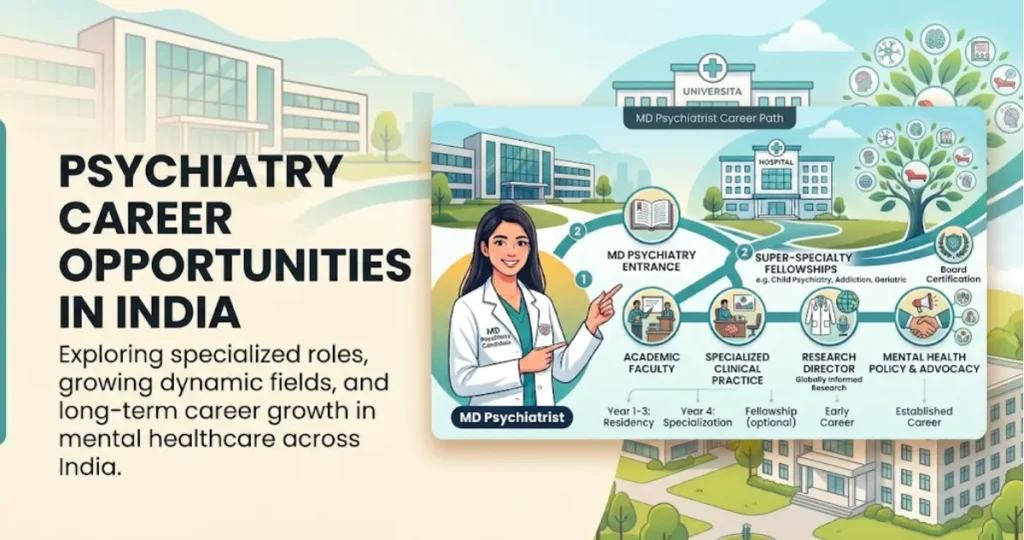
The Psychiatry Career Scope in India extends across government hospitals, private hospitals, medical colleges, mental-health institutes, rehabilitation services, community programmes, research institutions, and private practice.
Government Hospitals
Government hospitals provide psychiatrists with opportunities to work with diverse patient populations.
Responsibilities can include:
- Outpatient psychiatric consultations
- Inpatient psychiatric care
- Psychiatric emergency assessment
- Community mental-health services
- Rehabilitation
- Teaching
- Public-health activities
- Referral and follow-up
The National Mental Health Programme includes district-level mental-health services and community-oriented service delivery. National Mental Health Programme
Private Hospitals
Private hospitals can provide psychiatric services through outpatient departments, inpatient units, consultation services, emergency services, and multidisciplinary teams.
Psychiatrists may work alongside physicians, neurologists, psychologists, psychiatric social workers, nurses, and other healthcare professionals.
Medical Colleges
Academic psychiatry combines clinical work with education and research.
A psychiatrist working in a medical college may participate in:
- Undergraduate teaching
- Postgraduate teaching
- Clinical case discussions
- Research
- Publications
- Academic conferences
- Resident supervision
Academic progression depends on current regulatory requirements, qualifications, experience, publications, and institutional recruitment policies.
Mental-Health Institutes
Specialized mental-health institutions can provide exposure to complex psychiatric conditions, multidisciplinary treatment, rehabilitation, research, and specialist services.
Depending on the institution, doctors may develop focused experience in areas such as child psychiatry, addiction psychiatry, geriatric psychiatry, community psychiatry, and consultation-liaison psychiatry.
Private Psychiatry Practice
Private practice is another possible career pathway.
A psychiatrist in private practice may provide:
- Psychiatric consultations
- Follow-up care
- Medication management
- Family consultations
- Mental-health assessments
- Treatment monitoring
- Referral and multidisciplinary coordination
The development of a successful private practice depends on clinical competence, ethical practice, patient trust, location, professional experience, accessibility, and continuity of care.
Psychiatry Subspecialties and Areas of Practice
Psychiatry includes several areas of clinical practice. Further specialization depends on training opportunities, professional interests, qualifications, and applicable regulations.
Child and Adolescent Psychiatry
Child and adolescent psychiatry focuses on mental and behavioural health during childhood and adolescence.
The field can involve developmental concerns, behavioural problems, attention-related conditions, emotional disorders, school-related difficulties, family concerns, and adolescent mental-health conditions.
The NMC’s psychiatry curriculum includes child psychiatry and behavioural and developmental conditions affecting younger patients. NMC MD Psychiatry Curriculum
Addiction Psychiatry
Addiction-related psychiatric care involves assessment and treatment of substance-use disorders and associated mental-health conditions.
Psychiatrists may work in hospitals, rehabilitation centres, de-addiction services, community programmes, and multidisciplinary treatment teams.
Geriatric Psychiatry
Geriatric psychiatry focuses on mental-health needs among older adults.
Clinical work may involve cognitive disorders, mood conditions, behavioural symptoms, and psychiatric problems associated with ageing and other medical conditions.
Consultation-Liaison Psychiatry
Consultation-liaison psychiatry connects psychiatric expertise with general medical and surgical care.
A psychiatrist may be consulted when a hospitalized patient has psychiatric symptoms, behavioural problems, substance-related concerns, emotional difficulties associated with medical illness, or complex interactions between physical and mental health.
Community Psychiatry
Community psychiatry focuses on providing mental-health services outside traditional psychiatric hospitals.
The National Mental Health Programme includes community-oriented mental-health services and district-level programmes. National Mental Health Programme
Community psychiatry can involve early identification, treatment, follow-up, rehabilitation, awareness, referral systems, and collaboration with primary healthcare providers.
Psychiatry Jobs in India
Psychiatrists can find professional opportunities across different healthcare sectors depending on qualifications, experience, location, and available positions.
Potential roles include:
- Psychiatrist in government hospitals
- Psychiatrist in private hospitals
- Consultant psychiatrist
- Medical college faculty
- Academic psychiatrist
- Community psychiatrist
- Rehabilitation psychiatrist
- Child and adolescent mental-health specialist
- Addiction-care specialist
- Consultation-liaison psychiatrist
- Research professional
- Private practitioner
The availability of positions varies between cities, states, institutions, and healthcare systems. Students should check current recruitment notifications rather than relying on old vacancy information.
Psychiatry Career Scope in Hospitals
Hospital psychiatry can involve both outpatient and inpatient responsibilities.
An outpatient psychiatrist may assess patients during scheduled consultations and provide ongoing follow-up.
Inpatient psychiatry may involve patients requiring more intensive assessment, treatment, observation, and multidisciplinary care.
Psychiatrists may also collaborate with emergency departments when patients present with acute psychiatric symptoms or behavioural emergencies.
Hospital work can provide exposure to a broad range of psychiatric conditions and multidisciplinary clinical decision-making.
Psychiatry Career Scope in Community Healthcare
Community healthcare is an important component of mental-health service delivery in India.
The National Mental Health Programme aims to improve accessibility to mental-healthcare services, including services for vulnerable and underserved populations. Its district-level approach includes treatment, follow-up, awareness, training, and community-oriented activities. National Mental Health Programme — DGHS
A psychiatrist working in community mental health may participate in:
- Outreach clinics
- Community awareness
- Early identification
- Treatment planning
- Referral systems
- Follow-up
- Rehabilitation
- Healthcare-worker training
- Public-health programmes
This area can be particularly suitable for doctors interested in population-level mental-health services.
Psychiatry and Tele-Mental Health
Digital healthcare has created another dimension of the Psychiatry Career Scope in India.
Tele-MANAS is India’s national tele-mental-health programme. The Directorate General of Health Services describes it as a 24×7 digital component of the National Mental Health Programme, with services including counselling, specialist video consultation, e-prescriptions, follow-up, and links to in-person services. Tele-MANAS — DGHS
Telepsychiatry can be useful where geographical distance, mobility, or limited local specialist availability creates barriers to mental-healthcare access.
Doctors working in digital mental health must follow applicable professional, ethical, privacy, documentation, prescribing, and telemedicine requirements.
Psychiatry Career Scope in Research
Psychiatry also provides opportunities in medical and mental-health research.
Research areas can include:
- Mental disorders
- Treatment outcomes
- Community mental health
- Child and adolescent mental health
- Addiction
- Neuropsychiatry
- Psychopharmacology
- Behavioural science
- Public mental health
- Digital mental-health services
- Mental-health policy
Research opportunities may exist through medical colleges, universities, specialist institutes, public-health organizations, and research institutions.
Research experience can also support an academic career.
Psychiatry Career Scope in Teaching
Psychiatry provides opportunities for doctors who enjoy teaching and academic medicine.
A psychiatrist working in a medical college may teach:
- MBBS students
- Postgraduate psychiatry residents
- Allied healthcare professionals
- Nurses
- Community-health workers
Teaching can be combined with clinical practice and research.
Academic progression depends on current regulatory requirements, institutional policies, qualifications, experience, and other applicable criteria.
Is Psychiatry a Good Career After MBBS?
Psychiatry can be a suitable career for an MBBS graduate who genuinely enjoys mental-healthcare, communication, behavioural science, clinical reasoning, and long-term patient management.
The specialty may suit students who:
- Enjoy talking with patients
- Are comfortable listening carefully
- Like understanding behaviour
- Prefer longitudinal patient care
- Have patience with complex cases
- Are interested in mental-health science
- Want hospital and outpatient opportunities
- Are interested in community healthcare
- Want research or teaching opportunities
Psychiatry may be less suitable for students who strongly prefer surgery, procedure-heavy work, imaging-focused practice, or laboratory-based medicine.
There is no universally best medical branch. Students should compare specialties according to their interests, abilities, preferred patient population, workload expectations, and long-term goals.
For a broader decision-making framework, readers can explore How to Choose a Medical Branch.
Psychiatry Salary in India
Psychiatry salary in India does not have one fixed national figure.
Income can vary according to:
- Qualification
- Clinical experience
- City
- Government or private employment
- Hospital type
- Patient volume
- Academic position
- Private consultations
- Subspecialization
- Professional reputation
- Practice model
A newly qualified psychiatrist can have a different income from an experienced consultant with an established private practice.
Government and academic positions generally follow applicable institutional pay structures. Private-sector compensation varies according to employer, location, experience, and responsibilities.
Private practice can provide additional earning potential, but it also involves operating costs, administrative responsibilities, professional obligations, and the time required to establish a patient base.
Students should therefore avoid selecting psychiatry solely because of estimated salary.
Psychiatry Work-Life Balance
Work-life balance in psychiatry depends strongly on the workplace and career model.
An outpatient-focused psychiatrist may have a more predictable schedule than a psychiatrist working in a hospital with emergency, inpatient, and on-call responsibilities.
Factors affecting workload include:
- Hospital type
- Patient volume
- Emergency duties
- Inpatient responsibilities
- On-call schedules
- Private practice
- Location
- Experience
- Subspecialty
Psychiatry should not automatically be described as an easy or low-stress specialty.
Psychiatric emergencies can be demanding, and some patients require intensive assessment and close monitoring.
FulliPedia’s Which Medical Branch Has the Best Work-Life Balance in India provides a broader comparison of how specialty, workplace, patient volume, emergency responsibilities, and career model can influence professional lifestyle.
Psychiatry vs Psychology
Psychiatry and psychology are related but different professions.
Psychiatry is a medical specialty. A psychiatrist is a medical doctor who receives medical education and specialist training in psychiatry.
Psychology is a separate professional field focused on psychological processes, behaviour, assessment, and interventions within the practitioner’s qualifications and professional scope.
A psychiatrist may use medication as part of treatment when clinically appropriate. Psychologists may provide psychological assessment and psychological interventions according to their training and professional scope.
Patients may receive coordinated care from psychiatrists, psychologists, psychiatric social workers, counsellors, nurses, and other professionals.
The appropriate professional depends on the individual’s needs and the nature of the condition.
Skills Needed for a Successful Psychiatry Career
A successful psychiatrist requires more than academic knowledge.
Communication Skills
Psychiatric assessment depends heavily on effective communication. Patients may find it difficult to explain their symptoms or may feel uncomfortable discussing personal experiences.
A psychiatrist must communicate clearly while maintaining professionalism, empathy, confidentiality, and appropriate boundaries.
Clinical Reasoning
Psychiatric symptoms can overlap across different conditions. Clinical reasoning helps doctors consider history, symptoms, mental status, medical factors, substance use, medications, and other relevant information.
Listening Skills
Careful listening is central to psychiatric practice.
The doctor needs to understand the patient’s concerns while identifying clinically relevant patterns within the history.
Emotional Resilience
Psychiatrists may work with patients experiencing severe distress, chronic illness, trauma, substance-use disorders, behavioural emergencies, or suicidal thoughts.
Professional emotional resilience is important for sustainable practice.
Continuous Learning
Psychiatric knowledge continues to develop through clinical research, neuroscience, pharmacology, psychotherapy research, digital health, and public-health initiatives.
A psychiatrist needs to maintain current knowledge throughout the career.
Challenges in a Psychiatry Career
Every medical specialty has challenges, and psychiatry is no exception.
Common professional challenges may include:
- Complex patient presentations
- Treatment-adherence difficulties
- Mental-health stigma
- Long-term follow-up
- Family concerns
- Psychiatric emergencies
- Emotional workload
- Documentation
- Multidisciplinary coordination
- Continuous learning
Mental-health stigma can influence whether people seek professional treatment. Public mental-health programmes therefore include awareness and community activities intended to improve access to care.
A psychiatrist needs clinical knowledge along with communication skills, ethical judgment, patience, and professional boundaries.
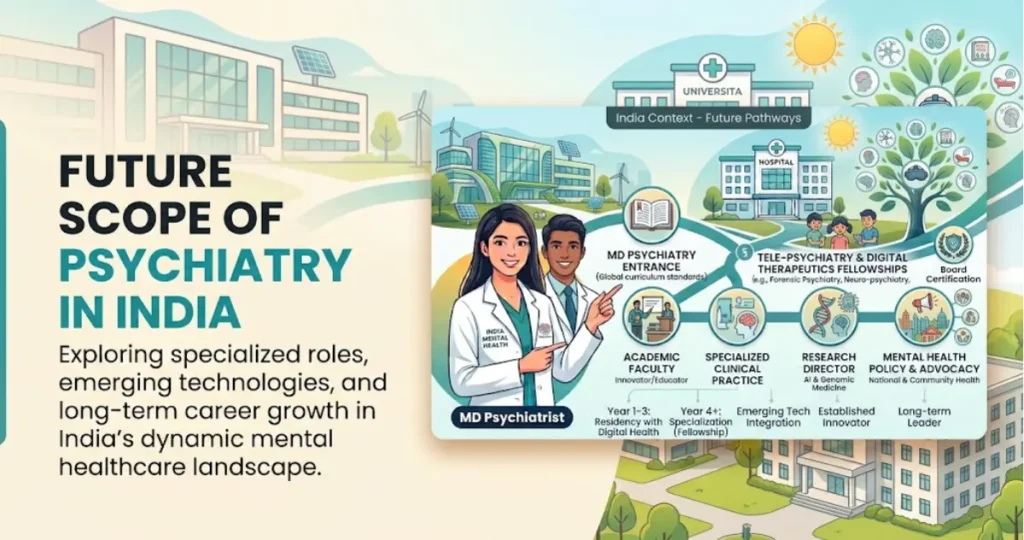
Future Scope of Psychiatry in India
The future Psychiatry Career Scope in India is connected with mental-health awareness, healthcare accessibility, community services, digital healthcare, specialist training, research, and multidisciplinary care.
The National Mental Health Programme includes objectives related to improving access to mental healthcare and strengthening human resources in mental-health services. National Mental Health Programme — DGHS
Potential future professional areas include:
- Hospital psychiatry
- Community psychiatry
- Child and adolescent mental health
- Addiction services
- Geriatric mental health
- Consultation-liaison psychiatry
- Rehabilitation
- Academic medicine
- Mental-health research
- Tele-mental health
- Digital mental-health services
- Public-health programmes
The future development of the specialty will also depend on healthcare delivery, technology, mental-health policy, professional regulation, and patient expectations.
Is Psychiatry in Demand in India?
Mental-healthcare services are relevant across hospitals, communities, rehabilitation services, primary healthcare, specialist institutions, and public-health programmes.
India’s National Mental Health Programme was established to improve access to mental-healthcare services and strengthen mental-health resources. Its programme structure includes district-level services and community-oriented care. National Mental Health Programme
Tele-MANAS has added a national digital service component that connects people with mental-health support and specialist services. Tele-MANAS
Demand can still vary significantly according to location, healthcare infrastructure, patient population, and available specialist services. Students should research the actual employment environment in the region where they plan to work.
Private Practice Scope in Psychiatry
Private psychiatry practice can become an important long-term career option.
A psychiatrist may develop a private practice focused on:
- General psychiatric consultations
- Follow-up care
- Medication management
- Family consultations
- Child and adolescent mental health
- Addiction-related care
- Older-adult mental health
- Psychotherapy coordination
- Tele-mental-health services where permitted
Building a successful practice takes time.
Clinical competence, ethical practice, communication, patient trust, professional reputation, location, accessibility, and continuity of care can influence the development of a practice.
Private practice should be approached as a professional healthcare service rather than simply an income opportunity.
Psychiatry Career Scope Abroad
Psychiatrists may also explore international career opportunities after completing the relevant medical and specialist qualifications.
International practice generally requires compliance with the destination country’s medical licensing, registration, examination, qualification-recognition, language, and immigration requirements.
An Indian postgraduate qualification does not automatically provide unrestricted medical practice rights in another country.
Students considering international careers should check the current requirements of the medical regulator in the country where they intend to work.
How to Decide If Psychiatry Is Right for You
A medical student can use a practical decision framework before selecting psychiatry.
Consider Your Clinical Interest
Ask whether you genuinely enjoy learning about mental health, behaviour, emotions, and psychiatric disorders.
Consider Patient Interaction
Psychiatry involves substantial communication. A student who strongly dislikes prolonged patient conversations may find the specialty less suitable.
Consider Your Preferred Work Environment
Think about whether you prefer outpatient care, hospital work, community healthcare, academic medicine, private practice, or a combination.
Consider Your Long-Term Goals
Decide whether your future goal involves clinical practice, teaching, research, private practice, public health, or focused mental-health services.
Speak With Practicing Psychiatrists
Conversations with psychiatrists and residents can provide practical insight into workload, training, emergencies, patient relationships, and career development.
Compare Psychiatry With Other Medical Branches
Do not evaluate psychiatry in isolation.
FulliPedia’s Best Medical Branch in India provides a broader comparison of medical specialties. The Medical Branches List After NEET in India can also help students understand where psychiatry fits among the wider range of postgraduate medical branches. Medical Branches List After NEET in India
Psychiatry Career Scope: Key Points
| Career Factor | Psychiatry |
|---|---|
| Main focus | Mental, emotional and behavioural health |
| Postgraduate pathway | MD Psychiatry and other recognized pathways subject to current regulations |
| Patient interaction | High |
| Hospital opportunities | Yes |
| Government opportunities | Yes |
| Private practice | Yes |
| Academic career | Yes |
| Research | Yes |
| Community healthcare | Yes |
| Tele-mental health | Yes |
| Subspecialty opportunities | Multiple |
| Work-life balance | Depends on workplace and career model |
| Income | Varies by qualification, experience, location and practice |
| International opportunities | Possible with destination-country licensing |
Frequently Asked Questions
What is the Psychiatry Career Scope in India?
The Psychiatry Career Scope in India includes government hospitals, private hospitals, medical colleges, mental-health institutes, community programmes, rehabilitation services, research, teaching, private practice, and tele-mental-health services.
Is MD Psychiatry a good career after MBBS?
MD Psychiatry can be a suitable career for MBBS graduates who are interested in mental health, behavioural science, patient communication, clinical reasoning, and long-term care. The decision should be based on genuine professional interest rather than salary alone.
What are the career options after MD Psychiatry?
Career options can include consultant psychiatry, government hospitals, private hospitals, medical colleges, academic medicine, community psychiatry, rehabilitation, research, private practice, and focused mental-health services.
Is psychiatry a high-paying medical specialty in India?
Psychiatry can provide good earning opportunities, but income varies according to qualification, experience, location, employer, patient volume, private practice, and professional reputation. There is no single salary applicable to every psychiatrist.
Can psychiatrists work in private practice?
Yes. Private psychiatric practice is a possible career pathway, subject to applicable professional and regulatory requirements.
Does psychiatry have future scope in India?
Psychiatry has continuing relevance because mental-health services are being integrated into hospitals, community healthcare, public-health programmes, and digital health services. The National Mental Health Programme and Tele-MANAS are examples of organized mental-health service development in India.
What is the difference between a psychiatrist and a psychologist?
A psychiatrist is a medical doctor with specialist training in psychiatry. Psychology is a separate professional field. Psychiatrists can provide medical evaluation and treatment within their professional scope, while psychologists provide psychological assessment and interventions according to their qualifications and applicable professional scope.
Can psychiatry offer academic and research careers?
Yes. Psychiatry can provide opportunities in medical education, clinical research, mental-health policy, public health, behavioural science, and specialist research.
Conclusion
The Psychiatry Career Scope in India extends across hospitals, government healthcare, private hospitals, medical colleges, community programmes, rehabilitation services, research institutions, private practice, and digital mental-health services.
Psychiatry combines clinical medicine with behavioural science, communication, diagnostic reasoning, and long-term patient care. The National Medical Commission includes MD Psychiatry within its postgraduate medical education framework, while the National Mental Health Programme supports broader mental-health service delivery and development of mental-health resources.
The specialty can suit MBBS graduates who enjoy patient communication, mental-health science, behavioural medicine, clinical reasoning, and longitudinal care. It can also provide pathways into child and adolescent psychiatry, addiction services, community psychiatry, consultation-liaison work, academic medicine, research, private practice, and tele-mental health.
Students should not select psychiatry simply because they expect a particular salary or lifestyle. Training quality, clinical exposure, professional interests, patient interaction, workload, career goals, and long-term development are more useful factors when making the decision.
Before finalizing a postgraduate specialty, students should verify the latest NMC requirements, admission rules, institutional training environment, and applicable professional regulations because medical education and professional requirements can change.
For broader medical-career planning, readers can also explore Medical Specialization After MBBS in India and How to Choose a Medical Branch.