
Introduction
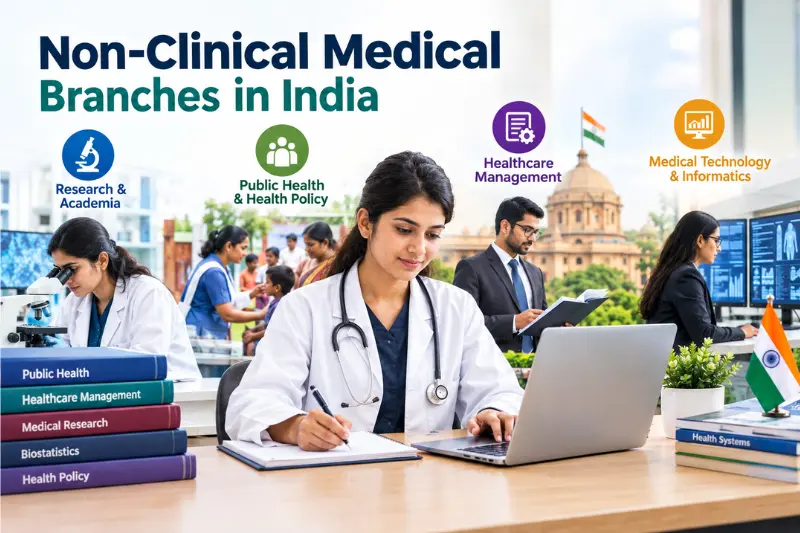
Medical education in India offers career paths beyond direct patient diagnosis, treatment, surgery, and bedside care. Non-Clinical Medical Branches in India provide opportunities in medical education, laboratory sciences, research, public health, healthcare administration, pharmaceutical organizations, biotechnology, and other healthcare-related fields.
Students who complete MBBS often focus on popular clinical specialties such as General Medicine, Surgery, Dermatology, Radiology, Psychiatry, or other patient-facing disciplines. A non-clinical specialty can suit an MBBS graduate who prefers scientific investigation, teaching, research, laboratory work, public health, academic medicine, or healthcare systems.
The National Medical Commission regulates postgraduate medical education in India. Its Post-Graduate Medical Education Regulations, 2023 list recognized postgraduate broad-specialty qualifications, including several disciplines that can be pursued with limited or less frequent direct patient-care responsibilities.
Students researching Non-Clinical Medical Branches in India after MBBS should understand the difference between a specialty, a postgraduate qualification, a career role, and a work environment. A non-clinical branch does not mean that the doctor is outside the medical profession. These specialists can contribute directly to medical education, diagnosis, scientific research, laboratory systems, population health, healthcare quality, and development of medical knowledge.
What Are Non-Clinical Medical Branches in India?
Non-clinical medical branches are postgraduate medical disciplines in which the professional role is generally less centered on routine bedside diagnosis and direct treatment of individual patients.
The exact nature of work differs between specialties and institutions. Some disciplines are strongly laboratory-oriented. Others are focused on medical education, scientific research, population health, healthcare administration, forensic work, or preventive medicine.
Common examples discussed under Non-Clinical Medical Branches in India include:
- Anatomy
- Physiology
- Biochemistry
- Pharmacology
- Microbiology
- Community Medicine
- Forensic Medicine and Toxicology
- Pathology
- Hospital Administration
- Health Administration
- Laboratory Medicine
- Medical education and research-oriented roles
The classification can vary depending on how medical colleges, students, and career resources group specialties. Some disciplines can contain both clinical and non-clinical elements. Pathology, for example, is strongly connected with laboratory diagnosis but also contributes to clinical decision-making.
The official NMC postgraduate regulations provide the more reliable reference for recognized postgraduate qualifications rather than informal lists published online.
Students who want a broader understanding of medical specialization can also explore Medical Specialization After MBBS in India, while this article focuses specifically on the non-clinical side of postgraduate medical careers.
Why Choose Non-Clinical Medical Branches After MBBS?
The reasons for choosing a non-clinical specialty can differ from one MBBS graduate to another.
Some students enjoy basic medical sciences more than continuous patient interaction. Others have a strong interest in laboratory investigation, teaching, research methodology, public health, medical writing, healthcare policy, or academic medicine.
Interest in Medical Education
Anatomy, Physiology, Biochemistry, Pharmacology, Microbiology, and related disciplines can support careers in medical colleges. Postgraduate doctors can participate in undergraduate teaching, postgraduate education, academic activities, curriculum-related work, student mentoring, and research.
Interest in Research
Non-clinical specialties can provide opportunities for biomedical research, laboratory research, epidemiology, pharmacological studies, microbiological research, biochemical investigation, and medical education research.
Preference for Laboratory Work
Some graduates prefer analytical work involving specimens, laboratory systems, diagnostic methods, quality control, and scientific interpretation. Microbiology, Biochemistry, Pathology, and Laboratory Medicine can provide such professional environments.
Interest in Public Health
Community Medicine is closely connected with disease prevention, epidemiology, health promotion, population health, health programmes, and public-health research.
The World Health Organization maintains India-specific information on major health challenges, including noncommunicable diseases, which demonstrates the importance of population-level health work alongside individual clinical care.
Interest in Healthcare Administration
Doctors interested in management can explore areas such as hospital administration and health administration. These careers can involve healthcare operations, quality systems, policy implementation, resource management, patient-safety systems, and organizational planning.
List of Non-Clinical Medical Branches in India
The following branches represent major areas that students may investigate when researching Non-Clinical Medical Branches in India.
Anatomy
Anatomy focuses on the structure of the human body. The discipline covers areas such as gross anatomy, microscopic anatomy, embryology, neuroanatomy, and related structural sciences.
Anatomy specialists can work in medical colleges, academic institutions, research environments, anatomical laboratories, and educational organizations.
Teaching is a major career direction. An anatomy postgraduate can teach MBBS students and participate in academic research. Research may involve anatomical variation, embryology, neuroanatomy, medical education, imaging correlation, or other areas depending on institutional facilities and professional interests.
Physiology
Physiology studies how the human body functions. It covers body systems, physiological mechanisms, regulation, adaptation, and relationships between different organ systems.
MD Physiology can be relevant for MBBS graduates interested in medical education and scientific research.
Career opportunities can include:
- Medical college teaching
- Academic research
- Biomedical research
- Physiology laboratories
- Medical education
- Research institutions
A physiology-focused career can suit a graduate who enjoys understanding mechanisms rather than primarily managing patients in a clinical setting.
Biochemistry
Biochemistry examines the chemical processes associated with living organisms and human health.
Medical biochemistry has strong connections with laboratory medicine, biochemical investigations, diagnostics, teaching, and research.
An MBBS graduate pursuing this discipline may develop knowledge of biochemical markers, metabolic processes, laboratory techniques, quality systems, and research methodology.
Career opportunities can include medical colleges, diagnostic laboratories, research institutions, biotechnology organizations, and academic settings.
Pharmacology
Pharmacology focuses on medicines, drug actions, therapeutic effects, adverse effects, interactions, pharmacokinetics, pharmacodynamics, and related scientific areas.
A pharmacology postgraduate can develop a career in teaching, academic research, clinical research, pharmaceutical research, drug-safety activities, and related healthcare organizations.
Pharmacology is particularly relevant to graduates who enjoy understanding how medicines work and how evidence is generated around their safety and effectiveness.
Microbiology
Microbiology studies microorganisms and their relationships with disease, health, laboratory diagnosis, infection control, and public health.
Medical microbiology can involve bacteriology, virology, mycology, parasitology, immunology, infection-related laboratory work, and antimicrobial-resistance research.
Career opportunities may include:
- Medical colleges
- Diagnostic laboratories
- Research institutions
- Public-health laboratories
- Infection-control departments
- Pharmaceutical and biotechnology organizations
Microbiology can combine laboratory science with public-health relevance.
Community Medicine
Community Medicine focuses on population health rather than individual patient treatment alone.
The field includes epidemiology, health promotion, disease prevention, community health programmes, public-health research, screening, health policy, and healthcare planning.
Community Medicine can be relevant for graduates interested in:
- Epidemiology
- Public health
- Health programmes
- Research
- Preventive medicine
- Health policy
- Community-based healthcare
WHO resources on India demonstrate the scale and importance of population-level health surveillance and disease prevention work.
Forensic Medicine and Toxicology

Forensic Medicine and Toxicology connects medical knowledge with legal and investigative processes.
The discipline can involve medicolegal examination, injury interpretation, poisoning, toxicology, forensic documentation, death investigation, and teaching.
Career settings may include medical colleges, government institutions, forensic facilities, and related academic or medico-legal environments.
The work can require careful documentation, scientific reasoning, professional ethics, and knowledge of applicable legal procedures.
Pathology
Pathology occupies an important position between laboratory science and clinical medicine.
Pathologists contribute to disease diagnosis through examination of tissues, cells, blood, and other specimens. Depending on the professional role and subspecialty, pathology can include histopathology, cytopathology, hematology, transfusion medicine, molecular diagnostics, and laboratory management.
Pathology is sometimes discussed separately from strictly non-clinical disciplines because its diagnostic contribution directly affects patient care.
Students should understand this distinction before placing Pathology into a personal list of Non-Clinical Medical Branches in India.
Hospital Administration
Hospital Administration focuses on the management and operation of healthcare organizations.
Doctors working in this field may contribute to hospital planning, quality management, healthcare operations, patient-safety systems, resource utilization, accreditation processes, staff coordination, and administrative decision-making.
The work is different from conventional bedside medicine. Communication, management, healthcare systems knowledge, leadership, documentation, and organizational skills become important.
Health Administration
Health Administration has a broader systems-oriented focus. The work can involve healthcare organizations, public programmes, policy implementation, planning, quality improvement, and management of health services.
This field can interest doctors who want to combine medical knowledge with management and healthcare-system responsibilities.
Non-Clinical Medical Branches After MBBS: Course Pathway
For an MBBS graduate, the postgraduate pathway depends on the chosen specialty, eligibility requirements, admission rules, recognized qualification, and institution.
A simplified pathway is:
MBBS → Postgraduate Medical Admission → Recognized Postgraduate Qualification → Academic, Research, Laboratory, Public Health, or Administrative Career
NEET-PG is an important national entrance pathway for admission to various MD/MS and postgraduate diploma courses, subject to the applicable eligibility requirements and current examination rules. The official NBEMS NEET-PG page provides current examination information, bulletins, application information, notices, and results.
Students should always verify the current admission requirements before applying because medical education regulations and examination arrangements can change.
National Board of Examinations in Medical Sciences (NBEMS) is the authoritative source for current examination-related information.
The NMC maintains the regulatory framework for postgraduate medical education. Its current regulations include recognized postgraduate broad-specialty qualifications and related standards.
MD Non-Clinical Branches in India
Many discussions about Non-Clinical Medical Branches in India focus on MD specialties.
Examples can include:
- MD Anatomy
- MD Physiology
- MD Biochemistry
- MD Pharmacology
- MD Microbiology
- MD Community Medicine
- MD Forensic Medicine and Toxicology
- MD Pathology
- MD Hospital Administration
- MD Health Administration
- Other recognized disciplines depending on the current regulatory framework
The NMC’s Post-Graduate Medical Education Regulations, 2023 list recognized broad-specialty qualifications. The list includes Anatomy, Biochemistry, Community Medicine, Forensic Medicine and Toxicology, Hospital Administration, Health Administration, Microbiology, Pathology and several other MD disciplines.
Students should not rely on an old branch list when planning postgraduate admission. Current NMC regulations and the applicable admission bulletin should be checked.
For students comparing broader MD options, Best MD Branches After MBBS in India covers both clinical and non-clinical MD pathways. This article narrows the focus to the non-clinical career model.
Career Scope of Non-Clinical Medical Branches in India
The career scope of Non-Clinical Medical Branches in India extends beyond medical college teaching.
A postgraduate doctor may develop a career in:
- Medical education
- Academic medicine
- Biomedical research
- Public health
- Epidemiology
- Diagnostic laboratories
- Pharmaceutical research
- Biotechnology
- Clinical research
- Healthcare administration
- Government health programmes
- Medical writing
- Scientific communication
- Quality management
- Healthcare organizations
The actual opportunities depend on qualification, experience, institution, location, additional training, research skills, professional networking, and applicable recruitment requirements.
Medical Colleges and Teaching
Medical colleges remain an important employment setting for postgraduate doctors in non-clinical specialties.
Teaching roles can involve lectures, practical sessions, student assessment, curriculum activities, mentoring, research, academic documentation, and institutional responsibilities.
Research Institutions
Research-oriented graduates can explore universities, medical colleges, government research organizations, private research institutions, pharmaceutical companies, biotechnology organizations, and healthcare technology companies.
Research work may involve study design, laboratory methods, epidemiology, data analysis, scientific writing, clinical research, or translational research.
Diagnostic Laboratories
Graduates from pathology, microbiology, biochemistry, and related disciplines may work within diagnostic and laboratory environments.
Responsibilities can include laboratory supervision, quality assurance, diagnostic interpretation, research, method development, and management functions depending on the qualification and organization.
Public Health Organizations
Community Medicine and related public-health expertise can support careers involving epidemiology, surveillance, prevention programmes, health promotion, research, and health-system planning.
WHO’s India surveillance resources provide examples of national-level disease surveillance activities, showing how population health relies on structured data and monitoring systems.
Pharmaceutical and Biotechnology Sector
Pharmacology, microbiology, biochemistry, pathology, and other scientific disciplines can connect medical graduates with pharmaceutical and biotechnology organizations.
Potential work areas can include research, drug development support, pharmacovigilance, medical affairs, scientific communication, regulatory functions, laboratory operations, and clinical research, depending on the employer and additional qualifications.
Non-Clinical Medical Branches for Teaching Careers
Teaching is one of the most visible career paths within Non-Clinical Medical Branches in India.
Anatomy, Physiology, Biochemistry, Pharmacology, Microbiology, Community Medicine, Pathology, and other disciplines can have strong academic components.
A teaching-oriented career requires more than subject knowledge.
Important skills include:
- Clear explanation of complex concepts
- Practical teaching ability
- Research methodology
- Academic writing
- Student mentoring
- Presentation skills
- Assessment skills
- Scientific communication
- Continuous professional development
The NMC regulatory framework includes requirements and standards related to postgraduate medical education and faculty qualifications, making official NMC information important for doctors planning academic careers.
Students interested in the broader medical-specialty selection process can also read How to Choose a Medical Branch.
Non-Clinical Medical Branches for Research Careers

Research is a major area for doctors who prefer scientific investigation.
A postgraduate doctor can contribute to research involving:
- Disease mechanisms
- Drug development
- Laboratory diagnostics
- Epidemiology
- Public health
- Medical education
- Biomedical sciences
- Molecular medicine
- Microbiology
- Pharmacology
- Healthcare systems
Research careers can develop within universities, medical colleges, government institutions, pharmaceutical organizations, biotechnology companies, hospitals, and independent research organizations.
The NMC’s current postgraduate framework also places emphasis on research methodology and ethics within postgraduate medical education.
Research-oriented doctors need skills in literature review, research design, statistics, data interpretation, scientific writing, ethical research conduct, and presentation of findings.
Non-Clinical Medical Branches and Work-Life Balance
Work-life balance can be an important consideration when comparing Non-Clinical Medical Branches in India with highly patient-facing specialties.
A non-clinical role may involve fewer emergency calls or routine bedside responsibilities, depending on the specialty and workplace. This does not mean every non-clinical medical career has fixed working hours.
Academic institutions can involve teaching schedules, examinations, research deadlines, administrative work, meetings, and institutional responsibilities.
Laboratories can involve shift-based operations, quality-control requirements, reporting responsibilities, and urgent diagnostic services.
Public-health positions can involve field programmes, reporting deadlines, programme monitoring, travel, and administrative responsibilities.
Healthcare administration can require extended hours during operational problems, audits, inspections, accreditation activities, or major organizational projects.
Work-life balance should be evaluated from the actual job description rather than the specialty name alone.
Fullipedia’s Work-Life Balance discussion for medical branches provides broader context for comparing professional lifestyle factors.
Salary in Non-Clinical Medical Branches in India
Salary varies significantly across Non-Clinical Medical Branches in India.
Factors can include:
- Postgraduate qualification
- Experience
- Employer
- City
- Government or private institution
- Academic position
- Research role
- Laboratory responsibilities
- Administrative responsibilities
- Additional qualifications
- Professional specialization
A medical college faculty position can have a different compensation structure from a private diagnostic laboratory role.
A research position can have a different salary structure from pharmaceutical employment.
A healthcare administration role can have different responsibilities from academic medicine.
Students should avoid choosing a non-clinical specialty based on a single salary figure found online. Actual compensation changes with experience, organization, location, role, and professional progression.
Non-Clinical vs Clinical Medical Branches
The difference between clinical and non-clinical branches is primarily related to the nature of professional work.
| Factor | Clinical Branches | Non-Clinical Branches |
|---|---|---|
| Main focus | Direct patient care | Science, education, research, systems or laboratory work |
| Patient interaction | Usually high | Often lower, depending on specialty |
| Emergency duties | Common in some specialties | Usually less common, depending on workplace |
| Teaching | Possible | Major career pathway |
| Research | Possible | Major career pathway |
| Laboratory work | Varies | Important in several disciplines |
| Public health | Some specialties | Important in Community Medicine and related fields |
| Administration | Possible | Important in administration-focused specialties |
The distinction is not absolute.
Pathology, for example, supports direct patient care through diagnosis even though much of the professional work occurs in laboratory settings.
Community Medicine can involve fieldwork and community interaction.
Forensic Medicine can involve practical medico-legal responsibilities.
The daily role depends on the specialty and institution.
Skills Needed for Non-Clinical Medical Careers
A successful career in Non-Clinical Medical Branches in India requires professional skills beyond MBBS knowledge.
Research Skills
Research methodology, study design, literature evaluation, data analysis, and scientific writing are valuable for academic and research positions.
Teaching Skills
Doctors interested in medical education need the ability to explain concepts clearly, design learning activities, assess students, and mentor learners.
Laboratory Skills
Laboratory-focused specialties require technical knowledge, quality assurance, interpretation of results, safety procedures, and scientific accuracy.
Communication Skills
Non-clinical doctors still communicate with students, researchers, healthcare professionals, administrators, laboratory staff, government officials, and other stakeholders.
Data and Technology Skills
Digital health systems, laboratory information systems, research databases, statistical software, electronic records, and healthcare technologies are increasingly relevant to modern medical careers.
Ethics and Professionalism
Medical education, research, laboratory medicine, public health, and administration all require professional ethics and responsible handling of medical information.
How to Choose Non-Clinical Medical Branches After MBBS
Choosing among Non-Clinical Medical Branches in India should begin with the type of work you want to perform every day.
A student who enjoys teaching may explore Anatomy, Physiology, Biochemistry, Pharmacology, Microbiology, or related academic disciplines.
A graduate interested in laboratory diagnosis may explore Pathology, Microbiology, Biochemistry, or Laboratory Medicine.
A graduate interested in population health may investigate Community Medicine and public-health pathways.
A student interested in medicines and drug science may explore Pharmacology.
Someone interested in healthcare systems may investigate Hospital Administration or Health Administration.
The decision should include:
- Subject interest
- Patient interaction preference
- Teaching interest
- Research interest
- Laboratory interest
- Public-health interest
- Work environment
- Career location
- Training requirements
- Long-term professional goals
Fullipedia’s broader guide on how to choose a medical branch can be used alongside this more focused non-clinical guide.
Admission and Eligibility for Non-Clinical Medical Branches
Eligibility depends on the specific postgraduate course and the applicable rules for the admission year.
An MBBS degree or recognized equivalent qualification, registration requirements, internship requirements, entrance examination requirements, and counselling rules can apply.
For NEET-PG pathways, the official NBEMS information states that candidates must satisfy the applicable qualification, registration, internship, and other eligibility requirements described in the relevant information bulletin.
Students should verify the current:
- NMC regulations
- NBEMS information bulletin
- Counselling rules
- Seat availability
- Qualification recognition
- Internship requirements
- Registration requirements
- Institution-specific conditions
The official NMC Rules and Regulations page should be checked for current regulatory information.
Future Scope of Non-Clinical Medical Branches in India
The future scope of Non-Clinical Medical Branches in India is connected with the expansion of medical education, biomedical research, laboratory diagnostics, public health, healthcare technology, pharmaceuticals, biotechnology, and healthcare administration.
India’s healthcare system requires professionals who can contribute outside direct bedside treatment.
Medical colleges require educators.
Research organizations require scientific professionals.
Laboratories require qualified medical expertise.
Public-health programmes require epidemiology and preventive-health knowledge.
Pharmaceutical and biotechnology organizations require scientific and medical expertise.
Healthcare organizations require professionals who understand both medicine and management.
Technology is also changing medical work. Digital pathology, laboratory automation, electronic health records, data systems, molecular diagnostics, telemedicine, and artificial-intelligence-assisted healthcare tools can create new professional environments.
Technology does not eliminate the need for medical expertise. Doctors still need to interpret evidence, understand limitations, follow ethical standards, and apply professional judgment.
Are Non-Clinical Medical Branches Good After MBBS?

The suitability of Non-Clinical Medical Branches in India depends on the graduate’s interests and preferred professional environment.
A student who wants daily bedside interaction and acute clinical decision-making may prefer a clinical specialty.
A graduate who enjoys teaching, laboratory science, research, public health, medical administration, or academic work may find a non-clinical pathway more aligned with their goals.
There is no single non-clinical branch that suits every MBBS graduate.
The practical question is not which branch is universally best. The useful question is which branch provides the type of work, training, environment, and professional development that matches the graduate’s long-term goals.
Frequently Asked Questions About Non-Clinical Medical Branches in India
What are Non-Clinical Medical Branches in India?
They are postgraduate medical disciplines in which the professional role is generally less centered on routine direct patient treatment. Common examples include Anatomy, Physiology, Biochemistry, Pharmacology, Microbiology, Community Medicine, Forensic Medicine and Toxicology, and other recognized disciplines.
Which non-clinical branches are available after MBBS?
The available specialties depend on the current recognized postgraduate qualification list, institutions, seat availability, and admission rules. NMC regulations provide the authoritative framework for recognized postgraduate qualifications.
Is Pathology a non-clinical branch?
Pathology is often grouped with non-clinical or laboratory-oriented specialties in career discussions, but its work directly supports patient diagnosis and clinical decision-making. Its classification can vary according to the context.
Can non-clinical doctors work in medical colleges?
Yes. Teaching and academic medicine are major career pathways for several non-clinical specialties.
Can non-clinical doctors work in research?
Yes. Research opportunities can exist in medical colleges, universities, government institutions, pharmaceutical organizations, biotechnology companies, laboratories, and healthcare research organizations.
Is NEET-PG required for non-clinical MD branches?
For relevant MD/MS postgraduate admissions through the applicable national pathway, NEET-PG is an important entrance examination. Eligibility and admission rules should be checked in the current NBEMS information bulletin and applicable regulations.
Which non-clinical branch is best for teaching?
Teaching opportunities exist across several non-clinical disciplines. The appropriate choice depends on the subject the graduate enjoys, academic interests, research goals, and available career opportunities.
Which non-clinical branch is suitable for research?
Anatomy, Physiology, Biochemistry, Pharmacology, Microbiology, Community Medicine, Pathology, and other research-oriented disciplines can provide research opportunities. The actual research environment depends on the institution and the individual’s interests.
Conclusion
Non-Clinical Medical Branches in India provide meaningful career pathways for MBBS graduates who want to move toward medical education, research, laboratory sciences, public health, pharmaceutical research, biotechnology, or healthcare administration.
Anatomy, Physiology, Biochemistry, Pharmacology, Microbiology, Community Medicine, Forensic Medicine and Toxicology, Pathology, Hospital Administration, Health Administration, and other recognized disciplines offer different professional environments.
The right choice depends on academic interest, preferred work setting, patient interaction, research goals, teaching interest, career plans, and postgraduate training opportunities.
Students should use current NMC regulations and official NBEMS information when checking recognized qualifications, eligibility, admission requirements, and examination procedures.
For readers comparing the wider postgraduate landscape, Fullipedia’s Medical Specialization After MBBS in India and Best MD Branches After MBBS in India provide broader context. This article remains focused on the specific career intent behind Non-Clinical Medical Branches in India.