
Introduction
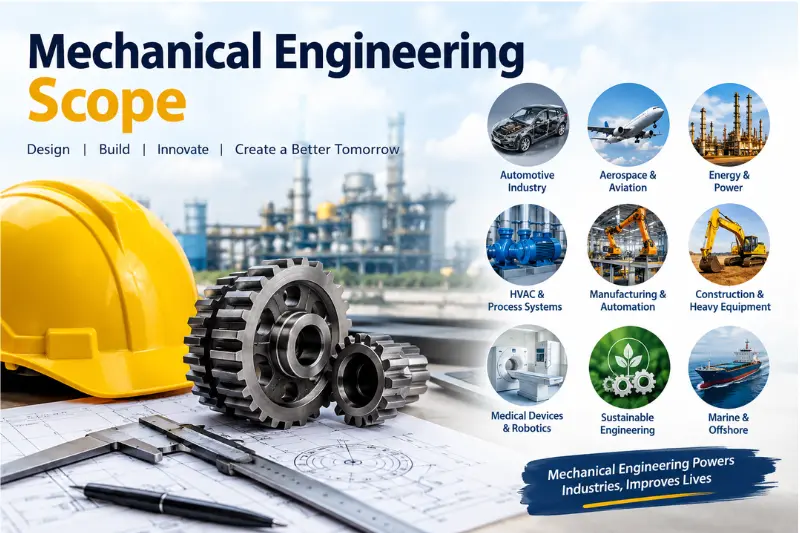
Mechanical engineering is one of the broadest engineering disciplines, offering career opportunities in manufacturing, automotive, aerospace, energy, robotics, automation, HVAC, healthcare, marine industries, and many other sectors. The mechanical engineering scope has expanded considerably as industries adopt automation, advanced manufacturing, renewable energy, electric vehicles, computer-aided design, simulation, robotics, and digital technologies.
For students and graduates, understanding the mechanical engineering scope is important because the field does not lead to only one type of job. A mechanical engineer may work as a design engineer, manufacturing engineer, maintenance engineer, production engineer, thermal engineer, project engineer, robotics engineer, quality engineer, or research engineer.
If you are new to the subject and want to understand the basic definition, history, subjects, and importance of mechanical engineering first, you can read What Is Mechanical Engineering.
What Is the Scope of Mechanical Engineering?
The scope of mechanical engineering refers to the range of industries, technologies, professional roles, and career opportunities available to mechanical engineers. The discipline covers systems involving machines, motion, force, energy, heat, fluids, materials, manufacturing, and mechanical components.
Mechanical engineers can be involved in designing a product, developing a machine, testing a prototype, improving a manufacturing process, maintaining industrial equipment, analyzing failures, managing projects, or developing new technologies.
The broad nature of this profession comes from its connection with many other engineering fields. Mechanical engineers may work with electrical engineers on motors and controls, software engineers on automation, materials engineers on advanced materials, civil engineers on building systems, and specialists from other disciplines on complex products.
The U.S. Bureau of Labor Statistics describes mechanical engineering as one of the broadest engineering fields, with applications ranging from medical devices and batteries to machinery, heating and cooling systems, and robots. U.S. Bureau of Labor Statistics – Mechanical Engineers
Why Is Mechanical Engineering Scope So Broad?
Mechanical engineering deals with physical systems used in almost every major industry. Manufacturing plants need machines and production systems. Transportation companies need vehicles and mechanical components. Energy companies need turbines, pumps, compressors, heat exchangers, and other equipment.
Buildings require heating, cooling, ventilation, and energy systems. Healthcare companies develop medical devices and equipment. Aerospace organizations need mechanical systems for aircraft and spacecraft. Modern factories require automation, robotics, and advanced manufacturing technologies.
The educational foundation of the discipline is also broad. The current ABET criteria for mechanical engineering programs include engineering principles, basic science, mathematics, modeling, analysis, design, realization of physical systems, and coverage of thermal and mechanical systems. ABET – 2026–2027 Engineering Accreditation Criteria
This combination of fundamental engineering knowledge and wide industrial application gives mechanical engineering graduates flexibility when choosing a career.
Major Industries in Mechanical Engineering
The mechanical engineering scope extends across numerous industries. The most important areas include automotive engineering, manufacturing, aerospace, energy, oil and gas, HVAC, robotics, automation, healthcare technology, marine engineering, construction equipment, and research and development.
Automotive Industry
The automotive industry has traditionally been one of the largest areas for mechanical engineers. Engineers may work on engines, transmissions, braking systems, suspension, vehicle structures, thermal systems, aerodynamics, manufacturing processes, testing, and reliability.
The industry is also changing rapidly because of electric vehicles, battery technology, lightweight materials, advanced thermal management, and automated vehicle systems.
Mechanical engineers can work for automobile manufacturers, automotive component companies, engineering consultancies, testing organizations, and manufacturing plants.
The growth of electric mobility does not eliminate the role of mechanical engineering. It changes the areas in which mechanical engineers apply their knowledge. Battery enclosures, cooling systems, vehicle structures, suspension, brakes, manufacturing equipment, and thermal management all involve mechanical engineering.
Manufacturing Industry
Manufacturing is another major area within the mechanical engineering scope. Manufacturing engineers work on production processes, machinery, tooling, quality, automation, process optimization, and product realization.
Mechanical engineers may help determine how a product should be manufactured, select suitable processes, develop production equipment, improve production efficiency, or investigate manufacturing problems.
Modern manufacturing increasingly combines mechanical systems with sensors, robotics, software, data, and automation. Engineers who understand both traditional manufacturing and modern production technologies can therefore find opportunities in a wide range of industrial environments.
Aerospace Industry
Aerospace engineering provides another career direction for mechanical engineers. They may contribute to aircraft structures, propulsion systems, thermal systems, landing systems, manufacturing, testing, maintenance, and mechanical components.
Aerospace work requires a strong understanding of mechanics, materials, fluid mechanics, thermodynamics, heat transfer, design, and engineering analysis.
Mechanical engineers can enter specialized aerospace roles by developing additional expertise in areas such as computational analysis, composite materials, propulsion, structural analysis, manufacturing, and testing.
Energy and Power Industry
Energy production and power generation depend heavily on mechanical equipment. Mechanical engineers can work with turbines, pumps, compressors, boilers, heat exchangers, cooling systems, pressure equipment, and other machinery.
Traditional power generation continues to require engineers for equipment design, operation, maintenance, reliability, and efficiency improvement.
At the same time, renewable energy is creating new opportunities. Wind turbines, solar thermal systems, energy storage equipment, hydrogen-related technologies, and energy-efficient mechanical systems all require engineering knowledge.
The mechanical engineering scope therefore includes both established energy industries and emerging energy technologies.
Oil and Gas Industry
Oil and gas facilities use mechanical engineers for rotating machinery, pumps, compressors, pressure equipment, pipelines, maintenance, reliability, equipment design, and plant operations.
Engineers may work in refineries, processing plants, offshore facilities, pipeline operations, equipment manufacturing, or engineering services.
Maintenance and reliability are particularly important because equipment failure can result in production losses, environmental risks, and safety concerns.
Mechanical engineers working in this sector may therefore develop expertise in inspection, equipment reliability, maintenance planning, vibration analysis, pressure systems, and industrial standards.
HVAC and Refrigeration
Heating, ventilation, air conditioning, and refrigeration represent an established part of the mechanical engineering scope.
Mechanical engineers in this field design and manage systems used in homes, offices, hospitals, factories, shopping centers, transportation systems, data centers, and other facilities.
Modern HVAC engineering increasingly focuses on energy efficiency, indoor environmental quality, automation, heat pumps, refrigeration efficiency, and sustainable building systems.
Engineers interested in thermal systems can develop a specialized career in HVAC design, consulting, project management, commissioning, energy analysis, or building services.
Robotics and Automation
Robotics has become one of the most important modern applications of mechanical engineering. Robots require mechanical structures, joints, actuators, motors, sensors, control systems, and software.
Mechanical engineers may design robotic mechanisms, arms, frames, end-effectors, motion systems, and supporting equipment. They can also contribute to industrial automation and automated production lines.
The U.S. Bureau of Labor Statistics specifically identifies robotic engineering as an area of mechanical engineering work, including planning, building, and maintaining robots. BLS Mechanical Engineers – Robotics and Automation
Students interested in this field can strengthen their mechanical engineering foundation with programming, electronics, control systems, sensors, and robotics.
Healthcare and Medical Technology
Mechanical engineering also has applications in healthcare. Engineers can contribute to medical devices, prosthetic systems, rehabilitation equipment, surgical instruments, diagnostic equipment, and other technologies.
This area requires knowledge of mechanical design, materials, manufacturing, testing, safety, and sometimes biomechanics.
Mechanical engineering graduates interested in healthcare technology can combine mechanical design skills with biomedical engineering concepts to develop specialized expertise.
Marine Engineering
Marine engineering is another potential career direction. Ships, propulsion systems, marine engines, pumps, compressors, auxiliary systems, cargo equipment, and offshore machinery all require mechanical engineering knowledge.
Engineers may work in shipbuilding, marine equipment manufacturing, offshore facilities, vessel maintenance, marine consulting, or related industrial sectors.
This area can be particularly suitable for engineers interested in large mechanical systems, rotating equipment, propulsion, maintenance, and industrial operations.
Mechanical Engineering Career Options
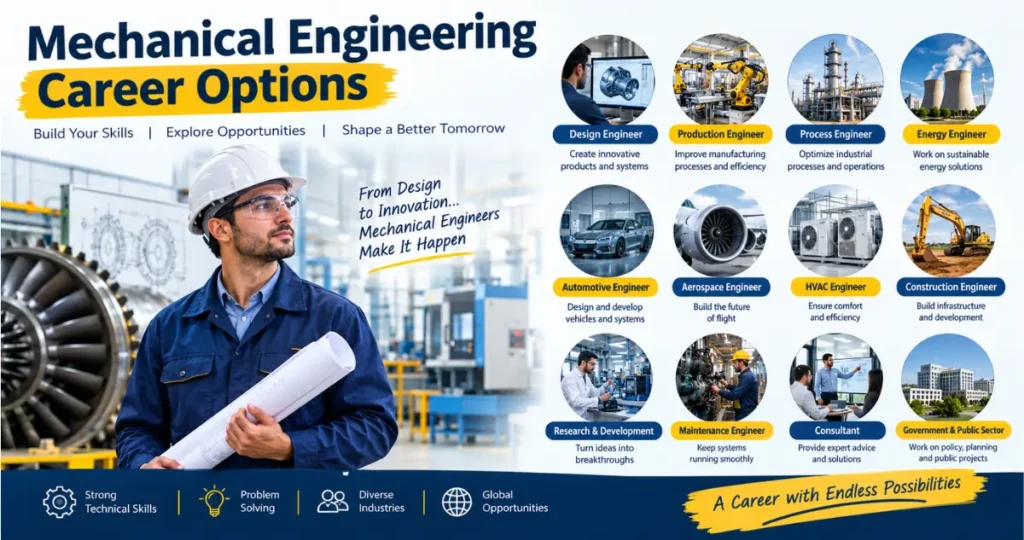
The mechanical engineering scope includes many different professional roles. A graduate does not have to follow a single career path throughout their working life.
Common job roles include:
- Mechanical Design Engineer
- Manufacturing Engineer
- Production Engineer
- Maintenance Engineer
- Reliability Engineer
- Quality Engineer
- Project Engineer
- Thermal Engineer
- HVAC Engineer
- Automotive Engineer
- Aerospace Engineer
- Robotics Engineer
- Automation Engineer
- Product Development Engineer
- Testing Engineer
- Research Engineer
- Energy Engineer
- Applications Engineer
- Sales Engineer
- Engineering Consultant
- Project Manager
The responsibilities associated with each position can vary considerably. A design engineer may spend much of the day working with CAD and engineering analysis, while a maintenance engineer may spend more time troubleshooting equipment at an industrial facility.
Mechanical Design Engineering
Mechanical design is one of the most established career paths in the mechanical engineering scope.
Design engineers develop components, machines, products, and systems that must meet performance, safety, cost, manufacturing, and reliability requirements.
Their work can include creating 3D models, preparing engineering drawings, selecting materials, evaluating loads, checking tolerances, performing calculations, developing prototypes, and working with manufacturing teams.
Computer-aided design is an important part of modern mechanical design. Depending on the industry, engineers may use software such as SolidWorks, AutoCAD, CATIA, Creo, or other engineering platforms.
Design engineers can work in automotive, aerospace, consumer products, industrial equipment, medical devices, energy systems, manufacturing, and many other industries.
Manufacturing and Production Engineering
Manufacturing engineers focus on how products and components are produced.
Their responsibilities may include selecting manufacturing processes, developing tooling, improving production lines, reducing waste, supporting production machinery, improving cycle times, and coordinating with quality teams.
Production engineers may also investigate manufacturing problems and identify ways to improve efficiency, consistency, safety, and productivity.
Advanced manufacturing is increasing the use of CNC machinery, industrial robots, automated material handling, machine vision, sensors, and digital monitoring. This gives mechanical engineers opportunities to work at the intersection of traditional manufacturing and automation.
Maintenance and Reliability Engineering
Maintenance engineering is particularly important in industries that depend on large and expensive equipment.
Maintenance engineers help keep machinery operational and reliable. Their work can include preventive maintenance, troubleshooting, inspection, failure analysis, spare-parts planning, equipment monitoring, and maintenance scheduling.
Reliability engineering focuses more deeply on understanding why equipment fails and how operating life can be improved.
These careers are common in manufacturing plants, power facilities, oil and gas, transportation, marine operations, process industries, and other industrial environments.
Thermal Engineering
Thermal engineering focuses on heat, energy, temperature, fluids, and related systems.
Mechanical engineers specializing in this area may work with engines, turbines, boilers, refrigeration systems, heat exchangers, HVAC equipment, energy systems, and thermal management.
Thermal engineering is becoming increasingly important because industries are seeking better energy efficiency and improved temperature control.
Electric vehicles also require thermal management for batteries, motors, power electronics, and passenger compartments.
Mechatronics and Automation
Mechatronics combines mechanical engineering with electronics, sensors, control systems, and computing.
Modern machines increasingly operate as integrated systems rather than isolated mechanical devices. A production machine may contain mechanical components, electric motors, sensors, controllers, communication systems, and software.
Mechanical engineers working in mechatronics can contribute to actuators, motors, sensors, automated mechanisms, robotics, machine controls, and industrial automation.
ABET’s current criteria for mechatronics and robotics-related programs also recognize the integration of mechanical systems, electronic circuits, control systems, computer science, sensors, actuators, and embedded controllers. ABET Engineering Accreditation Criteria
Additive Manufacturing and 3D Printing
Additive manufacturing has introduced new possibilities in product development and manufacturing.
Unlike many traditional processes that remove material to create a component, additive manufacturing builds objects layer by layer.
Mechanical engineers can work on component design, material selection, process development, testing, quality control, production optimization, and applications of 3D printing.
The technology can be useful for prototypes, customized components, complex geometries, lightweight structures, and specialized manufacturing.
Renewable Energy and Sustainable Engineering
Sustainability is becoming an increasingly important consideration in engineering.
Mechanical engineers can contribute to renewable energy systems, energy-efficient machinery, waste-heat recovery, energy storage, sustainable manufacturing, and low-emission industrial systems.
Wind turbines, for example, contain mechanical components such as shafts, bearings, gearboxes, brakes, structural elements, and mechanical transmission systems.
Mechanical engineers can also improve the efficiency of existing equipment, reduce energy consumption, optimize thermal systems, and develop more efficient industrial processes.
Research and Development
Research and development is an attractive path for mechanical engineers who enjoy experimentation, innovation, analysis, and technical problem-solving.
R&D engineers may develop new machines, materials, manufacturing processes, energy systems, medical devices, robotics, or industrial technologies.
They may work for universities, research institutions, aerospace organizations, automotive companies, energy companies, technology firms, or specialized manufacturers.
Advanced research positions may require postgraduate education. The BLS notes that a Ph.D. can be important for some research and development positions and engineering faculty careers. U.S. Bureau of Labor Statistics – Mechanical Engineers
Government and Public-Sector Opportunities

Mechanical engineers can also work in government departments, public-sector organizations, defense-related industries, transportation organizations, research institutions, energy organizations, and infrastructure-related agencies.
Depending on the country, government engineering positions can involve equipment maintenance, design, inspection, manufacturing, project management, energy systems, research, transportation, and technical administration.
Public-sector employment can provide an alternative career path for graduates who prefer structured organizations and long-term professional development.
Skills Required for a Successful Mechanical Engineering Career
A mechanical engineering degree provides the technical foundation, but professional success also depends on practical and communication skills.
A strong understanding of engineering mechanics, thermodynamics, fluid mechanics, heat transfer, materials, manufacturing, machine design, mathematics, and engineering analysis remains important.
CAD and simulation skills can be valuable for design and analysis positions. Engineers should also understand how to interpret simulation results rather than relying on software without understanding the underlying engineering principles.
Problem-solving is another essential skill. Mechanical engineers often investigate failures, performance problems, manufacturing defects, excessive energy consumption, equipment breakdowns, or design limitations.
Communication also matters because engineers work with technicians, managers, suppliers, customers, production teams, and other engineers.
Project management, teamwork, documentation, technical reporting, presentation skills, and professional communication can become increasingly important as engineers progress into senior positions.
Education Required for Mechanical Engineering Careers
A bachelor’s degree is a common entry-level educational route for mechanical engineering careers.
Mechanical engineering programs generally cover mathematics, physics, engineering mechanics, thermodynamics, fluid mechanics, heat transfer, materials, manufacturing, machine design, and related engineering subjects.
Practical experience can make a significant difference. Internships, laboratory work, industrial training, design projects, engineering competitions, and final-year projects allow students to apply academic concepts to real engineering problems.
The BLS states that mechanical engineers typically need a bachelor’s degree in mechanical engineering or mechanical engineering technology. BLS – How to Become a Mechanical Engineer
Students should also consider the quality and accreditation of the engineering program they choose. ABET’s 2026–2027 criteria include mathematics and basic sciences, engineering topics, modern engineering tools, and a major engineering design experience for accredited baccalaureate engineering programs. ABET – Engineering Accreditation Criteria 2026–2027
Certifications and Professional Development
Certifications can complement a mechanical engineering degree, particularly when they are directly related to a target career.
Depending on the industry, engineers may develop professional skills in CAD, project management, quality systems, HVAC, energy management, manufacturing, reliability, inspection, safety, or specialized engineering software.
Professional engineering licensure may also be relevant in countries where engineering services are regulated. In the United States, the BLS states that engineers who sell services directly to the public generally need to meet licensing requirements. U.S. Bureau of Labor Statistics – Mechanical Engineers
The best certification is usually the one that supports a specific career objective rather than simply increasing the number of certificates on a résumé.
Mechanical Engineering Salary and Job Outlook
Mechanical engineering salaries vary by country, industry, experience, specialization, employer, and location. Therefore, a salary figure from one country should not be treated as a worldwide benchmark.
For the United States, the latest BLS data reports a median annual wage of $104,110 for mechanical engineers in May 2025. The lowest 10 percent earned less than $73,990, while the highest 10 percent earned more than $164,340. BLS – Mechanical Engineer Pay Data
The same BLS data shows that mechanical engineers held approximately 298,500 jobs in 2025. Employment is projected to grow 11% from 2025 to 2035, compared with 3% for all occupations. About 17,800 openings per year are projected on average over that period. BLS – Mechanical Engineer Job Outlook 2025–2035
BLS also reports that employment is expected to increase as automation and innovation create demand for engineers who can design, develop, test, maintain, and integrate increasingly complex equipment.
These figures apply to the United States. Students and professionals in other countries should consult their local employment statistics and salary information.
Mechanical Engineering Scope in India
India offers mechanical engineering opportunities across automotive, manufacturing, energy, infrastructure, aerospace, railways, defense, engineering services, HVAC, industrial equipment, and production.
The country’s large manufacturing and industrial sectors create opportunities for engineers in design, production, maintenance, quality, operations, project management, and engineering services.
The development of electric vehicles, renewable energy, industrial automation, advanced manufacturing, robotics, and other technologies is also creating new areas of specialization.
Students in India should therefore evaluate the mechanical engineering scope beyond traditional production and maintenance jobs. Skills in CAD, simulation, automation, programming, robotics, data analysis, advanced manufacturing, and energy systems can help graduates target emerging opportunities.
Mechanical Engineering Scope in the United States
The United States has a broad market for mechanical engineers across engineering services, manufacturing, scientific research, transportation equipment, computer and electronic product manufacturing, and other industries.
According to the latest BLS data, the largest employer categories include architectural, engineering, and related services; machinery manufacturing; transportation equipment manufacturing; scientific research and development services; and computer and electronic product manufacturing. BLS – Mechanical Engineers Work Environment and Employment
This diversity demonstrates why mechanical engineering can remain relevant even when demand changes within individual industries.
Global Mechanical Engineering Scope
The global mechanical engineering scope remains connected to manufacturing, transportation, energy, industrial equipment, consumer products, building systems, healthcare technology, aerospace, and many other sectors.
Countries with strong industrial and manufacturing bases naturally require mechanical engineers for product development, production, maintenance, quality, automation, and equipment management.
Countries investing in renewable energy, electric mobility, infrastructure, aerospace, robotics, and advanced manufacturing can also create specialized opportunities.
International employment depends on factors such as education, work experience, professional licensing, language skills, technical standards, and local regulations.
Engineers seeking international opportunities should therefore develop transferable technical skills and practical experience rather than depending only on the name of their degree.
Future Scope of Mechanical Engineering
The future of mechanical engineering is increasingly connected with digital technologies.
Automation is changing manufacturing processes. Artificial intelligence is supporting design optimization and data analysis. Digital simulation allows engineers to evaluate designs before physical production. Additive manufacturing is changing how certain components are developed. Renewable energy is creating demand for more efficient mechanical systems.
These developments are expanding the mechanical engineering scope rather than eliminating the discipline.
Core subjects such as mechanics, thermodynamics, fluid mechanics, heat transfer, materials, manufacturing, machine design, and engineering analysis remain fundamental because new technologies still operate according to physical principles.
The future engineer will increasingly combine these fundamentals with digital tools.
Mechanical Engineering and Artificial Intelligence
Artificial intelligence is becoming another tool that mechanical engineers can use for design, analysis, optimization, predictive maintenance, fault detection, manufacturing monitoring, and engineering data analysis.
AI can help engineers examine large datasets, identify patterns, optimize designs, and automate certain repetitive tasks.
However, engineering judgment remains essential. Engineers must understand physical systems, assumptions, constraints, safety requirements, materials, manufacturing processes, and real-world operating conditions.
Mechanical engineers who combine traditional engineering knowledge with appropriate digital and AI skills may be better prepared for increasingly technology-driven workplaces.
Mechanical Engineering and Electric Vehicles
Electric vehicles are changing automotive engineering, but they continue to require extensive mechanical engineering expertise.
Mechanical engineers work on vehicle structures, suspension, brakes, thermal management, battery enclosures, cooling systems, manufacturing equipment, materials, testing, and reliability.
Battery systems also create thermal challenges because temperature affects performance, efficiency, safety, and battery life.
This means electric mobility creates new mechanical engineering applications while reducing the importance of some traditional engine-related work.
Mechanical Engineering and Industry 4.0
Industry 4.0 connects manufacturing equipment with sensors, automation, software, data, communication technologies, and intelligent monitoring.
Mechanical engineers working in Industry 4.0 environments may deal with automated production lines, robotics, machine monitoring, digital manufacturing, predictive maintenance, simulation, and data-driven process improvement.
The ability to understand both physical machinery and digital technologies can therefore become increasingly valuable.
Mechanical Engineering Abbreviations and Technical Terms
Mechanical engineers encounter many abbreviations, acronyms, and initialisms during education and professional work. Terms such as CAD, CNC, FEA, HVAC, FBD, FOS, and many others are commonly used in drawings, specifications, technical reports, software, manuals, and engineering discussions.
Fullipedia’s Mechanical Engineering category contains a growing collection of mechanical engineering resources and A–Z initialism articles.
Readers who want to understand engineering abbreviations beginning with A can also explore Mechanical Engineering Initialisms – Alphabet A.
For terms beginning with B, see Mechanical Engineering Initialism – Alphabet B.
Readers looking for the letter C can use Mechanical Engineering Initialism – Alphabet C.
These supporting resources can be useful when students or professionals encounter unfamiliar technical abbreviations while studying mechanical engineering or working with engineering documentation.
Is Mechanical Engineering a Good Career Choice?
Mechanical engineering can be a good career choice for students who enjoy mathematics, physics, machines, design, technology, and practical problem-solving.
One of its main advantages is flexibility. A graduate can begin in manufacturing and later move into design, automation, energy, project management, reliability, consulting, research, or another specialized area.
The discipline also provides a strong foundation for emerging technologies. Mechanical engineers can develop careers in robotics, electric vehicles, renewable energy, advanced manufacturing, medical devices, simulation, and other technology-driven industries.
However, a mechanical engineering degree does not automatically guarantee a high-paying job. Career development depends on technical knowledge, practical experience, communication, specialization, industry, location, and continuous learning.
How to Build a Strong Mechanical Engineering Career

Students should begin by developing a strong foundation in mathematics, physics, mechanics, thermodynamics, fluid mechanics, materials, manufacturing, and machine design.
Practical experience should be developed alongside academic knowledge. Internships, laboratory projects, CAD work, engineering simulations, industrial training, manufacturing exposure, and final-year projects can help students understand how engineering principles are applied in real situations.
Students should also select a specialization according to their interests and career goals.
Someone who enjoys product development may prefer mechanical design. Someone interested in factories may choose manufacturing or automation. A student interested in energy may focus on thermal engineering or renewable energy. Someone who enjoys troubleshooting industrial equipment may find maintenance or reliability engineering more suitable.
Developing digital skills is also useful. CAD, simulation, programming, data analysis, automation, robotics, and modern manufacturing technologies can complement traditional mechanical engineering knowledge.
Final Thoughts on Mechanical Engineering Scope
The mechanical engineering scope extends far beyond traditional machine design. It includes automotive engineering, aerospace, manufacturing, energy, HVAC, robotics, automation, healthcare technology, marine engineering, oil and gas, renewable energy, additive manufacturing, research, and many other fields.
The profession continues to evolve as industries adopt automation, artificial intelligence, electric mobility, advanced materials, digital engineering, and sustainable technologies.
The fundamentals of mechanical engineering remain important because every physical machine and system must still obey the laws of mechanics, energy, materials, heat, fluids, and motion.
For students, the strongest approach is to combine a solid engineering foundation with practical experience and modern technical skills. CAD, simulation, automation, robotics, programming, manufacturing technology, energy systems, and data analysis can all expand career possibilities.
Current U.S. labor data also provides a positive indication for the profession. BLS projects 11% employment growth for mechanical engineers from 2025 to 2035, with approximately 17,800 openings each year on average. BLS – Mechanical Engineers Job Outlook
Overall, mechanical engineering remains one of the most versatile engineering disciplines. Its combination of fundamental engineering knowledge, industrial applications, and adaptability to emerging technologies gives graduates multiple paths for building a long-term engineering career.