
Introduction
Choosing a medical branch is one of the most important academic and career decisions for a medical student in India. After entering medical education, students eventually have to decide whether they want to pursue a clinical specialty, surgical specialty, diagnostic field, laboratory discipline, public health, or another area of medicine. The decision becomes particularly important after MBBS, when students begin considering postgraduate options such as MD, MS, and other recognized medical qualifications.
A Medical Branches List After NEET can help students understand the different pathways available in medical education. However, the term “after NEET” can refer to different stages. NEET-UG is associated with undergraduate medical admissions, while NEET-PG is associated with postgraduate medical education. A student who has just qualified NEET-UG is generally considering undergraduate courses, whereas an MBBS graduate preparing for postgraduate specialization is considering branches available through the postgraduate admission pathway. For comparison of branches explore the article MD vs MS: Which Is Better After MBBS in India
The National Medical Commission regulates medical education in India and maintains the current postgraduate regulatory framework. Its official regulations page lists the Post-Graduate Medical Education Regulations, 2023 and related postgraduate standards.
The purpose of this guide is to provide a practical overview of the major medical branches, explain the difference between MD and MS specialties, discuss clinical and non-clinical options, and help students understand how to choose a suitable branch according to their interests and career goals.
What Does Medical Branch Mean?
A medical branch is a specialized area of medical education and practice. During MBBS, students study multiple subjects and receive broad exposure to different areas of medicine. Postgraduate training allows doctors to develop deeper knowledge and skills in a particular specialty.
Medical branches can broadly be divided into clinical specialties, surgical specialties, diagnostic and laboratory disciplines, public health-oriented specialties, and other specialized areas. The exact availability of courses depends on recognized institutions, seats, eligibility requirements, and the prevailing regulatory and admission framework.
For postgraduate medical education, the NMC’s recognized qualifications include MD and MS broad specialties. Its official compendium lists numerous MD specialties and MS specialties under recognized postgraduate broad-specialty qualifications.
A student should therefore avoid thinking of a medical branch as simply a “subject.” It represents a professional pathway involving specialized training, clinical responsibilities, further learning, and long-term career development.
Medical Branches List After NEET in India
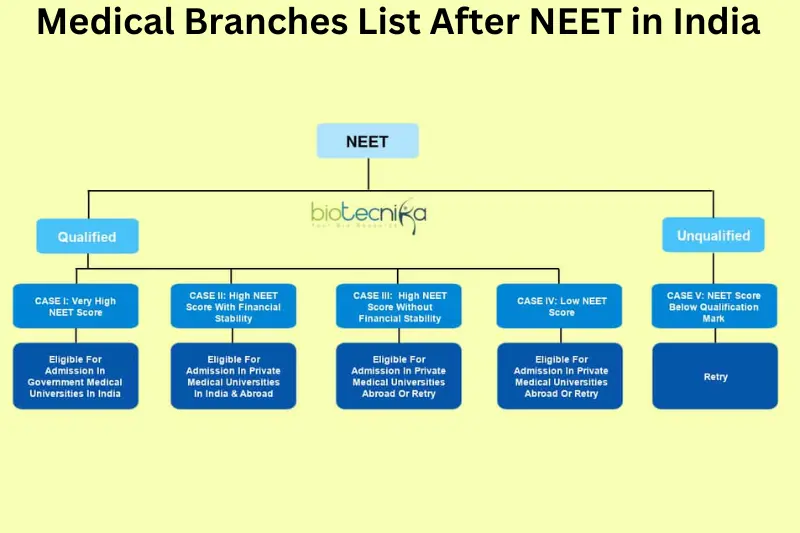
Students searching for a Medical Branches List After NEET may actually be looking for two different categories of information: courses available after NEET-UG and postgraduate medical branches available after MBBS through NEET-PG.
After NEET-UG, students may enter undergraduate medical education, depending on eligibility, rank, counselling, seat availability, and applicable rules. MBBS is the major undergraduate medical degree for students who want to become doctors and subsequently pursue postgraduate medical specialization.
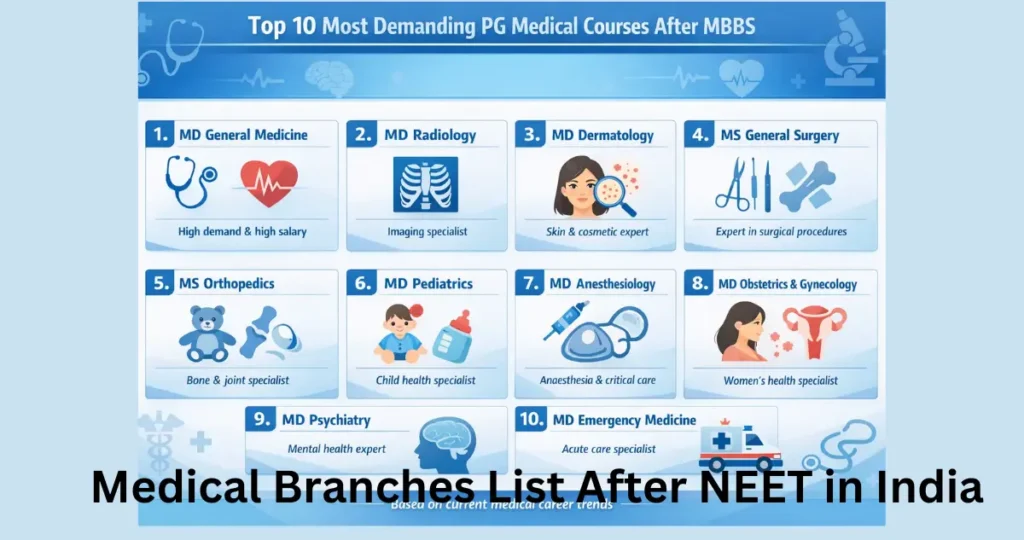
After MBBS, postgraduate medical education provides a much wider range of specialties. These include MD branches such as General Medicine, Pediatrics, Dermatology, Psychiatry, Anesthesiology, Radiodiagnosis, Pathology, and others. MS branches include General Surgery, Orthopaedics, ENT, Ophthalmology, and other recognized surgical specialties.
The NMC’s current postgraduate curriculum page separately lists MD and MS curricula, including MD specialties such as General Medicine, Pediatrics, Psychiatry, Radiodiagnosis, Pathology, Emergency Medicine, Family Medicine, and others, as well as MS curricula including ENT and General Surgery.
NEET-UG vs NEET-PG: Which One Leads to Medical Branch Selection?
Understanding the difference between NEET-UG and NEET-PG is essential before creating a Medical Branches List After NEET.
NEET-UG is relevant to undergraduate medical admissions. A student qualifying for NEET-UG may participate in the applicable counselling process for medical education based on eligibility, rank, seat availability, category, and other requirements.
NEET-PG is associated with postgraduate medical education after MBBS. It is relevant to students seeking postgraduate specialties such as MD and MS, subject to the current admission framework.
Therefore, a student searching for “medical branches after NEET” should first determine whether they mean branches after NEET-UG or postgraduate specialties after MBBS and NEET-PG.
This distinction prevents a common misunderstanding. MD General Medicine is not a branch selected immediately after NEET-UG. It is a postgraduate specialty pursued after the required undergraduate medical education and eligibility requirements.
Types of Medical Branches in India
Medical branches in India can be grouped into several broad categories. This classification helps students understand the nature of different specialties before comparing individual courses.
Clinical branches primarily involve diagnosis, treatment, patient management, and direct healthcare delivery. Surgical branches focus more heavily on operative and procedural treatment. Diagnostic and laboratory specialties support disease identification through imaging, laboratory testing, pathology, and related methods.
Public health and preventive specialties focus on disease prevention, population health, epidemiology, healthcare systems, and community medicine. Academic and basic medical science branches focus strongly on scientific foundations, teaching, laboratory work, and research.
No category should automatically be considered better than another. The appropriate branch depends on the student’s interests, abilities, career objectives, and preferred working environment.
MD Branches After NEET-PG
MD stands for Doctor of Medicine. It is used for a broad range of postgraduate medical specialties. MD branches generally include medical, diagnostic, laboratory, and several other non-surgical specialties.
MD General Medicine
General Medicine is one of the broadest clinical specialties. Physicians diagnose and manage a wide range of adult diseases involving multiple organ systems.
The specialty can suit students who enjoy detailed history-taking, clinical examination, diagnostic reasoning, chronic disease management, and complex medical cases. It can also provide a foundation for further specialization in areas such as Cardiology, Neurology, Gastroenterology, Nephrology, Endocrinology, and other advanced fields through applicable pathways.
MD Pediatrics
Pediatrics focuses on the health and medical care of infants, children, and adolescents. Pediatricians manage common illnesses as well as complex congenital, developmental, infectious, nutritional, and chronic conditions.
Students who enjoy working with children and communicating with families may find Pediatrics suitable. Further specialized career pathways can include Neonatology, Pediatric Cardiology, Pediatric Neurology, and other areas, subject to applicable training requirements.
MD Dermatology
MD Dermatology focuses on diseases of the skin, hair, nails, and related structures. The specialty includes diagnosis, medical treatment, follow-up, patient counseling, and appropriate procedures.
Dermatology can appeal to students who prefer outpatient-based clinical practice and detailed visual diagnosis. Career opportunities can include hospitals, clinics, academic institutions, and private practice.
MD Psychiatry
Psychiatry focuses on mental, behavioral, and emotional health. Psychiatrists evaluate patients through clinical interviews, mental-status assessment, history-taking, and appropriate investigations.
The specialty can suit graduates who enjoy communication, behavioral science, long-term patient relationships, and multidisciplinary care. Career opportunities exist in hospitals, mental health centers, academic institutions, clinics, rehabilitation settings, and research.
MD Anesthesiology
Anesthesiology involves anesthesia, perioperative care, physiological monitoring, airway management, emergency care, pain management, and related responsibilities.
The branch requires strong knowledge of physiology, pharmacology, clinical decision-making, and procedural skills. It can suit students who enjoy acute care, technical procedures, operating-room environments, and teamwork.
MD Radiodiagnosis
Radiodiagnosis focuses on diagnostic imaging, including modalities such as X-ray, ultrasound, CT, and MRI. Radiologists interpret imaging studies and contribute to diagnosis and treatment planning.
The specialty can suit students interested in anatomy, technology, image interpretation, and diagnostic medicine. Modern radiology also involves digital systems and evolving technologies, requiring continuous professional learning.
MD Pathology
Pathology focuses on laboratory-based diagnosis through the examination of tissues, cells, blood, and other specimens. Pathologists play an essential role in identifying diseases and supporting treatment decisions.
Students who enjoy laboratory science, microscopic examination, analytical work, and research may find Pathology suitable.
Related Posts:



MD Respiratory Medicine
Respiratory Medicine focuses on diseases affecting the lungs and respiratory system. It includes conditions such as asthma, chronic respiratory disease, respiratory infections, sleep-related breathing disorders, and other pulmonary conditions.
The branch combines outpatient care, inpatient management, diagnostic evaluation, and selected procedures.
MD Emergency Medicine
Emergency Medicine focuses on immediate assessment and stabilization of patients with acute and potentially life-threatening conditions.
The specialty can suit students who enjoy rapid decision-making, emergency procedures, trauma-related care, teamwork, and unpredictable clinical presentations.
MD Family Medicine
Family Medicine focuses on comprehensive healthcare across different age groups. It emphasizes primary care, prevention, diagnosis, treatment, continuity of care, and appropriate referral.
The specialty can suit doctors interested in community-based practice, primary healthcare, preventive medicine, and long-term patient relationships.
MD Community Medicine
Community Medicine focuses on public health, epidemiology, disease prevention, health promotion, healthcare systems, and population-level interventions.
It can suit students interested in public health programs, research, epidemiology, health policy, and preventive medicine.
Other MD Specialties
The recognized postgraduate MD list is broader than the commonly discussed clinical branches. The NMC’s recognized qualifications and curriculum resources include specialties such as Anatomy, Biochemistry, Microbiology, Pharmacology, Physiology, Forensic Medicine and Toxicology, Nuclear Medicine, Physical Medicine and Rehabilitation, Radiotherapy, Sports Medicine, Palliative Medicine, Laboratory Medicine, and others.
Availability of a specific specialty varies by institution and current seat matrix. Students should verify current course recognition and availability before making counselling decisions.
MS Branches After NEET-PG
MS stands for Master of Surgery. It is associated with postgraduate surgical specialties and provides training in surgical diagnosis, operative management, perioperative care, emergency treatment, and procedural skills.
MS General Surgery
General Surgery is one of the broadest surgical specialties. It covers a wide range of surgical diseases and procedures involving areas such as the abdomen, gastrointestinal system, breast, thyroid, soft tissues, and surgical emergencies.
The specialty can provide a foundation for further advanced surgical training in appropriate pathways.
MS Orthopaedics
Orthopaedics focuses on the musculoskeletal system, including bones, joints, muscles, ligaments, fractures, trauma, and related conditions.
Students interested in trauma, anatomy, biomechanics, procedures, and hands-on surgical care may find Orthopaedics suitable.
MS Obstetrics & Gynaecology
Obstetrics & Gynaecology combines women’s healthcare with obstetric management and surgical care. The specialty includes pregnancy care, childbirth, gynecological conditions, and related procedures.
It can be demanding because obstetric emergencies may require rapid decision-making and intervention.
MS Ophthalmology
Ophthalmology focuses on diseases and surgical conditions involving the eye and visual system. It combines outpatient care, specialized diagnostics, microsurgery, and other procedures.
Students interested in precision, technology, detailed anatomy, and specialized surgical practice may consider this branch.
MS ENT
ENT, or Otorhinolaryngology, focuses on conditions affecting the ear, nose, throat, and related head-and-neck structures.
The specialty combines outpatient consultations, diagnostic procedures, medical management, and surgery.
The NMC’s PG curriculum resources list MS in ENT and MS in General Surgery among its MS curricula.
Clinical Medical Branches
Clinical branches involve direct interaction with patients. Doctors assess symptoms, perform examinations, make diagnoses, recommend treatment, monitor progress, and coordinate care.
Examples include General Medicine, Pediatrics, Dermatology, Psychiatry, Emergency Medicine, Respiratory Medicine, and Family Medicine.
Clinical specialties require strong communication and patient-management skills. Some also involve significant emergency responsibilities, while others may have a larger outpatient component.
Students who enjoy patient interaction should compare the type of clinical relationship associated with each branch rather than assuming all clinical specialties offer the same experience.
Surgical Medical Branches
Surgical branches focus heavily on procedures and operative treatment. General Surgery, Orthopaedics, Obstetrics & Gynaecology, Ophthalmology, and ENT are major examples commonly considered by postgraduate students.
Surgical careers can be rewarding for students who enjoy anatomy, procedures, hands-on treatment, teamwork, and decision-making under pressure.
Surgical training can also involve demanding schedules and emergency duties. The workload varies by specialty and institution, so students should investigate the actual training environment before selecting a branch.
Non-Clinical and Laboratory Medical Branches
Not every medical graduate wants a career based primarily on bedside patient care or surgery. Several postgraduate disciplines offer careers in teaching, research, laboratory medicine, public health, and healthcare systems.
Anatomy, Physiology, Biochemistry, Pharmacology, Microbiology, Pathology, Community Medicine, and related disciplines can support academic, research, diagnostic, and public health careers.
These fields are essential to healthcare even when direct patient interaction is less prominent. They contribute to disease diagnosis, medical education, scientific research, public health, laboratory systems, and development of medical knowledge.
How to Choose a Medical Branch After NEET
Choosing a branch should begin with understanding your own interests rather than looking for a universal ranking.
A student who enjoys complex adult disease management may consider General Medicine. Someone interested in surgery may compare General Surgery, Orthopaedics, ENT, Ophthalmology, and Obstetrics & Gynaecology.
A student who prefers outpatient consultation may consider Dermatology, Psychiatry, Family Medicine, or other suitable clinical specialties. Someone interested in diagnostic technology may investigate Radiodiagnosis. Students interested in research or teaching can also explore laboratory and basic medical science specialties.
The actual daily work of a branch should be examined carefully. Ask what type of patients you will see, how many emergencies are involved, how much procedural work is required, what the typical working environment looks like, and what career options exist after postgraduate training.
Factors to Consider Before Choosing a Medical Branch
Clinical Interest
Choose a subject that genuinely interests you. Postgraduate medical education involves years of intensive study and practical training. Genuine interest can make sustained learning easier.
Patient Interaction
Consider whether you prefer frequent patient communication, long-term follow-up, emergency care, diagnostic interpretation, or laboratory-based work.
Surgical Interest
If you enjoy procedures and operative treatment, surgical specialties may be more appropriate. If you prefer medical diagnosis and non-operative management, clinical MD specialties may be a better fit.
Emergency Workload
Emergency duties differ considerably between branches and institutions. Ask residents about night shifts, emergency calls, trauma exposure, and workload.
Work-Life Expectations
Do not assume that a specialty automatically provides a particular lifestyle. Workload depends on specialty, institution, location, experience, and career setting.
Future Specialization
If you already have a particular subspecialty in mind, investigate the applicable feeder qualifications and current regulations before selecting your broad specialty.
NMC regulations can be updated, and its official website currently includes postgraduate regulations and recent notices concerning medical education.
Institution and Training Quality
The same specialty can provide very different experiences at different institutions. Patient volume, case diversity, faculty supervision, infrastructure, academic teaching, and procedural exposure matter greatly.
NEET-PG Rank and Medical Branch Selection
NEET-PG rank can influence which postgraduate specialties and institutions are available during counselling. Popular branches and highly preferred institutions can be competitive.
Students should not use one previous year’s closing rank as a guaranteed prediction. Counselling outcomes can change because of seat availability, candidate preferences, category, institution, counselling round, and other factors.
A practical strategy is to create three preference groups: first-choice branches, acceptable alternatives, and branches you would not genuinely want to pursue.
The decision should remain career-focused. A student should not select a branch simply because it was available at a particular rank if the actual work does not match their interests.
Best Medical Branches After NEET for Different Career Goals
There is no single “best” branch for everyone.
For broad clinical medicine: MD General Medicine can be considered.
For surgery: MS General Surgery can provide broad surgical training.
For trauma and musculoskeletal care: MS Orthopaedics may be suitable.
For eye surgery and precision procedures: MS Ophthalmology can be considered.
For women’s health and surgery: MS Obstetrics & Gynaecology can be appropriate.
For imaging and diagnostic technology: MD Radiodiagnosis may be attractive.
For outpatient skin care: MD Dermatology can be considered.
For mental health: MD Psychiatry offers a specialized clinical pathway.
For children: MD Pediatrics focuses on pediatric healthcare.
For laboratory diagnosis: MD Pathology and other laboratory-oriented specialties may suit students interested in diagnostic science.
For public health: MD Community Medicine provides a population-health-oriented pathway.
These descriptions are career-orientation tools, not universal rankings.
Related Posts:
MD vs MS After NEET-PG
MD and MS represent different postgraduate pathways. MD generally covers medical and related specialties, while MS focuses on surgical specialties.
A student who enjoys diagnosis, medical management, chronic disease care, and non-operative treatment may prefer MD. A student who enjoys anatomy, procedures, surgery, and hands-on intervention may prefer MS.
Neither qualification is inherently better. The correct choice depends on the student’s interests and career objectives.
The NMC’s recognized postgraduate qualifications list includes both MD and MS broad specialties.
Medical Branches and Future Career Opportunities
Career opportunities after postgraduate specialization can include hospital employment, government service, private practice, academic medicine, research, healthcare organizations, and further specialization.
The future of medicine is also being influenced by advanced imaging, minimally invasive procedures, digital health, artificial intelligence, molecular diagnostics, telemedicine, and data-driven healthcare.
Technology is changing medical practice, but clinical judgment and professional responsibility remain essential. Doctors need to continue updating their knowledge and skills throughout their careers.
A strong postgraduate career depends on more than the name of the branch. Clinical competence, training quality, communication, ethical practice, experience, professional development, and location can all influence long-term outcomes.
Common Mistakes When Choosing a Medical Branch
Choosing only by salary: Income varies by experience, location, employer, private practice, patient volume, and professional reputation.
Choosing because a branch is popular: Popularity does not guarantee personal satisfaction.
Ignoring residency workload: Students should investigate actual duty schedules and emergency responsibilities.
Following friends: Different students have different interests and career goals.
Ignoring the institution: The quality of training can vary considerably between departments.
Using outdated information: Admission rules, seat availability, recognition, and postgraduate regulations can change.
Choosing without considering the future: A branch should fit the type of career you want to build over many years.
Frequently Asked Questions
What are the medical branches after NEET in India?
Medical branches depend on the stage of education. After NEET-UG, students primarily enter undergraduate medical education according to applicable counselling and eligibility rules. After MBBS and the postgraduate admission process, students can pursue recognized specialties such as MD and MS branches.
What are the main MD branches after NEET-PG?
Major MD specialties include General Medicine, Pediatrics, Dermatology, Psychiatry, Anesthesiology, Radiodiagnosis, Pathology, Respiratory Medicine, Emergency Medicine, Family Medicine, Community Medicine, and several other recognized disciplines.
What are the main MS branches after NEET-PG?
Major MS options include General Surgery, Orthopaedics, Obstetrics & Gynaecology, Ophthalmology, and ENT, subject to current recognition, institutional availability, and admission rules.
Which medical branch is best after NEET?
There is no universally best branch. The right choice depends on clinical interest, patient interaction, surgical preference, lifestyle expectations, career goals, rank, and available institutions.
Which branch is best for private practice?
Several specialties can support private practice, but success depends on clinical expertise, location, patient demand, infrastructure, experience, professional reputation, and ethical practice. A branch should not be selected solely for private-practice income.
Which is better, MD or MS?
MD and MS serve different professional interests. MD generally focuses on medical specialties, while MS focuses on surgical specialties. The better option depends on the career you want.
How do I choose a medical branch after NEET-PG?
Compare your interests, expected rank, preferred patient population, emergency tolerance, procedural interests, work-life expectations, future specialization plans, and the quality of the institutions available to you.
Can I change my medical specialty later?
Career pathways after postgraduate training depend on eligibility, regulations, additional entrance requirements, and available programs. Students should check the current rules before planning a specialty change or further qualification.
Final Thoughts
The Medical Branches List After NEET is much broader than a simple ranking of “top” specialties. Medical education in India provides multiple pathways ranging from clinical medicine and surgery to diagnostic specialties, laboratory medicine, public health, academic disciplines, and advanced specialization.
Students considering postgraduate education should understand the distinction between NEET-UG and NEET-PG. NEET-UG is associated with entry into undergraduate medical education, while postgraduate branch selection occurs after MBBS through the applicable postgraduate admission pathway.
MD specialties provide options such as General Medicine, Pediatrics, Dermatology, Psychiatry, Anesthesiology, Radiodiagnosis, Pathology, Emergency Medicine, Respiratory Medicine, Family Medicine, Community Medicine, and other recognized fields. MS specialties provide surgical pathways including General Surgery, Orthopaedics, Obstetrics & Gynaecology, Ophthalmology, ENT, and other recognized options where available. The NMC maintains current postgraduate regulations, recognition information, and curriculum resources that should be consulted when verifying course details.
The best medical branch is ultimately the one that matches your interests, abilities, professional goals, and preferred working environment. A high rank or prestigious specialty can provide opportunities, but long-term professional satisfaction depends heavily on whether you genuinely enjoy the work.
Before making a final decision, compare current official admission information, recognized qualifications, institution-specific training, seat availability, counselling requirements, and future career pathways. NMC continues to update medical education regulations and related notices, so students should use current official information rather than relying exclusively on older articles or social media discussions.
A thoughtful approach to branch selection can help an MBBS graduate build a sustainable medical career. The objective should not simply be to find the most popular specialty, but to identify the branch in which you can develop strong expertise, maintain professional interest, and provide effective patient care throughout your career.