

Introduction
Many people in India use the terms General Medicine and General Physician interchangeably, but they are not exactly the same. The confusion is understandable because both are closely connected with the diagnosis and treatment of common and complex medical conditions.
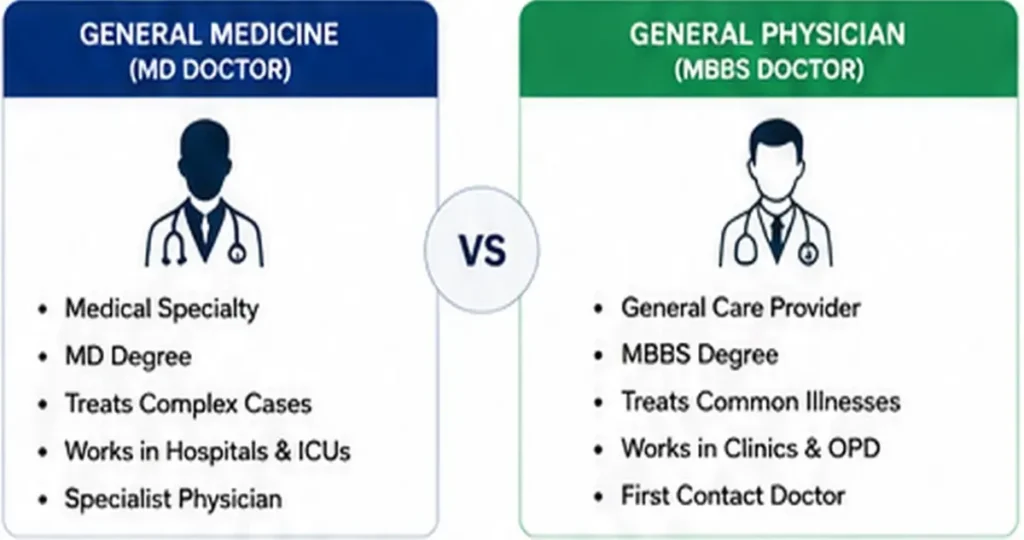
General Medicine is a recognized medical specialty focused mainly on the diagnosis and management of diseases affecting adults and multiple body systems. A General Physician, meanwhile, is a term commonly used for a doctor who provides broad medical care. In many healthcare settings, the term may refer to a doctor practicing general medicine, but the title itself does not automatically tell you the doctor’s exact postgraduate qualification.
This distinction becomes especially important for MBBS graduates deciding whether to enter postgraduate medical education and for patients trying to understand whether they need a general doctor or a specialist.
The National Medical Commission (NMC) lists MD General Medicine among postgraduate medical curricula, making General Medicine a formal postgraduate specialty in India.
This guide explains General Medicine vs General Physician in simple terms, including their meaning, qualification, clinical responsibilities, patient care, career scope, salary considerations, work environment, and the difference medical students should understand before choosing a career path.
What Is General Medicine?
General Medicine is a broad medical specialty concerned with the diagnosis, evaluation, treatment, and ongoing management of diseases, particularly in adults.
Unlike a specialty that focuses on one specific organ, General Medicine covers multiple body systems. A General Medicine specialist may deal with conditions affecting the heart, lungs, kidneys, liver, digestive system, endocrine system, nervous system, and other areas of the body.
The specialty requires strong clinical reasoning because patients do not always arrive with a clear diagnosis. A person may visit a doctor with fever, weakness, breathlessness, weight loss, abdominal discomfort, dizziness, or unexplained pain. The physician must evaluate the symptoms, medical history, physical findings, and appropriate investigations to identify the underlying problem.
General Medicine therefore combines broad medical knowledge with detailed diagnostic decision-making.
The NMC’s postgraduate curriculum resources specifically list MD General Medicine among recognized MD curricula.
For MBBS graduates who are considering postgraduate education, our guide to Medical Specialization After MBBS in India provides a broader overview of the specialization pathway.

What Conditions Does General Medicine Cover?
General Medicine can involve the management of many adult medical conditions, including:
- Diabetes
- Hypertension
- Respiratory diseases
- Infections
- Gastrointestinal disorders
- Kidney-related medical conditions
- Liver diseases
- Endocrine disorders
- Cardiovascular presentations
- Neurological presentations
- Autoimmune diseases
- Multi-system disorders
- Chronic diseases
- Complex undiagnosed illnesses
The exact scope of an individual doctor depends on qualification, training, experience, clinical setting, and applicable professional regulations.
What Is a General Physician?
A General Physician is a doctor who provides broad medical care rather than limiting practice to one narrow specialty.
In everyday healthcare, patients commonly consult a General Physician when they have symptoms such as fever, cough, headache, weakness, digestive problems, blood-pressure concerns, diabetes follow-up, infections, or other general medical complaints.
However, an important point is often missed:
“General Physician” is not itself the name of a separate postgraduate degree equivalent to MD General Medicine.
The term is commonly used in clinical practice to describe a physician who provides general medical care. The doctor’s actual qualification should therefore be checked separately.
For example, an MBBS doctor may provide medical care within the scope permitted by their qualification and registration. An MD General Medicine doctor has completed formal postgraduate specialization in General Medicine.
A doctor with an MD or DNB in General Medicine may also be described as a physician or General Physician in everyday practice.
This is why the terms can overlap without being exact synonyms.
What Does a General Physician Usually Treat?
Depending on the doctor’s qualifications and scope of practice, general medical consultations can involve:
- Fever and infections
- Cough and respiratory symptoms
- Headache
- Weakness and fatigue
- Digestive complaints
- Blood-pressure problems
- Diabetes follow-up
- Common medical illnesses
- Initial evaluation of unexplained symptoms
- Chronic disease monitoring
A General Physician can also recognize when a patient’s condition requires specialist evaluation.
General Medicine vs General Physician: The Basic Difference
The easiest way to understand General Medicine vs General Physician is this:
General Medicine is a medical specialty. General Physician is a professional term commonly used for a doctor providing broad medical care.
| Factor | General Medicine | General Physician |
|---|---|---|
| Meaning | Medical specialty | Doctor providing broad medical care |
| Formal specialty | Yes | Not a separate postgraduate specialty by itself |
| Common postgraduate qualification | MD General Medicine or other recognized physician qualification | Qualification varies |
| Main focus | Adult medical diseases and complex diagnosis | General medical assessment and treatment |
| Patient care | Common and complex medical cases | Broad/general medical complaints |
| Clinical setting | Hospitals, clinics, wards, academic institutions and other settings | Clinics, hospitals, outpatient settings and other settings |
| Further specialization | Possible after appropriate postgraduate training | Depends on doctor’s qualification |
| Best way to verify expertise | Check qualification | Check actual qualification |
The important lesson is that the words written outside a clinic should not replace checking the doctor’s actual medical qualification.
Is General Medicine the Same as General Physician?
Not exactly.
This is probably the most important question behind the keyword General Medicine vs General Physician.
General Medicine refers to the specialty itself. General Physician generally refers to a doctor who practices broad medical care.
In some contexts, an MD General Medicine doctor may be called a General Physician. Therefore, the two terms can refer to the same doctor in everyday conversation.
But the terms still have different meanings.
For example, saying:
“General Medicine is a postgraduate medical specialty.”
describes a field of specialization.
Saying:
“I am visiting a General Physician.”
describes the doctor a patient is consulting.
Therefore, the relationship is similar to specialty versus professional role, rather than two completely separate medical branches.
General Medicine vs General Physician: Qualification Difference
Qualification is where patients and medical students need to be particularly careful.
An MBBS degree represents undergraduate medical education. After MBBS, an eligible graduate may pursue postgraduate specialization according to the current admission and regulatory framework.
MD General Medicine is a postgraduate specialty. The NMC’s official postgraduate curriculum resources list MD General Medicine among MD specialties.
A General Physician, however, does not automatically mean that the doctor holds MD General Medicine.
The doctor may have:
- MBBS
- MD General Medicine
- DNB General Medicine
- Another relevant recognized qualification
- Additional training or specialization
Therefore, the safest approach for patients is to check the doctor’s actual degree, registration and specialty qualification rather than relying only on the words “General Physician.”
For students comparing postgraduate choices, Best MD Branches After MBBS in India provides a broader comparison of MD specialties.
General Medicine vs General Physician: Patient Care
Both can be associated with broad medical care, but the level of specialization can differ.
A general medical consultation may begin with a patient’s symptoms. The doctor takes a history, performs an examination, considers possible diagnoses, and decides whether investigations or treatment are needed.
For a straightforward medical complaint, general medical care may be sufficient.
However, a patient with a complicated condition, multiple chronic illnesses, an unclear diagnosis, or a disease requiring specialized management may need evaluation by a specialist.
An MD General Medicine specialist is trained specifically in the broader discipline of internal medicine and may manage complex adult medical conditions.
This does not mean that every General Physician treats only minor illnesses. A General Physician can identify serious conditions and refer patients appropriately.
When Is Specialist Care Important?
A patient may need specialist evaluation when:
- Symptoms persist despite initial treatment
- The diagnosis remains unclear
- The condition is complicated
- Multiple diseases interact with one another
- A specialized procedure is required
- A disease requires organ-specific expertise
- Warning signs indicate a potentially serious condition
Referral does not mean the first doctor failed. Referral is an important part of coordinated medical care.
General Medicine vs General Physician: Clinical Role
A General Physician may act as an important first point of contact for patients.
The doctor may:
- Assess symptoms
- Take medical history
- Perform physical examination
- Recommend appropriate investigations
- Provide treatment
- Monitor chronic conditions
- Review treatment response
- Identify warning signs
- Refer patients to specialists
General Medicine specialists perform many of these activities but may also manage more complex inpatient and outpatient cases as part of their specialist practice.
The difference is therefore not simply “simple diseases versus serious diseases.”
The more accurate distinction is based on qualification, specialist training, clinical complexity, workplace, and professional scope.
General Medicine vs General Physician: Hospital Practice
The hospital environment can make the difference easier to understand.
General medical doctors may work in outpatient departments, clinics, wards, emergency services, and other healthcare settings.
An MD General Medicine specialist may work in:
- Medical wards
- Outpatient departments
- Emergency services
- Intensive-care-related settings
- Teaching hospitals
- Government hospitals
- Private hospitals
- Medical colleges
- Research environments
- Private practice
The exact responsibilities vary according to the institution.
Postgraduate training in General Medicine includes structured clinical learning and development of medical competencies. The NMC maintains dedicated postgraduate curriculum resources for MD General Medicine.
Students interested in understanding the wider landscape can also read Medical Branches List After NEET in India, which explains the distinction between undergraduate and postgraduate medical branch selection.
General Medicine vs General Physician: Career Path After MBBS
For an MBBS graduate, the two terms can represent different points in a career discussion.
A simplified pathway may be:
MBBS → Postgraduate Training → MD General Medicine → Physician Career → Possible Further Specialization
An MBBS graduate may also enter general medical practice, subject to current registration and professional requirements, without necessarily pursuing MD General Medicine immediately.
The decision depends on the career the doctor wants.
A graduate interested in specialist-level adult medical care may consider MD General Medicine.
Someone who wants to begin broad medical practice may follow a different career path, subject to applicable requirements.
Students researching the overall pathway can read MD vs MS: Which Is Better After MBBS in India?, which compares the two major postgraduate routes.

Is MD General Medicine a Good Career After MBBS?
MD General Medicine can be an excellent career option for students who enjoy:
- Clinical diagnosis
- Adult medicine
- Complex medical cases
- Patient interaction
- Chronic disease management
- Hospital medicine
- Clinical reasoning
- Long-term medical learning
One of the biggest advantages of General Medicine is its breadth.
A physician can encounter patients with several conditions at the same time, requiring careful clinical reasoning and coordination of treatment.
The specialty can also provide pathways toward further specialization, subject to current eligibility and admission requirements.
Potential advanced areas may include:
- Cardiology
- Neurology
- Gastroenterology
- Nephrology
- Endocrinology
- Medical Oncology
- Rheumatology
- Pulmonology
Students should verify current feeder qualifications and admission rules before planning a particular super-specialty pathway.
General Physician Career Scope in India
General medical practice remains important because many patients first seek help for symptoms that do not immediately require a highly specialized consultation.
General Physicians may work in:
- Private clinics
- Hospitals
- Outpatient departments
- Primary-care settings
- Government healthcare
- Corporate healthcare
- Community healthcare
- Telemedicine settings where appropriate
The career scope depends on qualification, experience, location, patient demand, professional reputation, and the healthcare setting.
A doctor who later completes postgraduate specialization may expand into a more specialized professional role.
For a wider look at postgraduate opportunities, see Best MS Branches in India.
General Medicine vs General Physician: Scope in India
Both play important roles in healthcare, but they contribute in somewhat different ways.
General Physicians can provide accessible first-contact medical care. They can assess common complaints, manage suitable conditions, monitor chronic illnesses, and recognize when referral is needed.
General Medicine specialists provide advanced medical expertise for adult diseases and complex medical cases.
This creates a natural relationship between general medical care and specialist care.
For example, a patient may initially visit a General Physician because of persistent fatigue. After assessment and investigations, the patient may be referred to an MD General Medicine specialist if the problem requires more advanced evaluation.
The specialist may then coordinate care with another specialist if the condition is related to a particular organ system.

General Medicine vs General Physician: Salary
Salary should be treated carefully because there is no single figure that applies to every doctor.
Income can vary according to:
- Qualification
- Experience
- City
- Hospital
- Government or private employment
- Patient volume
- Private practice
- Additional specialization
- Professional reputation
- Clinical services provided
An MBBS doctor working in general medical practice can have a completely different income from an experienced MD General Medicine specialist.
Likewise, a newly qualified specialist may earn differently from a senior physician with an established private practice.
Therefore, students should not select General Medicine solely because of expected income.
For broader salary comparisons, Fullipedia also covers medical-branch earning and career topics in its Medical Branch content.
General Medicine vs General Physician: Work-Life Balance
Work-life balance depends heavily on the actual job rather than the title alone.
An MD General Medicine specialist working in a tertiary-care hospital may have:
- Inpatient duties
- Emergency responsibilities
- Night shifts
- Ward rounds
- Complex cases
- Outpatient clinics
A General Physician working mainly in an outpatient clinic may have a more predictable daily schedule.
However, this is not guaranteed.
Workload depends on:
- Hospital type
- Location
- Patient volume
- Emergency services
- Seniority
- Employment model
- Private practice
- Subspecialization
Fullipedia’s article on Which Medical Branch Has the Best Work-Life Balance in India provides a broader comparison of lifestyle factors across specialties.
General Medicine vs General Physician: Which Is Better?
There is no simple winner because they are not two equivalent postgraduate branches.
If you are a patient, choose a doctor according to the nature of your medical problem and check the doctor’s actual qualification.
For a common or initially unexplained medical complaint, a qualified doctor providing general medical care may be an appropriate starting point.
For complex adult medical conditions, specialist evaluation by an appropriately qualified physician may be more suitable.
If you are a medical student, the question should be:
“Do I want broad general medical practice, or do I want postgraduate specialization in General Medicine?”
That is a much more useful question than asking which title is better.
General Medicine vs General Physician for Medical Students
Medical students should first understand the difference between a specialty and a professional role.
General Medicine is a postgraduate medical specialty.
General Physician is a term commonly used for a doctor who provides broad medical care.
If your goal is postgraduate specialist training, MD General Medicine can be one option to consider among MD specialties.
If you are interested in comparing all major medical pathways, the Medical Specialization After MBBS in India guide explains MD, MS, clinical specialties, training, career opportunities and further specialization.
Questions Medical Students Should Ask
Before selecting General Medicine, consider:
- Do I enjoy adult medical diagnosis?
- Am I comfortable managing complex patients?
- Do I enjoy hospital-based clinical work?
- Am I comfortable with emergency responsibilities?
- Do I want to pursue further specialization?
- Do I enjoy long-term disease management?
- Do I want a broad clinical knowledge base?
If the answers are mostly yes, General Medicine may be worth serious consideration.
General Medicine vs General Physician: Common Misconceptions
Misconception 1: General Medicine and General Physician are two completely separate specialties.
They are not. General Medicine is a specialty, while General Physician is generally a professional term.
Misconception 2: Every General Physician has MD General Medicine.
Not necessarily. The doctor’s actual qualification should be checked.
Misconception 3: A General Physician only treats minor illnesses.
General medical doctors can evaluate a wide range of conditions and identify serious illnesses requiring specialist care.
Misconception 4: MD General Medicine doctors treat every disease.
General Medicine is broad, but specialists from other fields may be required for organ-specific, procedural, surgical, or highly specialized conditions.
Misconception 5: General Medicine is automatically better because it is a postgraduate specialty.
A postgraduate qualification and a professional role are not directly comparable. The appropriate choice depends on the patient’s needs or the student’s career goals.
When Should You Choose a General Physician?
A General Physician may be a practical first point of contact when you have a common or initially unclear medical complaint.
Examples include:
- Fever
- Cough
- Headache
- Weakness
- Digestive symptoms
- Blood-pressure concerns
- Diabetes follow-up
- General infections
- Unexplained but non-emergency symptoms
The doctor can assess the problem and determine whether additional testing or specialist referral is appropriate.
Patients with severe or emergency symptoms should seek urgent medical attention rather than relying on an online comparison of medical specialties.
When Should You See a General Medicine Specialist?
A General Medicine specialist may be particularly relevant when a patient has:
- Complex adult medical disease
- Multiple chronic conditions
- Persistent unexplained symptoms
- Difficult diagnostic problems
- Complicated diabetes or hypertension
- Multi-system illness
- Recurrent hospital admissions
- A condition requiring specialist medical management
The exact need depends on the individual patient.
General Medicine vs General Physician: How to Decide
For patients, use this simple approach:
Step 1: Identify the problem.
Step 2: Consider whether it is a routine medical complaint or a complex condition.
Step 3: Check the doctor’s qualification.
Step 4: Ask whether specialist referral is needed.
For medical students:
Step 1: Identify your strongest clinical interests.
Step 2: Decide whether you want broad practice or postgraduate specialization.
Step 3: Compare General Medicine with other MD options.
Step 4: Consider residency workload and emergency duties.
Step 5: Research future specialization opportunities.
Step 6: Compare institutions and clinical exposure.
For students who want a broader career comparison, Best MD Branches After MBBS in India is a useful supporting resource.
General Medicine vs General Physician: Key Differences at a Glance
| Question | General Medicine | General Physician |
|---|---|---|
| Is it a specialty? | Yes | No, not as a separate postgraduate specialty |
| What does it describe? | A medical specialty | A doctor providing broad medical care |
| Can an MD doctor be called a General Physician? | Yes, commonly | — |
| Does the title alone prove MD qualification? | No | No |
| Main patient focus | Mainly adult medical conditions | Broad medical complaints |
| Can complex cases be managed? | Yes, according to training and setting | Depends on doctor’s qualification and scope |
| Can referral be made? | Yes | Yes |
| Is it a career option after MBBS? | MD General Medicine is a postgraduate career path | General medical practice may be a career path subject to requirements |
| Best way to verify expertise | Check qualification | Check qualification |
Frequently Asked Questions
Is General Medicine the same as General Physician?
No, not exactly. General Medicine is a medical specialty, while General Physician is a term commonly used for a doctor who provides broad medical care. An MD General Medicine doctor may also be called a General Physician in everyday clinical practice.
Is a General Physician an MBBS doctor?
A General Physician may have different qualifications. The term itself does not establish that the doctor is MBBS-only or holds MD General Medicine. Patients should check the doctor’s actual qualification and registration.
Is MD General Medicine the same as General Physician?
MD General Medicine is a postgraduate specialty and qualification. General Physician is a professional term commonly used to describe a doctor providing general medical care. An MD General Medicine doctor may work as a General Physician.
Which is better, General Medicine or General Physician?
They are not directly comparable because General Medicine is a specialty and General Physician is a professional role or description. For a medical student, MD General Medicine is a postgraduate career option. For a patient, the appropriate doctor depends on the medical problem and the doctor’s qualification.
Can a General Physician treat diabetes?
A qualified doctor providing general medical care may evaluate and manage diabetes within their professional scope. Complicated cases may require specialist medical care.
Can a General Physician refer patients to specialists?
Yes. Referral is an important part of coordinated healthcare when a patient’s condition requires specialized evaluation or treatment.
Is General Medicine a good branch after MBBS?
It can be an excellent option for students who enjoy adult medicine, clinical reasoning, complex diagnosis, hospital medicine, and long-term disease management.
Can MD General Medicine doctors become super-specialists?
Eligible doctors may pursue further specialization through applicable pathways. The exact eligibility and admission requirements should be checked against current regulations.
Does General Medicine have good career scope in India?
General Medicine offers broad career possibilities in hospitals, private practice, academic medicine, government healthcare, research, and further specialization. Actual opportunities vary according to experience, location, institution, qualification, and career model.
Conclusion
The difference between General Medicine vs General Physician becomes much easier to understand once the two terms are viewed correctly.
General Medicine is a medical specialty. General Physician is a professional term commonly used for a doctor who provides broad medical care.
An MD General Medicine doctor has completed postgraduate specialization in General Medicine and may commonly work as a physician or General Physician. However, the term General Physician alone does not establish the doctor’s exact postgraduate qualification.
For patients, the most important step is therefore to look beyond the title and check the doctor’s actual qualifications.
For MBBS graduates, the decision is different. Students should decide whether they want to enter broad general medical practice or pursue postgraduate specialist training in General Medicine.
General Medicine can be particularly suitable for students who enjoy adult disease management, diagnostic reasoning, complex medical cases, hospital practice, and continuous clinical learning.
Ultimately, there is no universal winner in General Medicine vs General Physician because the two terms describe different concepts. Understanding that distinction helps patients choose appropriate medical care and helps medical students make better-informed career decisions.
For current postgraduate medical education information, the National Medical Commission’s official PG curriculum resources should be checked because recognized specialties, regulations, and educational requirements can change.