
Introduction
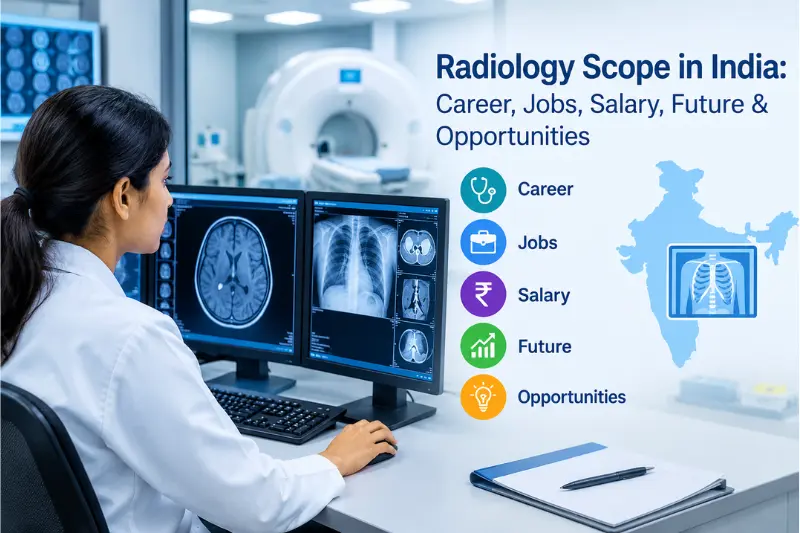
Radiology has become an important medical specialty in India because modern healthcare depends heavily on accurate medical imaging for diagnosis, treatment planning, disease monitoring, and image-guided procedures. The radiology scope in India extends across government hospitals, private hospitals, diagnostic centers, medical colleges, research institutions, teleradiology services, and specialized imaging facilities.
For MBBS graduates considering postgraduate specialization, radiology can offer a technology-driven medical career with opportunities in diagnostic imaging, interventional procedures, academics, research, hospital practice, and private diagnostic services. The National Medical Commission’s postgraduate curriculum for MD Radiodiagnosis covers conventional and advanced imaging, diagnostic and interventional studies, research, teaching, ethics, and legal aspects of imaging.
Students researching radiology career opportunities in India after MBBS should evaluate the specialty beyond salary or popularity. Training quality, imaging exposure, clinical responsibility, technology, work environment, specialization options, and long-term career objectives all matter.
What Is Radiology?
Radiology is a medical specialty that uses imaging techniques to help diagnose, monitor, and sometimes treat diseases and injuries. Common imaging modalities include X-ray, computed tomography (CT), magnetic resonance imaging (MRI), ultrasound, Doppler, mammography, fluoroscopy, and other specialized imaging techniques.
A hospital radiology department may support almost every major clinical specialty. Physicians, surgeons, emergency teams, oncologists, neurologists, orthopaedic specialists, obstetricians, and other clinicians depend on imaging findings when evaluating patients.
The National Medical Commission’s MD Radiodiagnosis curriculum describes training in diagnostic and interventional imaging, with exposure to areas such as chest radiology, neuroradiology, gastrointestinal radiology, urology, cardiovascular radiology, musculoskeletal imaging, emergency radiology, pediatric radiology, and women’s imaging.
Students who want a broader understanding of specialization options can also read Medical Specialization After MBBS in India.
Radiology Scope in India
The radiology scope in India is broad because diagnostic imaging is integrated into multiple levels of healthcare.
Radiologists can work in:
- Government hospitals
- Private hospitals
- Corporate hospitals
- Diagnostic imaging centres
- Medical colleges
- Teaching hospitals
- Research institutions
- Teleradiology services
- Specialized imaging centres
- Interventional radiology units
- Academic and research organizations
- Healthcare technology environments
The scope is not limited to reading X-rays. Modern radiology includes cross-sectional imaging, advanced MRI, CT, ultrasound, image-guided procedures, emergency imaging, breast imaging, musculoskeletal imaging, neuroradiology, pediatric imaging, and other subspecialty areas.
The Ministry of Health and Family Welfare lists imaging services including MRI, CT/PET-CT, sonography, X-ray, cathlab, DSA, OPG, and DEXA within diagnostic-centre standards, demonstrating the wide range of imaging services operating within India’s healthcare system.
For students comparing specialties, Best Medical Branch in India provides broader information about medical career selection.
Why Is Radiology Important in Modern Healthcare?
Radiology provides information that can influence diagnosis, treatment planning, emergency management, surgical decisions, and follow-up.
X-rays can help evaluate fractures and chest conditions. CT can provide detailed cross-sectional imaging for trauma, neurological emergencies, cancers, abdominal conditions, and many other clinical problems. MRI provides detailed soft-tissue imaging. Ultrasound is widely used for abdominal, obstetric, vascular, and other examinations.
The Department of Radiology at Dr. Ram Manohar Lohia Hospital describes radiology services involving X-ray, CT, MRI, ultrasound, Doppler, mammography, and DEXA, with radiologists contributing to diagnosis and image-guided procedures.
Radiology also contributes to minimally invasive care. Image guidance can support procedures such as biopsies, drainage procedures, and other interventions.
What Does a Radiologist Do in India?
A radiologist is a medical doctor trained to interpret medical images and provide diagnostic information to the treating clinical team. Depending on training and practice setting, radiologists can also perform image-guided procedures.
Common responsibilities include:
- Reviewing patient clinical information
- Selecting or recommending appropriate imaging
- Interpreting X-rays
- Interpreting CT scans
- Interpreting MRI studies
- Interpreting ultrasound examinations
- Evaluating mammography
- Reporting emergency imaging
- Communicating important findings
- Performing selected image-guided procedures
- Participating in multidisciplinary discussions
- Teaching medical students and residents
- Conducting research
- Maintaining professional and ethical standards
Radiology requires strong anatomical knowledge, diagnostic reasoning, attention to detail, communication skills, and familiarity with imaging technology.
How to Become a Radiologist in India After MBBS
Students searching for how to become a radiologist in India after MBBS generally need to understand the postgraduate medical education pathway.
The broad route is:
- Complete MBBS.
- Meet applicable postgraduate eligibility requirements.
- Appear for the relevant postgraduate admission process.
- Obtain a postgraduate seat in Radiodiagnosis or an applicable recognized pathway.
- Complete postgraduate training.
- Develop competency in diagnostic and relevant interventional imaging.
- Pursue further specialization or focused training where appropriate.
- Build a career in hospital practice, diagnostic services, academics, research, or other eligible settings.
The National Board of Examinations in Medical Sciences currently provides the official NEET-PG information and application resources, including the 2026 examination information. Students should verify current admission requirements from the official source before making career decisions.
Students comparing MD and MS pathways can read MD vs MS: Which Is Better After MBBS?.
MD Radiodiagnosis in India
MD Radiodiagnosis is a recognized postgraduate medical specialty listed within the National Medical Commission’s postgraduate curriculum resources.
The training is designed to develop competence in diagnostic and interventional imaging. The NMC curriculum identifies multiple radiology subspecialties and expects postgraduate trainees to develop knowledge and skills relevant to imaging interpretation, procedures, research, teaching, ethics, and legal aspects.
This makes MD Radiodiagnosis career scope in India wider than a simple diagnostic-reporting role.
A student considering radiology should investigate:
- Number and variety of imaging modalities
- CT exposure
- MRI exposure
- Ultrasound exposure
- Emergency radiology workload
- Interventional exposure
- Faculty expertise
- Patient volume
- Reporting responsibility
- Academic opportunities
- Research opportunities
- Fellowship or advanced training options
The name of the medical college alone does not determine the quality of radiology training. Actual clinical exposure and faculty support matter.
Radiology Specializations in India
Radiology offers multiple areas of focused expertise.
Diagnostic Radiology
Diagnostic radiology involves interpretation of medical images to identify or evaluate diseases, injuries, abnormalities, and treatment response.
It can include:
- X-ray imaging
- CT
- MRI
- Ultrasound
- Mammography
- Fluoroscopy
- Emergency imaging
Interventional Radiology
Interventional radiology uses imaging guidance to perform minimally invasive diagnostic and therapeutic procedures.
Potential areas include:
- Image-guided biopsies
- Drainage procedures
- Vascular interventions
- Image-guided injections
- Tumour-related procedures
- Other minimally invasive interventions
The exact scope depends on training, institutional facilities, credentials, and applicable regulations.
Neuroradiology
Neuroradiology focuses on imaging of the brain, spine, head, neck, and related neurological structures.
The NMC has also published a dedicated DM Neuroradiology curriculum covering advanced neuroimaging and endovascular, therapeutic, and interventional neuroradiology.
Musculoskeletal Radiology
Musculoskeletal imaging focuses on bones, joints, muscles, tendons, ligaments, and sports-related injuries.
Breast Imaging
Breast imaging includes mammography, ultrasound, MRI in appropriate settings, and image-guided procedures.
Pediatric Radiology
Pediatric radiology focuses on imaging children while considering age-specific anatomy, disease patterns, communication, and radiation-safety principles.
Emergency Radiology
Emergency radiology deals with urgent imaging findings involving trauma, stroke, acute abdominal conditions, chest emergencies, and other time-sensitive problems.
Radiology Jobs in India
The radiology jobs in India market includes multiple healthcare settings.
Government Hospitals
Government hospitals require radiologists for diagnostic imaging services, emergency care, specialist departments, and teaching institutions.
Private Hospitals
Private and corporate hospitals employ radiologists for inpatient, outpatient, emergency, oncology, surgical, neurological, and other imaging requirements.
Diagnostic Centres
Diagnostic centres provide imaging services such as CT, MRI, ultrasound, mammography, and X-ray. Radiologists may work in reporting, supervision, quality systems, procedures, and clinical coordination.
Medical Colleges
Medical colleges provide opportunities in teaching, clinical services, academic administration, research, and postgraduate training.
Teleradiology
Teleradiology allows imaging studies to be transmitted electronically for interpretation from another location. This model can support hospitals and diagnostic centres that need specialist reporting coverage.
Research and Healthcare Technology
Radiologists may also participate in imaging research, artificial intelligence projects, medical technology development, clinical trials, education, and healthcare innovation.
Radiology Scope in Government Hospitals
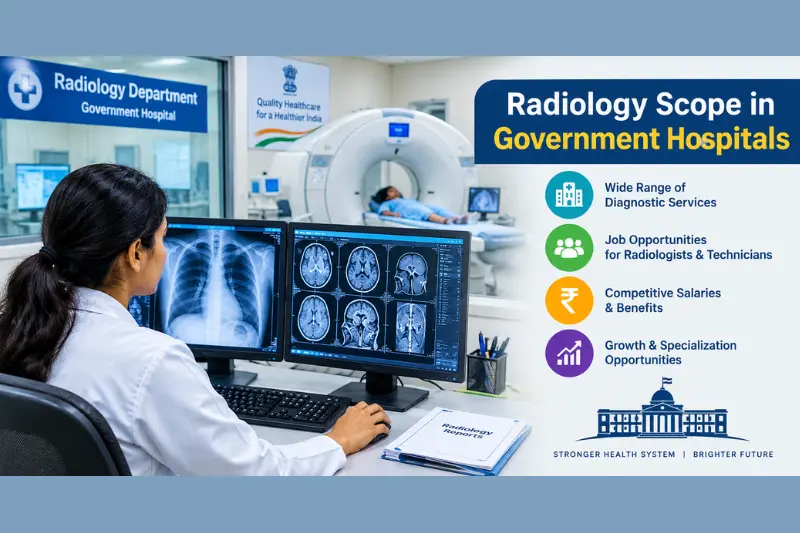
Government healthcare facilities can provide radiologists with opportunities to work with diverse patient populations and a broad range of diseases.
The work may include:
- Routine imaging
- Emergency imaging
- Trauma cases
- Inpatient imaging
- Outpatient investigations
- Ultrasound
- CT
- MRI
- Teaching
- Academic activities
- Hospital committees
- Research
Government-sector opportunities depend on recruitment rules, vacancies, qualifications, state or central government requirements, and institutional needs.
Students should check official recruitment notifications rather than relying on old vacancy information.
Radiology Scope in Private Hospitals
Private hospitals can provide access to advanced imaging equipment and large patient volumes.
Career opportunities may include:
- Consultant radiologist
- Hospital radiologist
- Imaging specialist
- Emergency radiologist
- Subspecialty radiologist
- Interventional radiology roles
- Academic positions
- Teleradiology services
Workload can vary significantly between hospitals. A large tertiary-care hospital may provide extensive exposure to complex imaging and multidisciplinary cases. A smaller facility may involve a different mixture of routine and emergency examinations.
Radiology Scope in Diagnostic Centres
Diagnostic centres are an important part of the radiology ecosystem in India.
A radiologist working in a diagnostic centre may interpret multiple imaging modalities and coordinate with referring clinicians.
Career growth can involve:
- Advanced reporting
- Subspecialty expertise
- Quality management
- Clinical consultation
- Procedure-based services
- Centre management
- Partnership or ownership opportunities where legally and professionally appropriate
A diagnostic centre also requires proper equipment, qualified personnel, regulatory compliance, radiation protection, quality assurance, and ethical clinical practice.
Radiation Safety in Radiology
Radiology professionals must understand radiation safety.
X-ray-based imaging involves ionizing radiation, which requires appropriate justification, optimization, equipment standards, shielding, trained personnel, and regulatory compliance.
The Atomic Energy Regulatory Board (AERB) guidance on diagnostic radiology explains that medical X-ray facilities in India are subject to regulatory requirements and that X-ray institutions require the relevant AERB consents through the e-LORA system.
The AERB medical diagnostic X-ray safety guidance also emphasizes licensed facilities, trained staff, equipment quality, and adequate shielding.
Radiation safety is part of professional responsibility, not merely an administrative requirement.
Role of Technology in Radiology
Technology is one of the strongest reasons for the expanding future scope of radiology in India.
Radiology continues to incorporate:
- High-resolution CT
- Advanced MRI
- Digital radiography
- 3D reconstruction
- Image-guided procedures
- PACS
- Teleradiology
- Artificial intelligence
- Automated image analysis
- Clinical decision-support technologies
The role of artificial intelligence deserves careful consideration. AI can assist with image analysis, workflow prioritization, pattern recognition, and decision support. Radiologists remain responsible for clinical interpretation and communication within the appropriate patient context.
Technology creates a need for radiologists who understand both medical imaging and digital healthcare systems.
Artificial Intelligence and the Future of Radiology in India
AI is changing radiology workflows.
Potential applications include:
- Detection support
- Image segmentation
- Workflow prioritization
- Quantitative analysis
- Structured reporting support
- Quality control
- Research
AI does not remove the need for medical expertise. Imaging findings must be interpreted alongside clinical history, examination findings, previous studies, laboratory information, and the patient’s overall condition.
Radiologists who develop strong clinical reasoning and digital skills may be better positioned for an evolving imaging environment.
Is Radiology a Good Career in India?
Radiology can be a strong career choice for students who enjoy anatomy, diagnostic reasoning, technology, imaging interpretation, and detail-oriented work.
Potential advantages include:
- Broad clinical relevance
- Technology-driven practice
- Multiple imaging modalities
- Hospital opportunities
- Diagnostic-centre opportunities
- Academic careers
- Research opportunities
- Teleradiology
- Subspecialization
- Interventional pathways
- Potential private-practice opportunities
The specialty also has demanding aspects.
Radiologists carry significant diagnostic responsibility. High-volume reporting can require sustained concentration. Emergency cases can involve time-sensitive decision-making. Ultrasound and interventional procedures may require direct patient interaction and procedural skills.
Radiology should not be selected only because it is perceived as a high-paying or lifestyle-friendly specialty.
Skills Needed for a Successful Radiologist
A successful radiologist needs more than knowledge of imaging machines.
Important skills include:
- Strong anatomical knowledge
- Diagnostic reasoning
- Attention to detail
- Pattern recognition
- Clinical correlation
- Communication
- Time management
- Decision-making
- Technology literacy
- Professional ethics
- Continuous learning
The ability to communicate significant findings clearly is particularly important because radiology reports influence clinical decisions.
Radiology Salary in India
Radiology salary in India varies widely.
Income can depend on:
- Qualification
- Experience
- City
- Hospital type
- Diagnostic-centre workload
- Imaging modalities
- Subspecialty
- Employment model
- Teleradiology work
- Private practice
- Professional reputation
A fixed salary figure cannot accurately represent the entire radiology profession.
Salaried hospital employment may provide a different income structure from private diagnostic practice or teleradiology. Experienced radiologists with advanced skills may have different earning opportunities from newly qualified specialists.
Students should avoid choosing radiology solely based on online salary estimates.
For broader comparisons, see Best MD Branches After MBBS in India.
Radiology vs Other Medical Branches
Radiology differs from many clinical specialties in the nature of patient interaction and diagnostic responsibility.
General Medicine involves direct management of adult medical conditions. Surgery involves operative treatment. Pediatrics focuses on children. Dermatology concentrates on skin and related conditions. Psychiatry focuses heavily on mental and behavioral health.
Radiology is strongly centered on diagnostic imaging and image-guided procedures.
Students should compare:
- Patient interaction
- Emergency duties
- Procedural work
- Technology use
- Working hours
- Residency workload
- Career opportunities
- Research opportunities
- Private-practice possibilities
- Long-term professional interests
The broader guide How to Choose a Medical Branch can help students evaluate these factors before selecting a specialty.
Work-Life Balance in Radiology
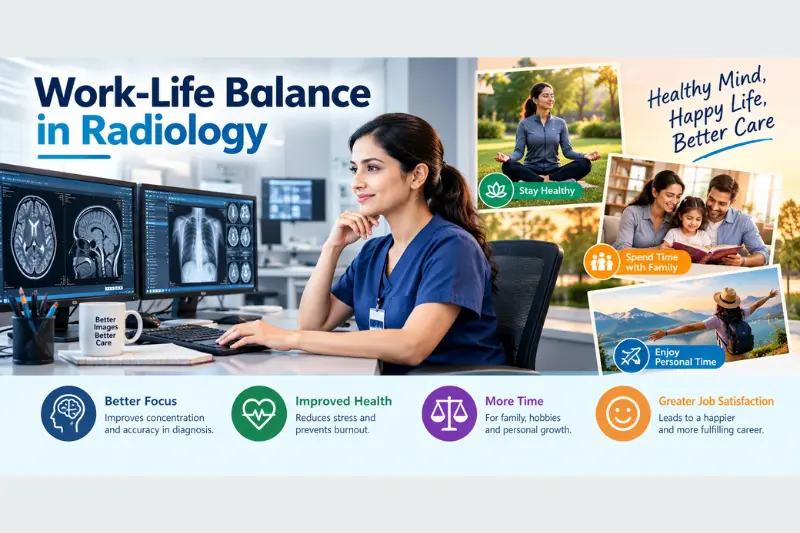
Radiology is often associated with relatively structured work compared with some emergency-heavy specialties. Actual work-life balance varies by workplace.
A radiologist working in a busy trauma centre may have significant emergency responsibilities. A diagnostic centre may involve high reporting volumes. Teleradiology can involve shift-based work, including overnight reporting.
Factors affecting work-life balance include:
- Hospital type
- Emergency coverage
- Shift system
- Patient volume
- Reporting targets
- Subspecialty
- Location
- Private practice commitments
Students should speak with practicing radiologists and residents to understand the real workload of the institutions they are considering.
Future Scope of Radiology in India
The future scope of radiology in India is linked to the increasing use of medical imaging, healthcare infrastructure, technology, advanced diagnostics, and subspecialty services.
Potential growth areas include:
- Advanced MRI
- CT imaging
- Emergency radiology
- Oncology imaging
- Neuroimaging
- Musculoskeletal imaging
- Breast imaging
- Pediatric imaging
- Interventional radiology
- Teleradiology
- AI-assisted imaging
- Imaging research
The future is likely to reward radiologists who combine strong diagnostic fundamentals with clinical understanding and technological adaptability.
Is Radiology in Demand in India?
Radiology services are required across hospitals, diagnostic centres, emergency departments, oncology services, surgical departments, and specialist clinics.
Demand varies by location and healthcare infrastructure. Metropolitan cities may have a high concentration of radiologists and advanced diagnostic centres. Smaller cities and underserved regions may have different needs and opportunities.
The expansion of diagnostic facilities can increase the need for trained imaging professionals, but students should evaluate actual local employment conditions before making career decisions.
Private Practice Scope in Radiology
Radiology can provide private-sector opportunities, particularly through diagnostic imaging services.
A radiologist may eventually become involved in:
- Diagnostic centre practice
- Imaging consultation
- Partnership models
- Advanced imaging services
- Interventional services
- Teleradiology
- Healthcare entrepreneurship
Operating an imaging facility requires more than medical expertise. Equipment procurement, staffing, maintenance, quality assurance, regulatory compliance, radiation safety, patient privacy, financial management, and ethical standards are important.
AERB states that medical diagnostic X-ray facilities must meet applicable licensing and radiation-safety requirements, making regulatory compliance an essential part of diagnostic-centre operations.
Academic and Teaching Career in Radiology
Radiology also offers an academic pathway.
Radiologists working in medical colleges can participate in:
- Undergraduate teaching
- Postgraduate teaching
- Case discussions
- Research
- Conferences
- Publications
- Clinical audits
- Training programmes
The NMC curriculum specifically includes teaching and research objectives within postgraduate Radiodiagnosis training.
Students interested in academic medicine should consider institutions with strong teaching departments and research opportunities.
Research Opportunities in Radiology
Radiology is suitable for doctors interested in medical research because imaging generates large amounts of clinical information.
Research areas can include:
- Imaging biomarkers
- AI in radiology
- Cancer imaging
- Neuroimaging
- Cardiovascular imaging
- Musculoskeletal imaging
- Pediatric imaging
- Radiation-dose optimization
- Interventional techniques
- Imaging workflow
- Teleradiology
Research experience during postgraduate training can help doctors develop skills in study design, data analysis, scientific writing, and evidence-based practice.
Challenges of a Radiology Career in India
Radiology offers strong opportunities but also presents professional challenges.
High Diagnostic Responsibility
A radiology report can influence major clinical decisions. Errors or missed findings can have serious consequences.
Continuous Learning
Imaging technology changes rapidly. Radiologists need continuous professional development.
High Workload
Large hospitals and diagnostic centres may have substantial imaging volumes.
Technology Dependence
Radiology practice depends on sophisticated equipment, digital systems, PACS, network infrastructure, and maintenance.
Radiation Safety
Radiologists and imaging teams must understand radiation protection and regulatory requirements.
AI and Automation
Radiologists need to adapt to AI-assisted workflows while maintaining clinical judgment and professional responsibility.
How to Choose Radiology as a Career After MBBS
Students considering radiology should use a structured decision process.
Evaluate Your Interest in Anatomy and Imaging
Radiology requires strong anatomical understanding and sustained attention to imaging details.
Observe a Radiology Department
Clinical exposure can reveal the actual daily routine better than online descriptions.
Compare Training Institutions
Review:
- CT exposure
- MRI exposure
- Ultrasound exposure
- Emergency cases
- Interventional procedures
- Patient volume
- Faculty
- Academic environment
- Research facilities
Understand the Lifestyle
Ask residents and practicing radiologists about working hours, emergency duties, reporting volume, procedures, and night shifts.
Consider Long-Term Specialization
Think about whether you want general diagnostic radiology, a subspecialty, interventional work, academics, research, or private practice.
Students who are still comparing specialties can use Medical Branches List After NEET in India as a broader reference.
Radiology Scope in India: Key Career Paths
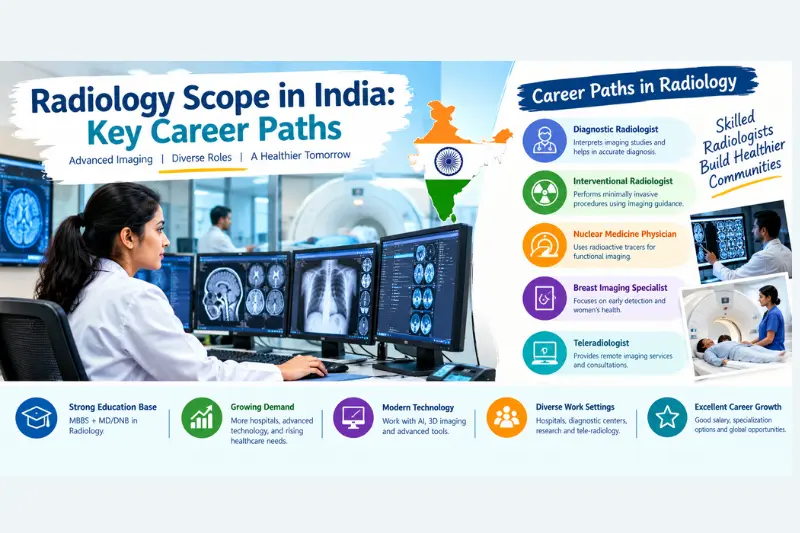
The major career paths can be summarized as:
| Career Path | Main Focus |
|---|---|
| Government Radiologist | Public-sector diagnostic services |
| Hospital Radiologist | Imaging within hospitals |
| Diagnostic Centre Radiologist | Imaging and reporting |
| Teleradiologist | Remote image interpretation |
| Academic Radiologist | Teaching and research |
| Interventional Radiologist | Image-guided procedures |
| Subspecialty Radiologist | Focused advanced imaging |
| Research Radiologist | Imaging research and innovation |
| Private Practitioner | Independent or partnered practice |
Each path has different requirements, responsibilities, workloads, and financial models.
Frequently Asked Questions
Is radiology a good career in India?
Radiology can be a strong career for doctors interested in medical imaging, anatomy, diagnostic reasoning, technology, research, and image-guided procedures. Career suitability depends on personal interests, training opportunities, workload preferences, and long-term goals.
What is the scope of radiology in India after MBBS?
The scope includes hospitals, diagnostic centres, government healthcare, private healthcare, medical colleges, teleradiology, research, advanced imaging, interventional radiology, and subspecialty practice.
Is MD Radiodiagnosis a good choice after MBBS?
MD Radiodiagnosis can be a suitable postgraduate option for students interested in imaging and technology. The NMC curriculum covers diagnostic and interventional imaging along with teaching, research, ethics, and legal aspects.
What are the main radiology career options in India?
Major options include hospital radiology, diagnostic-centre practice, government service, academic medicine, teleradiology, research, interventional radiology, and subspecialty imaging.
Does radiology have a future in India?
Radiology has continuing relevance because imaging is integrated into diagnosis, treatment planning, emergency care, oncology, surgery, and disease monitoring. Technology, advanced imaging, teleradiology, and AI-assisted workflows are also changing the specialty.
Is radiology only about X-rays?
No. Radiology includes multiple imaging modalities such as X-ray, CT, MRI, ultrasound, mammography, fluoroscopy, and specialized image-guided procedures.
Can radiologists work in diagnostic centres?
Yes. Diagnostic centres are an important employment setting for radiologists. The exact responsibilities depend on the facility, imaging modalities, workload, qualifications, and applicable regulations.
Is radiology a high-paying medical branch in India?
Radiology can offer strong earning opportunities, but income varies by experience, city, employer, workload, subspecialty, private practice, and professional reputation. A single salary figure cannot represent the entire profession.
Can radiologists work from home in India?
Teleradiology can allow qualified radiologists to interpret imaging studies remotely where the service, technology, professional arrangements, and applicable requirements support remote reporting.
Does AI threaten radiology careers?
AI is changing radiology workflows and can assist with detection, segmentation, prioritization, and quantitative analysis. Radiologists remain responsible for clinical interpretation, patient context, communication, and professional decision-making.
Conclusion
The radiology scope in India extends far beyond traditional X-ray reporting. Modern radiologists can work with CT, MRI, ultrasound, mammography, fluoroscopy, emergency imaging, image-guided procedures, teleradiology, research, teaching, and advanced healthcare technologies.
The specialty offers opportunities across government hospitals, private hospitals, diagnostic centres, medical colleges, research institutions, and technology-enabled healthcare services. The National Medical Commission’s Radiodiagnosis curriculum reflects the breadth of training in diagnostic and interventional imaging, while AERB regulations highlight the importance of radiation safety and licensed diagnostic facilities.
Radiology can be an excellent career for an MBBS graduate who enjoys anatomy, technology, diagnostic reasoning, attention to detail, and continuous learning. The right decision should be based on genuine interest, quality of postgraduate training, clinical exposure, lifestyle expectations, career goals, and long-term professional development.