
Introduction
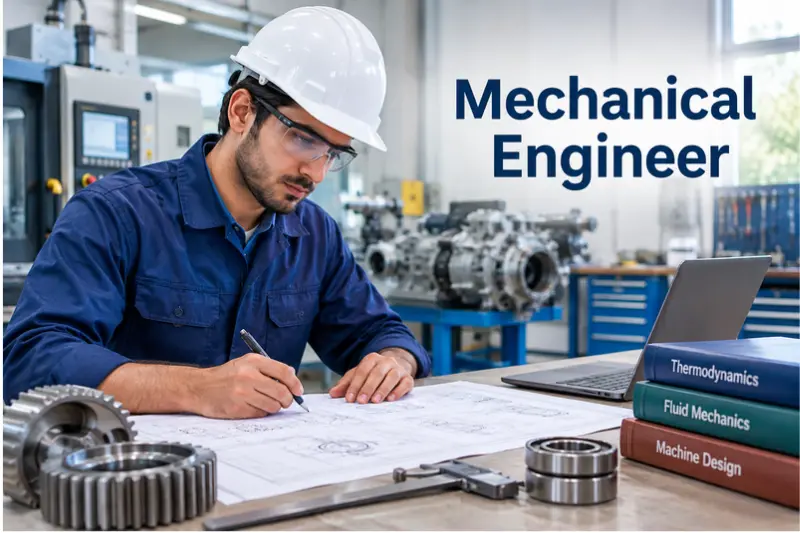
A mechanical engineer applies scientific principles, mathematics, materials knowledge, and engineering design to develop, improve, operate, and maintain machines and mechanical systems. From automotive engines and aircraft components to industrial robots, heating systems, manufacturing equipment, and renewable energy technologies, mechanical engineers contribute to products and infrastructure used around the world.
The profession combines theoretical knowledge with practical problem-solving. A mechanical engineer may design a new component, investigate equipment failure, test a prototype, improve production efficiency, or evaluate the performance of an energy system. Consequently, the work varies considerably depending on the employer, industry, qualification, and specialization.
Mechanical engineering offers opportunities across the United States, India, the United Kingdom, Canada, Australia, the Middle East, and many other regions. However, educational requirements, professional licensing, salaries, and employment conditions differ between countries.
This guide explains what a mechanical engineer does, the qualifications and skills required, major specializations, technical abbreviations and acronyms, and career opportunities for students, graduates, and experienced professionals.
What Is a Mechanical Engineer?
A mechanical engineer is an engineering professional who uses principles of mechanics, thermodynamics, materials science, fluid mechanics, and design to solve technical problems. These professionals develop machines, mechanical components, thermal equipment, production systems, and other technologies that perform specific functions safely and efficiently.
For example, an automotive mechanical engineer may help develop an engine cooling system, while a manufacturing engineer may improve a production line. Similarly, an energy engineer may evaluate turbine performance, and an HVAC engineer may design systems that control temperature, ventilation, and indoor air quality.
Although the terms mechanical engineer and mechanical engineering are closely connected, they describe different things. Mechanical engineering is the academic and technical discipline, whereas a mechanical engineer is the person who applies that knowledge professionally.
Readers who want to understand the wider discipline can explore What Is Mechanical Engineering?, which covers its fundamentals, applications, skills, and general career possibilities.
What Does a Mechanical Engineer Do?
The responsibilities of a mechanical engineer depend on the job title, project requirements, and industry. Nevertheless, most positions involve a combination of analysis, design, testing, technical documentation, and collaboration.
Designing machines and components: Engineers create or improve mechanical parts, assemblies, tools, engines, pumps, compressors, and other equipment. They evaluate dimensions, loads, materials, tolerances, and operating conditions before approving a design.
Using engineering software: Computer-based tools help engineers create drawings, model components, and evaluate performance. CAD means Computer-Aided Design, while CAE means Computer-Aided Engineering. These technologies are particularly important in product development, industrial design, and engineering analysis.
Testing prototypes: Before a product enters production, engineers may build prototypes and test them under different operating conditions. The results help identify weaknesses, verify performance, and determine whether a design needs modification.
Troubleshooting equipment: Mechanical engineers investigate abnormal vibration, overheating, leakage, excessive wear, poor efficiency, and unexpected breakdowns. They use inspection, measurements, engineering calculations, and maintenance records to identify possible causes and recommend corrective actions.
Improving manufacturing processes: Engineers work with production teams to reduce waste, improve product consistency, shorten production cycles, and maintain quality. In automated facilities, they may help integrate robots, sensors, and computer-controlled machinery.
Evaluating energy and thermal systems: Thermodynamics and heat transfer are essential when working with boilers, turbines, refrigeration equipment, engines, heat exchangers, and power-generation systems.
Preparing technical documentation: Drawings, specifications, calculations, inspection reports, maintenance procedures, and testing records communicate engineering requirements to other professionals.
In addition, a mechanical engineer may coordinate with electrical engineers, civil engineers, software developers, technicians, project managers, suppliers, and clients. Effective communication is therefore just as important as technical knowledge.
The U.S. Bureau of Labor Statistics describes mechanical engineers as professionals who research, design, develop, build, and test mechanical and thermal devices.
Main Responsibilities in Different Industries
A mechanical engineer does not necessarily perform the same tasks throughout an entire career. Instead, responsibilities change according to the employer’s products, operational environment, and business objectives.
In the automotive industry, engineers may work on vehicle structures, engines, transmissions, braking components, thermal management, or electric-vehicle systems. In aerospace, they may contribute to propulsion systems, mechanical assemblies, structural components, and thermal analysis.
Manufacturing companies employ engineers to design production equipment, improve factory layouts, evaluate machine performance, and support quality assurance. Energy companies require expertise in turbines, pumps, compressors, heat exchangers, and other equipment used in power generation and industrial processes.
Construction-related engineering services also provide opportunities. For example, HVAC engineers design heating, ventilation, and air-conditioning systems for commercial buildings, hospitals, residential developments, and industrial facilities.
Marine industries employ mechanical engineers in shipboard machinery, propulsion systems, auxiliary equipment, and maintenance planning. Healthcare and medical-device companies may need engineers to develop precision mechanisms, testing equipment, and specialized mechanical components.
These examples illustrate why the profession remains relevant across several sectors rather than depending on a single industry.
Essential Skills for a Mechanical Engineer
A successful mechanical engineer combines technical competence with analytical thinking, practical judgment, and teamwork. The exact skill requirements vary, but several capabilities are useful across most specializations.
Mathematics and physics: Calculus, algebra, differential equations, mechanics, and physical sciences support engineering calculations and design decisions.
Mechanical design: Engineers need to understand component geometry, dimensions, fits, tolerances, loads, material properties, and assembly requirements.
Problem-solving: Investigating a failure requires the ability to distinguish symptoms from root causes, compare possible explanations, and select an appropriate corrective action.
Computer skills: Familiarity with CAD, simulation software, spreadsheets, and technical documentation systems helps engineers perform calculations and communicate designs.
Communication: Engineers frequently explain technical findings to colleagues who may not share the same specialization. Clear reports and accurate drawings reduce misunderstandings.
Project management: Planning, budgeting, scheduling, procurement coordination, and risk assessment become increasingly important as professionals progress into senior roles.
Continuous learning: Engineering technology changes as companies adopt automation, advanced materials, digital simulation, and energy-efficient systems. Professional development helps engineers maintain relevant knowledge.
Furthermore, practical experience through internships, laboratory projects, workshops, and industrial placements can help students connect academic concepts with real engineering work.
Qualifications Required to Become a Mechanical Engineer
The educational route depends on the country, institution, intended role, and professional regulations. However, a relevant engineering degree is a common starting point for design and development positions.
In the United States, many mechanical engineering positions require a bachelor’s degree in mechanical engineering or a closely related discipline. Students normally study mathematics, physics, engineering mechanics, materials, thermodynamics, fluid mechanics, design, and manufacturing.
Accreditation can also matter. Students can consult ABET to investigate engineering program accreditation and understand how accredited education relates to professional preparation.
In India, students commonly pursue a Bachelor of Technology (B.Tech.) or Bachelor of Engineering (B.E.) in Mechanical Engineering. Admission routes and eligibility conditions depend on the institution and applicable rules. Many students enter through national, state, or university-level admission processes.
The All India Council for Technical Education (AICTE) provides information about technical education and its regulatory framework in India. Prospective students should verify current admission criteria and program recognition with the relevant institution and authorities.
Other countries have their own education systems. Depending on the role, employers may accept a recognized bachelor’s degree, an engineering technology qualification, or another relevant technical pathway. Requirements for engineering design authority and regulated professional practice may be different from those for technician or technologist positions.
A master’s degree can be useful for specialized research, advanced design, thermal sciences, robotics, materials engineering, or academic work. However, it is not universally required for entry-level mechanical engineering employment.
For a clearer understanding of degree content, students can also read Mechanical Engineering Subjects, which explores core courses, electives, and practical learning.
Mechanical Engineer Abbreviations, Initialisms, and Acronyms
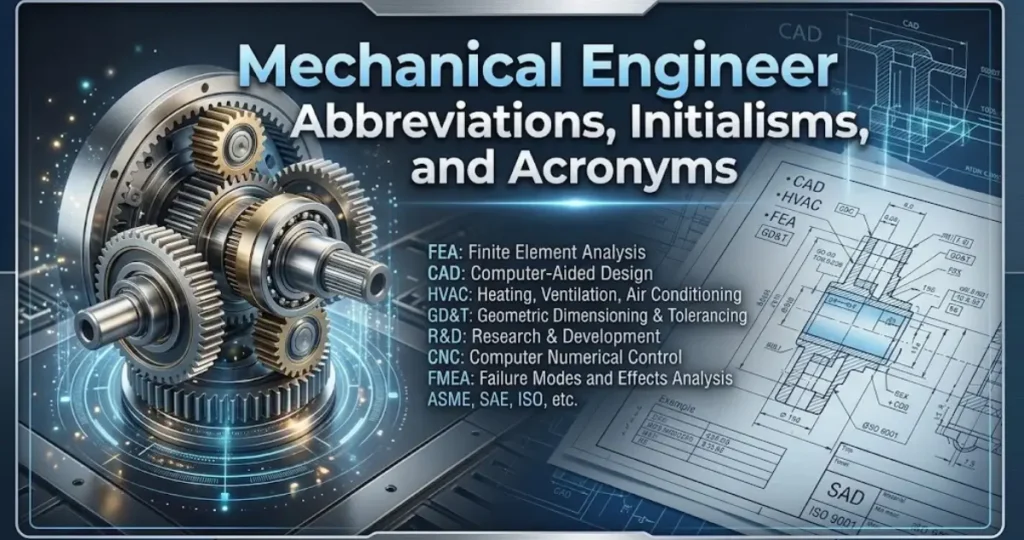
Technical short forms appear throughout engineering drawings, software interfaces, specifications, textbooks, maintenance manuals, and industrial reports. A mechanical engineer should understand the terminology relevant to the work being performed.
Although the words are sometimes used interchangeably in everyday conversation, abbreviations, initialisms, and acronyms are not exactly the same.
An abbreviation is a shortened form of a word or phrase. An initialism is formed from initial letters that are pronounced separately. An acronym is formed from initial letters or parts of words and is pronounced as a word. Usage varies, and some technical terms can be classified differently depending on convention.
Common examples include:
CAD — Computer-Aided Design: Software-assisted creation and modification of engineering drawings and three-dimensional models.
CAM — Computer-Aided Manufacturing: Computer-based planning or control of manufacturing operations.
CAE — Computer-Aided Engineering: Computer tools used to analyze, simulate, or evaluate engineering designs.
CFD — Computational Fluid Dynamics: Numerical analysis of fluid flow and related heat-transfer phenomena.
CNC — Computer Numerical Control: Automated control of machine tools using programmed instructions.
CMM — Coordinate Measuring Machine: Equipment used to measure physical dimensions and geometric features.
FEA — Finite Element Analysis: A numerical technique used to estimate structural, thermal, and other physical responses.
FBD — Free-Body Diagram: A simplified representation of a body showing the forces and moments acting on it.
FOS — Factor of Safety: A design measure used to provide a margin against specified failure conditions.
HVAC — Heating, Ventilation, and Air Conditioning: Systems that regulate indoor temperature, ventilation, and air quality.
These short forms are useful in education and industry, but engineers must interpret them in context. For example, FEA refers to an analysis technique, while FEM commonly means Finite Element Method. The two are closely related, but they do not always describe precisely the same thing.
Fullipedia provides additional resources for readers who want to explore engineering terminology alphabetically. Start with Mechanical Engineering Initialisms – Alphabet A. You can also explore Alphabet B, Alphabet C, and Alphabet F.
These resources can help students, technicians, graduates, and experienced engineers understand specialized vocabulary encountered in technical documents.
Major Specializations for a Mechanical Engineer
Mechanical engineering is a broad field, so professionals often specialize in a particular technology, industry, or type of engineering problem.
Mechanical design engineering: Design engineers develop components, assemblies, mechanisms, and products. Their work may involve CAD modeling, material selection, tolerance analysis, and design verification.
Manufacturing engineering: Manufacturing engineers improve how products are produced. They may evaluate tooling, machining operations, assembly processes, production layouts, and manufacturing costs.
Thermal engineering: This specialization focuses on heat transfer, thermodynamics, refrigeration, combustion, power generation, and thermal equipment.
Automotive engineering: Automotive professionals work on vehicle systems, engines, transmissions, suspension, braking, thermal management, and emerging electric-vehicle technologies.
Aerospace engineering: Mechanical engineering principles support aircraft mechanisms, propulsion components, structural analysis, thermal systems, and testing. Some aerospace roles require more specialized qualifications.
Robotics and automation: Engineers contribute to robotic mechanisms, automated production lines, motion systems, industrial equipment, and machine integration.
HVAC engineering: HVAC specialists design, evaluate, commission, and maintain systems for heating, cooling, ventilation, and indoor environmental control.
Maintenance and reliability engineering: These professionals focus on equipment availability, inspection, failure prevention, maintenance planning, and operational reliability.
Marine engineering: Depending on the employer and vessel, marine-related roles may involve propulsion machinery, pumps, compressors, auxiliary systems, and maintenance operations.
Renewable energy engineering: Mechanical engineers contribute to wind turbines, thermal energy systems, energy storage equipment, and other technologies supporting energy efficiency and decarbonization.
A professional may move between specializations as experience develops. For instance, manufacturing experience can provide a foundation for quality engineering, production management, automation, or reliability work.
Mechanical Engineer Jobs and Career Opportunities
Career opportunities depend on qualifications, technical skills, industrial demand, location, and experience. Entry-level graduates often begin as graduate engineers, junior design engineers, production engineers, maintenance engineers, or quality engineers.
With experience, a mechanical engineer may progress into roles such as senior engineer, project engineer, engineering consultant, technical specialist, engineering manager, or research and development professional.
Some positions emphasize technical depth, while others involve leadership, budgets, suppliers, client communication, and coordination across multiple engineering disciplines.
Industries employing mechanical engineers include manufacturing, automotive, aerospace, energy, engineering services, transportation equipment, industrial machinery, construction services, consumer products, and research organizations.
To investigate the profession in more detail, consult the U.S. Bureau of Labor Statistics Occupational Outlook Handbook. It provides information about job duties, education, pay, and employment projections in the United States.
Readers can also explore Fullipedia’s Mechanical Engineering Scope: Career, Jobs, Industries & Future for a broader discussion of career pathways and industry opportunities.
Mechanical Engineer Opportunities in the United States
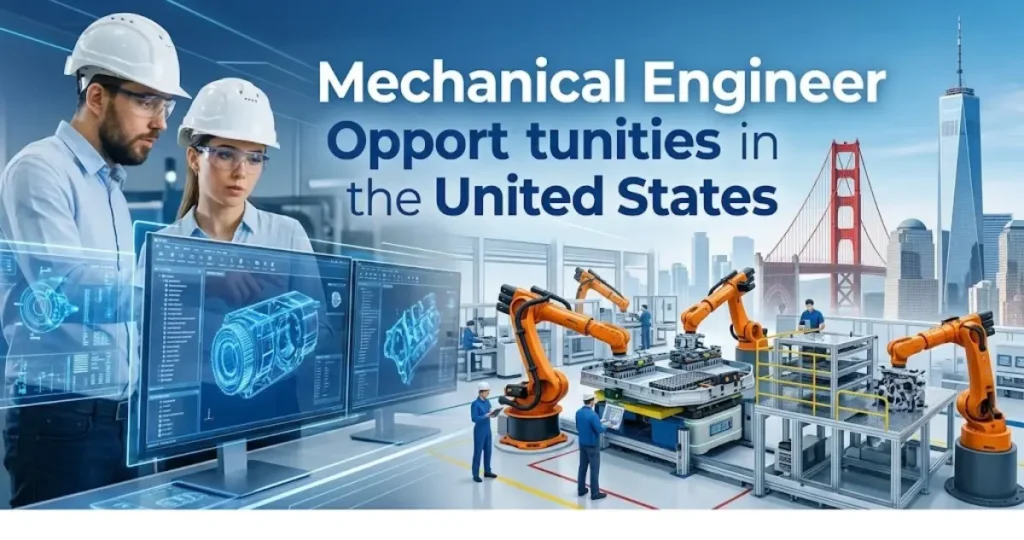
The United States has employment opportunities in engineering services, manufacturing, aerospace, automotive technology, energy, industrial machinery, and research and development.
A mechanical engineer may work for a manufacturer, consulting firm, engineering contractor, research organization, government agency, or technology company. Some professionals focus on product design and simulation, while others work in testing, production, maintenance, or project coordination.
A relevant bachelor’s degree is typical for many professional positions. Nevertheless, employers can have additional requirements for specialized responsibilities, and certain regulated activities require appropriate authorization or licensure.
For professionals pursuing a path toward licensed engineering practice, the National Council of Examiners for Engineering and Surveying (NCEES) provides information about examinations and professional licensure. Requirements vary by jurisdiction and type of practice.
International applicants should also investigate employer sponsorship, work authorization, and any applicable immigration requirements before accepting a position.
Mechanical Engineer Opportunities in India
India offers opportunities across automotive manufacturing, industrial machinery, infrastructure-related services, energy, engineering design, production, maintenance, and emerging manufacturing technologies.
A mechanical engineer may work in a factory, design office, power plant, research facility, engineering services company, or industrial project organization. Graduate recruitment programs, internships, and technical examinations can provide entry routes depending on the employer.
Public-sector and government-related engineering opportunities may have specific educational eligibility, examination requirements, age conditions, or recruitment procedures. Applicants should consult the relevant official recruitment notification rather than relying on general career advice.
Practical knowledge of CAD, CNC manufacturing, quality control, maintenance systems, technical documentation, and industrial processes can strengthen a graduate’s employability. However, the importance of each skill depends on the vacancy.
In addition, experience with automation, energy efficiency, electric vehicles, and advanced manufacturing can be valuable for candidates targeting evolving industrial sectors.
International Career Opportunities
Outside the United States and India, mechanical engineers can pursue positions in countries such as Canada, the United Kingdom, Australia, Germany, the United Arab Emirates, and Saudi Arabia.
Potential employers include manufacturers, engineering consultants, energy companies, infrastructure contractors, marine organizations, and industrial service providers. Nevertheless, the required qualification, professional registration, language ability, and work authorization vary by destination.
Before relocating, candidates should compare local job descriptions, salary structures, licensing rules, tax obligations, and living expenses. A qualification that is accepted by one employer may require additional assessment or documentation elsewhere.
Mechanical Engineer Salary: What Affects Earnings?
There is no single worldwide salary for a mechanical engineer. Earnings depend on the country, city, employer, experience, qualifications, specialization, and responsibility level.
Entry-level professionals generally earn differently from senior engineers, project leaders, or managers. Industries with specialized technical demands may offer different compensation from sectors with more standardized responsibilities.
In the United States, the Bureau of Labor Statistics publishes occupational wage data and employment information. Its figures should be interpreted according to the reporting period and the population covered.
In India, salaries can vary considerably between cities, employers, manufacturing sectors, public-sector organizations, and multinational companies. Candidates should compare current vacancies and compensation packages rather than assuming that a single national average applies to every mechanical engineering role.
For international comparisons, it is also important to consider benefits, healthcare arrangements, retirement contributions, bonuses, working hours, housing costs, and currency exchange rates. A higher nominal salary does not automatically mean a higher standard of living.
Therefore, job seekers should evaluate the complete compensation package alongside career development, job security, working conditions, and opportunities for specialization.
Tools and Technologies Used by Mechanical Engineers
Modern mechanical engineering combines conventional engineering principles with digital design, simulation, measurement, and manufacturing technologies.
CAD platforms allow engineers to develop two-dimensional drawings and three-dimensional models. CAE software supports simulations and engineering analysis, while CFD tools help evaluate fluid movement and heat transfer.
CNC equipment enables programmed manufacturing operations. Coordinate measuring machines and other inspection tools help verify dimensions and product quality.
In addition, engineers may use spreadsheets, programming languages, data-analysis tools, sensors, and equipment-monitoring systems. The choice depends on the project and employer.
Emerging technologies are also changing engineering workflows. Digital twins, additive manufacturing, industrial robotics, predictive maintenance, and artificial intelligence can support design development and operational decision-making.
However, software is not a substitute for engineering judgment. A mechanical engineer must understand assumptions, material properties, boundary conditions, measurement uncertainty, and the limitations of a model before relying on its results.
Challenges Faced by Mechanical Engineers
The profession involves technical and organizational challenges. Engineers must balance performance, cost, reliability, maintainability, manufacturing feasibility, and environmental considerations.
A design that performs well in a simulation may require modification after physical testing. Manufacturing tolerances, material variation, operating temperatures, vibration, corrosion, and unexpected loading can affect real-world performance.
Project schedules and budgets create additional pressures. Engineers may need to coordinate with several teams, respond to design changes, evaluate suppliers, and document decisions carefully.
Safety and regulatory compliance are also important. Equipment must be designed, installed, operated, and maintained according to applicable requirements. The relevant standards depend on the equipment, industry, and jurisdiction.
Furthermore, professionals need to keep their skills current as industries adopt new materials, manufacturing processes, energy technologies, and digital systems.
Future of the Mechanical Engineering Profession
The future of mechanical engineering is closely connected to industrial innovation, automation, transportation, energy systems, and advanced manufacturing.
Electric vehicles create engineering challenges involving thermal management, lightweight structures, cooling systems, and mechanical integration. Renewable energy projects require reliable equipment, efficient power conversion, and effective maintenance strategies.
Robotics and automation are changing production methods, while additive manufacturing enables certain complex geometries and specialized components. Digital simulation and connected equipment also help organizations evaluate designs and monitor performance.
Sustainability is another important area. Mechanical engineers can contribute to energy-efficient systems, material optimization, waste reduction, equipment life extension, and improved manufacturing processes.
Nevertheless, technological developments do not guarantee identical employment growth in every location or specialization. Opportunities depend on investment, industrial activity, local demand, and the skills employers require.
For students and professionals, a useful long-term strategy is to build strong engineering fundamentals while developing relevant digital, analytical, communication, and project-management skills.
How to Become a Successful Mechanical Engineer
The first step is to choose an appropriate education pathway and verify that the program meets the requirements for the intended career. Students should develop a strong understanding of mathematics, physics, mechanics, materials, and engineering design.
Next, practical experience can help turn academic knowledge into useful professional skills. Internships, laboratory projects, manufacturing exposure, design assignments, and supervised industrial training can provide valuable experience.
Learning relevant software is another useful step. Depending on the target role, this may include CAD modeling, simulation, technical drawing, data analysis, or manufacturing technologies.
Candidates should also create a portfolio of genuine academic or professional projects. Examples may include a mechanical assembly, a documented design calculation, a manufacturing improvement project, or a properly validated simulation.
During the job search, applicants should tailor their resumes to the vacancy and describe their actual skills and achievements accurately. Professional networking, career fairs, university placement services, and industry events may also help identify opportunities.
Finally, ongoing learning remains important after graduation. Technical standards, software, manufacturing practices, and employer expectations evolve over time, so experienced engineers also benefit from professional development.
Frequently Asked Questions About Mechanical Engineers
What does a mechanical engineer do?
A mechanical engineer designs, analyzes, develops, tests, improves, or maintains mechanical systems and equipment. Responsibilities vary across industries and can include product design, manufacturing, energy systems, automation, and troubleshooting.
What degree does a mechanical engineer need?
Many professional engineering positions require a bachelor’s degree in mechanical engineering or a related discipline. In India, B.Tech. and B.E. degrees are common pathways. Requirements depend on the employer, role, and country.
Is mechanical engineering a good career?
It can be a rewarding career for people interested in machines, mathematics, design, problem-solving, manufacturing, and technology. Career prospects depend on local demand, qualifications, specialization, and continuing professional development.
Can a mechanical engineer work in the United States after studying in India?
Potentially, yes. However, employment depends on qualifications, employer requirements, work authorization, and any professional licensing rules applicable to the role. Candidates should verify the relevant requirements before applying.
Which skills are important for mechanical engineers?
Important skills include engineering mechanics, mathematics, materials knowledge, CAD, problem-solving, technical communication, and teamwork. Specialized roles may require additional knowledge of CFD, FEA, CNC manufacturing, automation, or thermal systems.
What are CAD, CAM, and CAE in mechanical engineering?
CAD means Computer-Aided Design, CAM means Computer-Aided Manufacturing, and CAE means Computer-Aided Engineering. These technologies support different stages of design, analysis, and manufacturing.
Do mechanical engineers need a professional license?
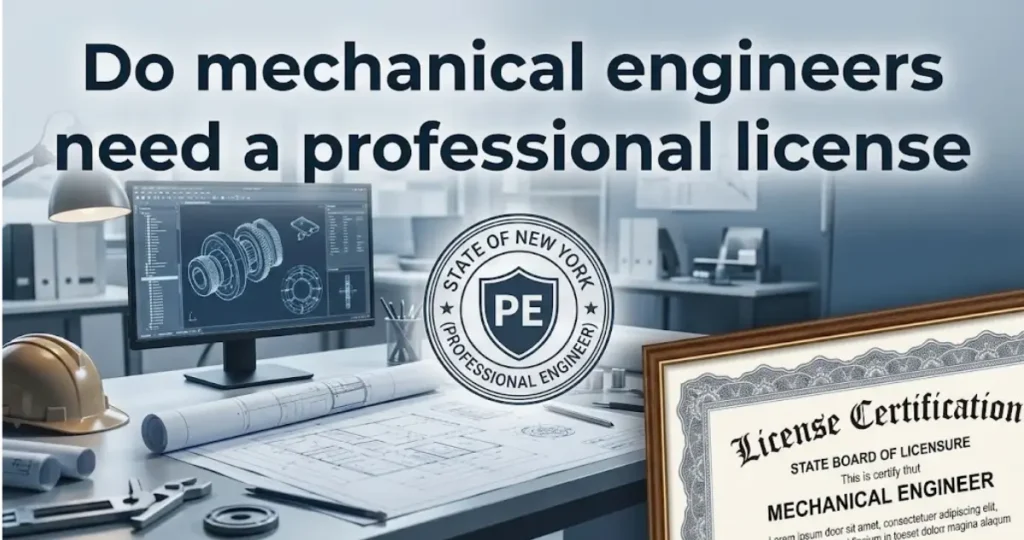
Not every mechanical engineering job requires a license. Requirements depend on the country, jurisdiction, job responsibilities, and whether the work falls under regulated professional engineering practice.
Can a mechanical engineer move into robotics or renewable energy?
Yes. Relevant experience in mechanics, controls, thermal systems, design, manufacturing, or simulation can provide a foundation for transitioning into these areas. Additional training may be necessary for specialized positions.
Conclusion
A mechanical engineer applies engineering science, design methods, and practical problem-solving to create and improve machines, equipment, products, and industrial systems. The profession offers a wide range of pathways in manufacturing, automotive technology, aerospace, energy, automation, HVAC, marine industries, and research.
Although qualifications, salaries, and professional requirements differ across the United States, India, and other countries, strong technical fundamentals, practical experience, communication skills, and continuous learning are valuable in many settings.
Understanding technical terminology is also part of professional development. Abbreviations, initialisms, and acronyms such as CAD, CAM, CAE, CFD, CNC, and FEA appear throughout mechanical engineering education and practice. Fullipedia’s A–Z initialism resources can help readers explore these terms and build their technical vocabulary.
By combining recognized qualifications with practical skills and a clear career direction, aspiring professionals can prepare for opportunities across the global mechanical engineering industry.