
Introduction
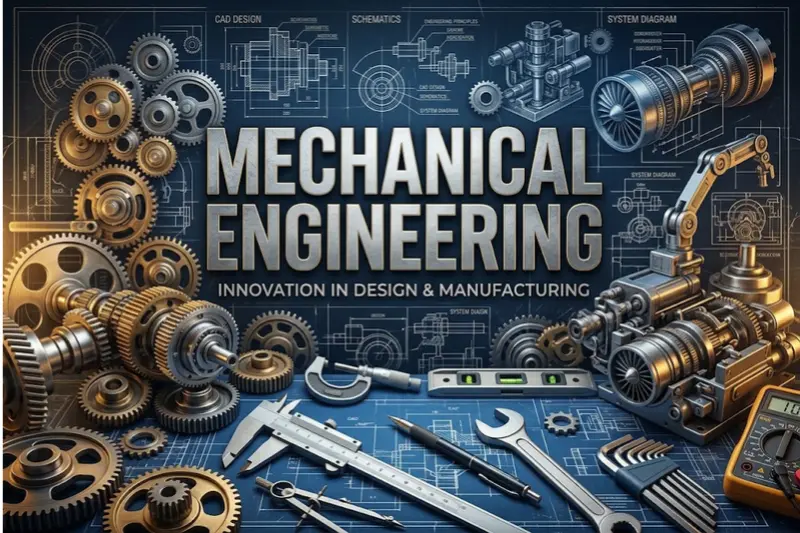
Mechanical Engineering is one of the broadest branches of engineering, combining physics, mathematics, materials science, energy, mechanics, design, and manufacturing to develop practical solutions for modern life. From automobiles and industrial machinery to renewable energy systems, medical devices, aircraft, and robotics, Mechanical Engineering supports technologies used across the world. It connects scientific principles with real-world applications, helping industries create products that are reliable, efficient, safe, and economical.
For students, researchers, manufacturers, and technology enthusiasts, understanding Mechanical Engineering provides a foundation for exploring how machines operate, how products are designed, and how energy is converted into useful work. The discipline also connects with electrical engineering, computer science, aerospace engineering, civil engineering, and industrial automation. Readers seeking a foundational explanation can also explore What Is Mechanical Engineering?, while those interested in professional opportunities can read Mechanical Engineering Scope.
What Is Mechanical Engineering?
Mechanical Engineering is an engineering discipline concerned with the design, analysis, development, manufacturing, operation, and maintenance of mechanical and thermal systems. It applies scientific principles to understand forces, motion, heat, fluid flow, materials, and energy. Engineers use this knowledge to develop everything from small precision components to large industrial machines.
For example, designing an automobile engine requires knowledge of thermodynamics, combustion, material properties, lubrication, cooling, and mechanical strength. Similarly, developing an industrial pump involves fluid mechanics, pressure calculations, shaft design, bearing selection, sealing, and performance testing. Each application combines multiple engineering principles to achieve a specific purpose.
Mechanical Engineering is not limited to traditional machinery. Modern applications include electric vehicles, industrial robots, automated production lines, advanced medical equipment, wind turbines, energy-efficient buildings, and additive manufacturing. As a result, the discipline continues to evolve alongside scientific research and technological innovation.
The American Society of Mechanical Engineers (ASME) provides professional resources, technical standards, publications, and engineering knowledge relevant to many of these applications.
History and Development of Mechanical Engineering
The foundations of Mechanical Engineering developed through humanity’s need to move objects, generate power, construct machines, and improve production. Early civilizations used simple machines such as levers, pulleys, wheels, gears, and inclined planes to perform tasks that would otherwise require substantial human effort.
Over time, developments in metallurgy, water-powered machinery, mechanical clocks, steam engines, and manufacturing transformed the field. The Industrial Revolution significantly expanded Mechanical Engineering by introducing powered factories, mechanized production, and increasingly complex machinery. Engineers began applying mathematical analysis and scientific experimentation to improve machine performance and reliability.
During the twentieth century, automobiles, aircraft, refrigeration, industrial production systems, and advanced power plants created new areas of specialization. Computer technology later transformed engineering calculations, technical drawing, and product development.
Today, computer-based simulation, robotics, additive manufacturing, artificial intelligence, digital twins, and advanced materials are influencing how engineers design and test mechanical systems. Although the tools have changed considerably, the fundamental principles of mechanics, thermodynamics, heat transfer, and materials science remain essential.
Major Branches of Mechanical Engineering
Mechanical Engineering covers numerous technical areas because mechanical systems are used in nearly every major industry. Students and professionals often specialize in one or more branches according to their interests, education, and career objectives.
Thermal Engineering: Thermal engineering focuses on heat, temperature, energy conversion, refrigeration, air conditioning, boilers, turbines, and thermal power systems. Engineers use thermodynamics and heat transfer to improve equipment performance and reduce energy losses. Applications include power generation, industrial heating, refrigeration plants, and building climate-control systems.
Design Engineering: Design engineering involves developing mechanical components, assemblies, and complete products. Engineers evaluate forces, dimensions, materials, tolerances, safety requirements, and manufacturing constraints before finalizing a design. Computer-Aided Design (CAD) software is widely used to create two-dimensional drawings and three-dimensional models.
Manufacturing Engineering: Manufacturing engineering examines how products can be produced efficiently, consistently, and economically. It covers machining, casting, welding, forming, assembly, production planning, quality control, and advanced manufacturing. Computer Numerical Control (CNC) machines and automated production systems are important tools in modern manufacturing.
Automotive Engineering: Automotive engineering applies mechanical principles to vehicles, including engines, transmissions, suspension systems, braking systems, cooling systems, and vehicle structures. The growth of electric vehicles has also increased the importance of battery thermal management, lightweight structures, electric drivetrains, and energy efficiency.
Aerospace Engineering Applications: Mechanical engineers contribute to aircraft structures, propulsion systems, thermal management, mechanical assemblies, and testing equipment. Aerospace engineering is a distinct discipline, but it shares many principles with Mechanical Engineering, particularly mechanics, materials, fluid dynamics, and thermodynamics.
Fluid Mechanics and Hydraulic Engineering: This area studies the behavior of liquids and gases in motion or at rest. Applications include pumps, compressors, turbines, hydraulic systems, pipelines, lubrication systems, and industrial fluid transport. Engineers use fluid mechanics to calculate pressure losses, flow rates, efficiency, and equipment performance.
Robotics and Mechatronics: Robotics combines mechanical design with electronics, control systems, sensors, and computing. Mechanical engineers help develop robot structures, actuators, transmissions, and movement systems. Mechatronics integrates mechanical components with electronic controls and software to create intelligent machines.
Materials and Failure Analysis: This branch examines material strength, hardness, fatigue, wear, corrosion, fracture, and deformation. Engineers select suitable materials and investigate why components fail under operating conditions. Such analysis is essential in machinery, vehicles, pressure equipment, manufacturing plants, and power-generation systems.
Fundamental Principles of Mechanical Engineering
The core principles of Mechanical Engineering help engineers predict how physical systems behave and determine whether a design will perform as intended.
Mechanics studies forces and their effects on bodies. Statics examines systems in equilibrium, while dynamics investigates motion and the forces associated with it. These principles are used in shaft design, machine structures, vehicle suspension, lifting equipment, and rotating machinery.
Thermodynamics examines heat, work, temperature, and energy conversion. Engineers use it to analyze engines, turbines, refrigeration cycles, heat pumps, and power-generation systems. The objective may be to improve efficiency, reduce energy consumption, or maintain suitable operating temperatures.
Fluid mechanics examines liquids and gases, including pressure, velocity, flow, and resistance. It supports the design of pumps, compressors, hydraulic systems, cooling circuits, and ventilation networks.
Heat transfer explains how thermal energy moves through conduction, convection, and radiation. Engineers apply these concepts when designing heat exchangers, engine cooling systems, industrial furnaces, refrigeration equipment, and thermal protection.
Materials science helps engineers understand how metals, polymers, ceramics, composites, and other materials respond to mechanical and thermal conditions. Appropriate material selection improves strength, durability, corrosion resistance, manufacturability, and product life.
Finally, control engineering and numerical analysis support the operation and optimization of complex systems. Engineers combine mathematical models, experiments, and simulations to predict performance before building or modifying equipment.
Mechanical Engineering Education and Subjects
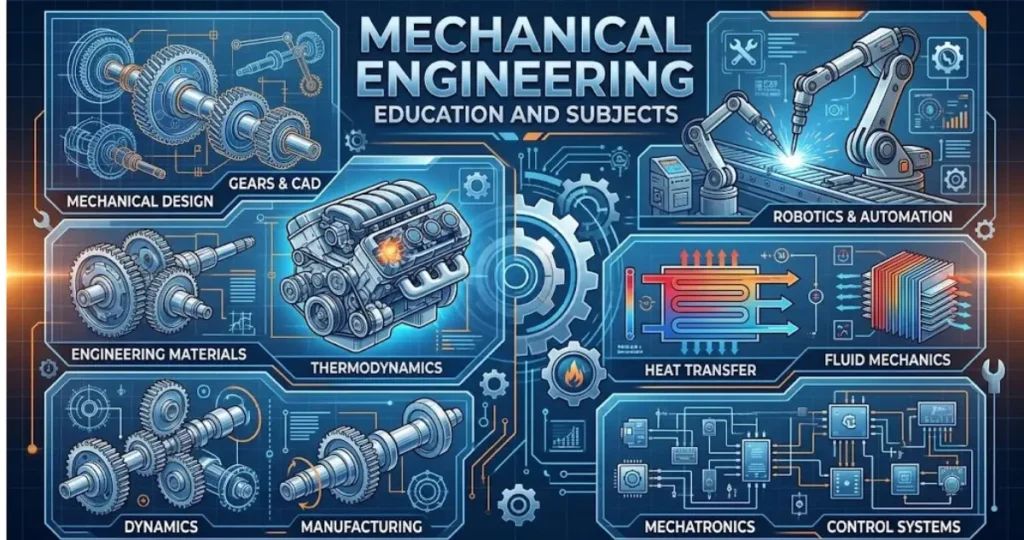
Mechanical Engineering education generally combines mathematics, basic sciences, engineering theory, laboratory work, design assignments, and practical projects. The exact curriculum varies by country, university, degree level, and accreditation requirements.
Students commonly study engineering mathematics, engineering mechanics, thermodynamics, fluid mechanics, heat transfer, materials science, manufacturing processes, machine design, measurements, and control systems. Advanced courses may include computational methods, robotics, finite element analysis, computational fluid dynamics, renewable energy, and product development.
Laboratory sessions help students connect theory with physical behavior. Depending on the institution, practical activities may involve material testing, vibration measurements, fluid-flow experiments, heat-transfer experiments, machining, metrology, and engine performance.
Design projects are equally important because they require students to identify a problem, evaluate alternatives, select materials, perform calculations, prepare drawings, and test a proposed solution. Teamwork and technical reporting also help prepare students for professional engineering environments.
Readers who want a detailed discussion of course structures and individual subjects can visit Mechanical Engineering Subjects. Students considering a program should also check the curriculum and recognition status of their chosen institution. The ABET engineering accreditation criteria provide a useful reference for understanding engineering education requirements in accredited programs.
Mechanical Engineering in the United States
The United States has a substantial Mechanical Engineering sector spanning manufacturing, transportation, aerospace, energy, engineering services, research, and technology development. Mechanical engineers contribute to the design and improvement of machines, thermal systems, industrial products, and automated processes.
Universities offer undergraduate and postgraduate programs that combine theoretical instruction with laboratories, design projects, internships, and research opportunities. However, degree requirements, professional responsibilities, and licensing rules vary according to the nature of the work and the state in which an engineer practices.
According to the U.S. Bureau of Labor Statistics, the median annual wage for mechanical engineers was $104,110 in May 2025. The agency projects employment growth of 11% from 2025 to 2035, with approximately 17,800 openings per year on average over that period. These figures apply to the United States and should not be treated as worldwide salary or employment estimates.
American employers may recruit engineers for product design, manufacturing, aerospace systems, energy technologies, heating and cooling systems, research, and equipment development. Demand for particular skills depends on industry investment, economic conditions, location, and technological developments.
Professional development may include industry certifications, specialized training, postgraduate education, and professional registration where applicable. Engineers whose work requires a professional license must meet the relevant state requirements.
Mechanical Engineering in India
India has a diverse Mechanical Engineering sector supported by manufacturing, automotive production, infrastructure development, industrial equipment, energy, railways, aerospace, and engineering services. Mechanical engineers contribute to the design, production, installation, inspection, and improvement of equipment used across these industries.
Engineering institutions in India offer diploma, undergraduate, postgraduate, and research programs. A Bachelor of Technology (B.Tech.) or Bachelor of Engineering (B.E.) in Mechanical Engineering is a common undergraduate route, although program structures and admission requirements vary between institutions.
Students generally develop knowledge of mechanics, thermodynamics, manufacturing, materials, machine design, fluid mechanics, and related technical areas. Practical laboratories, industrial training, internships, and final-year projects can help students connect academic learning with workplace requirements.
The All India Council for Technical Education (AICTE) provides information about technical education and engineering education frameworks. Its Mechanical Engineering model curriculum is a useful reference for understanding the academic and technical subjects included in engineering programs.
Career opportunities in India may be available in automotive manufacturing, industrial machinery, power generation, process industries, maintenance, design services, public-sector organizations, research, and emerging technology businesses. Entry requirements differ by employer, and recruitment into government organizations may involve specific examinations, qualifications, or selection procedures.
Rather than relying on a single salary estimate, students should compare current job advertisements, employer requirements, location, experience levels, and specialization. Practical software skills, communication, technical documentation, and hands-on experience can strengthen professional preparation.
Global Applications of Mechanical Engineering
Mechanical Engineering is internationally relevant because machines, energy systems, transportation equipment, and manufactured products are essential to modern economies. Although industrial priorities differ between countries, many fundamental engineering problems are shared across borders.
In manufacturing, engineers improve production processes, reduce material waste, and develop equipment capable of producing consistent results. In transportation, they work on engines, drivetrains, vehicle structures, braking systems, and thermal management. In energy, they contribute to turbines, heat exchangers, renewable energy equipment, and systems that improve conversion efficiency.
Healthcare is another important application area. Mechanical engineering knowledge supports the development of prosthetic components, medical equipment, rehabilitation devices, precision mechanisms, and temperature-control systems used in specialized environments.
Building services rely on mechanical systems for heating, ventilation, air conditioning, pumping, and energy management. Meanwhile, agriculture uses mechanical engineering in irrigation equipment, processing machinery, harvesting systems, and food-production technologies.
International engineering projects may also require collaboration between specialists from different disciplines and countries. Common technical standards, clear drawings, accurate measurements, and reliable documentation help teams communicate and maintain consistent engineering practices.
Mechanical Engineering Abbreviations, Initialisms, and Acronyms
Mechanical Engineering uses technical short forms in engineering drawings, research papers, software, manufacturing instructions, maintenance manuals, specifications, and industrial communication. Understanding these terms helps students interpret technical documents and allows professionals to communicate more precisely.
Although abbreviations, initialisms, and acronyms are often grouped together, they have slightly different meanings. An abbreviation is a shortened form of a word or phrase. An initialism uses the initial letters of a phrase pronounced separately. An acronym is formed from initial letters or parts of words and is pronounced as a word. In technical practice, usage and classification can vary.
Some important examples are listed below.
CAD — Computer-Aided Design: Software-assisted creation, modification, and documentation of engineering designs. Engineers use CAD tools to produce drawings and three-dimensional component models.
CAM — Computer-Aided Manufacturing: Computer-based technologies that assist manufacturing operations, production planning, and machine control.
CAE — Computer-Aided Engineering: Software-based analysis and engineering evaluation used to investigate product performance and support design decisions.
CFD — Computational Fluid Dynamics: Numerical analysis of fluid flow, pressure, temperature, and related physical phenomena. It is commonly used to investigate airflow, liquid transport, combustion, and cooling.
CNC — Computer Numerical Control: Automated control of machine tools through programmed instructions. CNC technology supports repeatable machining and manufacturing operations.
CMM — Coordinate Measuring Machine: Equipment used to measure the dimensions and geometry of manufactured components.
FEA — Finite Element Analysis: A numerical method used to estimate physical behavior, including stress, deformation, heat transfer, and vibration, under specified conditions.
FBD — Free Body Diagram: A simplified representation of a body showing the external forces and moments acting on it. It helps engineers solve mechanics problems.
FOS — Factor of Safety: A design measure used to account for uncertainties and provide an appropriate safety margin. Its application depends on the design method, loading conditions, materials, and applicable codes.
HVAC — Heating, Ventilation, and Air Conditioning: Systems that regulate indoor temperature, ventilation, humidity, and air quality.
PID — Proportional-Integral-Derivative: A widely used control method that adjusts system behavior based on the control error and its accumulated and changing values.
FMS — Flexible Manufacturing System: A manufacturing arrangement designed to produce different products or components with adaptable equipment and control systems.
These examples illustrate how technical short forms support engineering communication. Readers can explore Fullipedia’s Mechanical Engineering Initialisms – Alphabet A, Alphabet B, Alphabet C, and Alphabet F for additional terminology and explanations.
The website also maintains dedicated collections for Mechanical Engineering Abbreviations A–Z and Mechanical Engineering Acronyms A–Z. These resources allow readers to explore terms alphabetically without making the main article an exhaustive dictionary.
Computer-Aided Design and Digital Engineering
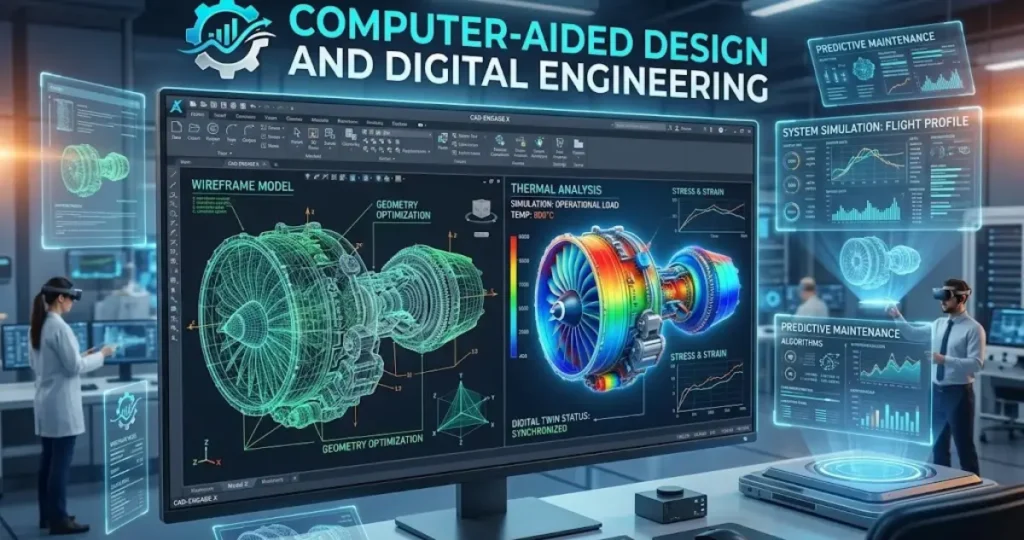
Digital tools have transformed the way Mechanical Engineering projects are developed, analyzed, and documented. CAD software enables engineers to create precise models and drawings, while CAE tools support simulation and performance evaluation.
For example, an engineer designing a gearbox may first create a three-dimensional model, calculate gear loads, evaluate shaft stresses, select suitable bearings, and examine thermal or lubrication requirements. The design can then be revised before expensive manufacturing begins.
FEA is useful for investigating stress distribution, deformation, vibration, and other physical responses. CFD supports the analysis of airflow, liquid flow, pressure losses, and thermal behavior. These methods can reduce the number of physical prototypes needed, although experimental testing and engineering judgment remain important.
Digital manufacturing systems connect design information with production equipment. CNC machines, automated inspection, product-data management, and production-monitoring systems help manufacturers improve consistency and traceability.
However, simulation results are only as reliable as the assumptions, input data, boundary conditions, and models used. Engineers must verify their calculations, validate models when necessary, and consider the limitations of the software.
Robotics, Automation, and Artificial Intelligence
Robotics and automation are expanding the applications of Mechanical Engineering. Industrial robots can perform repetitive assembly, welding, material handling, inspection, and manufacturing tasks. Mechanical engineers contribute by designing robot structures, selecting actuators, evaluating loads, and ensuring that moving components operate reliably.
Artificial intelligence can assist engineering teams with design optimization, predictive maintenance, quality inspection, process monitoring, and analysis of large datasets. For example, condition-monitoring systems may use vibration and temperature measurements to identify patterns associated with developing equipment faults.
These technologies do not eliminate the need for fundamental engineering knowledge. Engineers must still understand forces, materials, thermal effects, mechanical tolerances, operating conditions, and safety requirements. Automated recommendations need appropriate validation before they are applied to critical systems.
The strongest approach combines established engineering principles with digital tools, practical testing, and informed human decision-making.
Renewable Energy and Environmental Sustainability
Mechanical Engineering contributes to energy production, conservation, and environmental improvement. Engineers design and maintain turbines, pumps, heat exchangers, thermal storage systems, and equipment used in conventional and renewable energy applications.
Wind energy requires mechanical systems capable of handling rotating loads, vibration, fatigue, and changing environmental conditions. Solar energy installations may require thermal management, tracking mechanisms, structural components, and efficient cooling systems. Hydropower uses turbines and fluid systems to convert water energy into useful power.
Mechanical engineers also help improve industrial energy efficiency. Better insulation, optimized heat exchangers, efficient motors, reduced friction, improved combustion, and effective maintenance can lower energy consumption and operating costs.
In transportation, lightweight materials, aerodynamic improvements, efficient drivetrains, and improved thermal management can support reductions in energy use. Electric vehicles introduce additional engineering challenges involving battery cooling, structural design, manufacturing, and component durability.
Sustainability is therefore not a separate concern from Mechanical Engineering. It is increasingly part of the process of designing products and systems that meet performance requirements while using resources responsibly.
Materials, Manufacturing, and Quality Control
Material selection strongly influences the strength, weight, cost, durability, and performance of a mechanical component. Engineers may choose steel for strength, aluminum alloys for lower weight, polymers for particular chemical or mechanical properties, or composites where a combination of properties is required.
The selection process considers operating temperature, loads, fatigue, corrosion, wear, manufacturing methods, availability, and cost. A material that performs well in one environment may be unsuitable in another.
Manufacturing methods must also match the component’s design. Casting can produce complex shapes, machining provides precise dimensions, welding joins components, and additive manufacturing builds parts through successive layers of material. Each process has different limitations, costs, and quality requirements.
Quality control verifies that products meet specified dimensions and performance criteria. Engineers may use inspection equipment, dimensional measurements, material testing, vibration analysis, and functional tests. Statistical methods can help identify production variation and determine whether a manufacturing process remains consistent.
Good engineering design considers manufacturability and inspection from the beginning rather than treating them as final steps.
Research, Innovation, and Interdisciplinary Collaboration
Mechanical Engineering research investigates new materials, improved manufacturing processes, energy-efficient systems, advanced robotics, thermal technologies, and innovative mechanical designs. Research may take place in universities, laboratories, manufacturing companies, government organizations, or private research and development facilities.
Engineers often collaborate with specialists in electronics, software, chemistry, materials science, and data analysis. For example, developing an electric vehicle requires mechanical design, electrical power systems, battery technology, control software, thermal management, and safety evaluation.
Similarly, medical equipment may require collaboration between mechanical engineers, electronics specialists, software developers, and healthcare professionals. These interdisciplinary projects show why communication and teamwork are essential technical skills.
Research and development also depend on testing, documentation, and repeatability. A promising concept must be evaluated under suitable conditions before its performance can be established. Engineering innovation is most valuable when a solution is technically sound, practical to manufacture, safe to operate, and appropriate for its intended use.
Challenges Facing Mechanical Engineering
Despite its broad applications, Mechanical Engineering faces several challenges. Increasing product complexity requires engineers to balance performance, cost, reliability, maintainability, and environmental impact. A design that improves one factor may create trade-offs elsewhere.
Rapid technological change creates a continuing need for professional learning. Engineers may need to update their knowledge of simulation tools, automated production, data analysis, advanced materials, and energy systems throughout their careers.
Global supply chains can also affect component availability, material costs, and production schedules. Engineers must consider alternative materials, manufacturing constraints, maintenance requirements, and long-term equipment reliability.
Safety remains a fundamental responsibility. Mechanical systems may contain stored energy, rotating components, high pressures, elevated temperatures, or hazardous moving parts. Designs must consider foreseeable operating conditions, appropriate protection, inspection, and applicable standards.
Finally, sustainability requirements encourage engineers to examine energy use, material consumption, product life cycles, repairability, and waste. Addressing these challenges requires sound engineering judgment alongside technical knowledge.
The Future of Mechanical Engineering
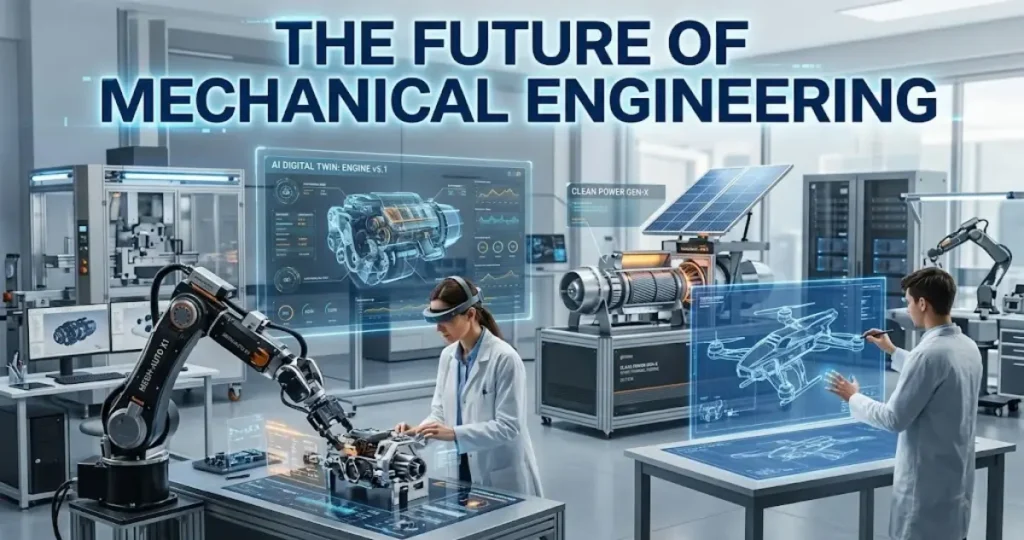
The future of Mechanical Engineering will continue to combine traditional physical principles with advanced digital technologies. Automation, artificial intelligence, robotics, additive manufacturing, electric transportation, and renewable energy are influencing the design and operation of mechanical systems.
Digital twins and connected sensors can help engineers monitor equipment performance and compare real operating behavior with digital models. Predictive maintenance can use operational data to identify potential faults before they lead to unexpected downtime. Advanced manufacturing can enable the production of components with complex geometries and specialized properties.
Energy efficiency will remain important as industries seek to improve performance and manage operating costs. Mechanical engineers will continue working on thermal systems, industrial equipment, transportation technologies, and manufacturing processes that use energy and materials more effectively.
Nevertheless, future developments will still depend on mathematics, physics, material behavior, experimentation, and reliable design. Engineers who combine these fundamentals with practical experience, digital competence, and continuous learning will be better prepared to adapt to changing technical requirements.
Conclusion
Mechanical Engineering is a broad and evolving discipline that connects scientific principles with the machines, products, energy systems, and manufacturing technologies used around the world. Its applications extend from conventional industrial equipment to robotics, electric vehicles, aerospace systems, medical devices, renewable energy, and advanced production.
The United States, India, and other countries offer different educational pathways and industrial opportunities, but the discipline shares a common foundation in mechanics, thermodynamics, fluid mechanics, materials, design, and engineering analysis. Understanding these principles helps students and professionals evaluate technical problems and develop practical solutions.
Technical communication is another essential part of the field. Learning abbreviations, initialisms, and acronyms such as CAD, CAM, CFD, CNC, FEA, and HVAC helps readers interpret engineering documentation and follow modern industrial practices.
As technology develops, Mechanical Engineering will continue to contribute to efficient manufacturing, reliable machinery, energy innovation, and sustainable product development. A strong understanding of its fundamentals provides a useful starting point for anyone exploring engineering education, industrial applications, or the technologies shaping the modern world.